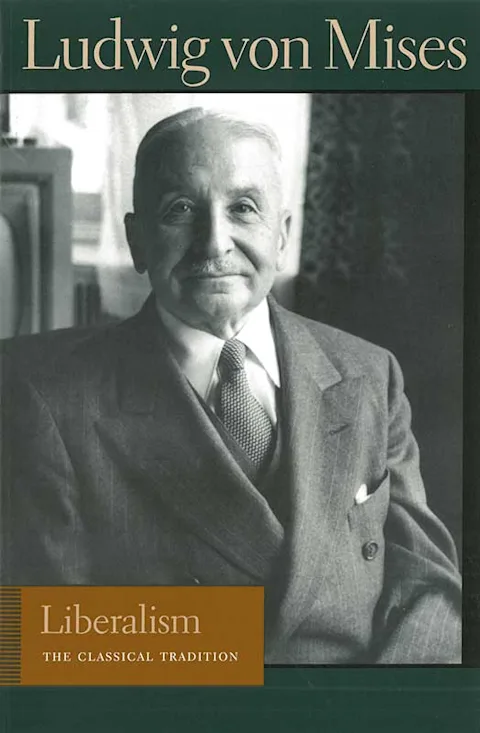
Liberalism: The Classical Tradition (LF ed.)
- Ludwig von Mises(author)
- Bettina Bien Greaves(editor)
The great Austrian economist Ludwig von Mises provides a concise and tightly-argued one volume defense of classical liberalism, focusing on the core concepts of private property, limited government, peace, and the free market.
Key Quotes
Passages from this text chosen by OLL editors.
- Liberty“
When liberal ideas began to spread to central and eastern Europe from their homeland in western Europe, the traditional powers—the monarchy, the nobility, and the clergy—trusting in the instruments of repression that were at their disposal, felt completely safe. They did not consider it necessary to combat liberalism and the mentality of the Enlightenment with intellectual weapons. Suppression, persecution, and imprisonment of the malcontents seemed to them to be more serviceable. They boasted of the violent and coercive machinery of the army and the police. Too late they realized with horror that the new ideology snatched these weapons from their hands by conquering the minds of officials and soldiers. It took the defeat suffered by the old regime in the battle against liberalism to teach its adherents the truth that there is nothing in the world more powerful than ideologies and ideologists and that only with ideas can one fight against ideas. They realized that it is foolish to rely on arms, since one can deploy armed men only if they are prepared to obey, and that the basis of all power and dominion is, in the last analysis, ideological.
- War & Peace“
The ultimate ideal envisioned by liberalism is the perfect cooperation of all mankind, taking place peacefully and without friction. Liberal thinking always has the whole of humanity in view and not just parts. It does not stop at limited groups; it does not end at the border of the village, of the province, of the nation, or of the continent. Its thinking is cosmopolitan and ecumenical: it takes in all men and the whole world. Liberalism is, in this sense, humanism; and the liberal, a citizen of the world, a cosmopolite.
About This Edition
Citation
Mises, Ludwig von. Liberalism: The Classical Tradition, trans. Ralph Raico, ed. Bettina Bien Greaves (Indianapolis: Liberty Fund, 2005). [Read the Liberty Classic](https://www.econlib.org/library/Columns/y2020/Mingardiliberalism.html) on this title from Econlib.
Mises, Ludwig von. Liberalism: The Classical Tradition (1927) (LF ed.). Edited by Bettina Bien Greaves, Liberty Fund, 2005. Online Library of Liberty, https://oll.libertyfund.org/titles/greaves-liberalism-the-classical-tradition-1927-lf-ed.
Mises, L. v. (2005). Liberalism: The Classical Tradition (1927) (LF ed.). Liberty Fund. https://oll.libertyfund.org/titles/greaves-liberalism-the-classical-tradition-1927-lf-ed
@book{mises2005ed,
  author = {Ludwig von Mises},
  editor = {Bettina Bien Greaves},
  title = {Liberalism: The Classical Tradition (1927) (LF ed.)},
  publisher = {Liberty Fund},
  address = {Indianapolis},
  year = {2005},
  url = {https://oll.libertyfund.org/titles/greaves-liberalism-the-classical-tradition-1927-lf-ed},
  note = {Online Library of Liberty}
}TY - BOOK AU - Mises, Ludwig von A2 - Greaves, Bettina Bien TI - Liberalism: The Classical Tradition (1927) (LF ed.) PY - 2005 CY - Indianapolis PB - Liberty Fund UR - https://oll.libertyfund.org/titles/greaves-liberalism-the-classical-tradition-1927-lf-ed DB - Online Library of Liberty ER -
Copyright
The copyright to this edition, in both print and electronic forms, is held by Liberty Fund, Inc.

About the author
Ludwig von Mises 1881–1973
Ludwig von Mises (1881-1973) was the acknowledged leader of the Austrian School of economic thought, a prodigious originator in economic theory, and a prolific author. Mises’ writings and lectures encompassed economic theory, history, epistemology, government, and political philosophy. His contributions to economic theory include important clarifications on the quantity theory of money, the theory of the trade cycle, the integration of monetary theory with economic theory in general, and a demonstration that socialism must fail because it cannot solve the problem of economic calculation.
Mises was the first scholar to recognize that economics is part of a larger science in human action, a science which Mises called “praxeology”. Mises wrote many works on two related economic themes: 1. monetary economics, inflation, and the role of government, and 2. the differences between government-controlled economies and free trade. His influential work on economic freedoms, their causes and consequences, brought him to highlight the interrelationships between economic and non-economic freedoms in societies, and the appropriate role for government.
See also our collection of extracts, essays, and other resources on Mises.
More in Political Theory
See all >The Political Writings of Jean Jacques Rousseau vol. 1
Jean-Jacques RousseauThe Writings of Thomas Paine, Vol. I (1774-1779)
Thomas PaineDissertations on Early Law and Custom
Sir Henry Sumner MaineAncient Law
Sir Henry Sumner MaineThe Political Writings of Jean Jacques Rousseau, 2 vols.
Jean-Jacques RousseauLeviathan (1909 ed)
Thomas HobbesPatriarcha, or the Natural Power of Kings
Sir Robert FilmerThe Man versus the State (1885 ed.)
Herbert SpencerThe Man versus the State, with Six Essays on Government, Society and Freedom (LF ed.)
Herbert Spencer