Political Theory1861
Ancient Law, its connection with the early history of society and its relation to modern ideas
- Sir Henry Sumner Maine(author)
- Sir Frederick Pollock(introduction)
A classic work on the history of law by one of the great English jurists of the 19th century. Another great English jurist, Sir Frederick Pollock wrote an introduction and extensive notes.
About This Edition
Citation
Maine, Sir Henry Sumner. Ancient Law, its connection with the early history of society and its relation to modern ideas, with an introduction and notes by Sir Frederick Pollock. 4th American from the 10th London edition (New York: Henry Holt and Co., 1906). The text is in the public domain.
Maine, Sir Henry Sumner. Ancient Law. Henry Holt and Company, 1906. Online Library of Liberty, https://oll.libertyfund.org/titles/pollock-ancient-law.
Maine, S. H. S. (1906). Ancient Law. Henry Holt and Company. https://oll.libertyfund.org/titles/pollock-ancient-law
@book{maine1906law,
  author = {Sir Henry Sumner Maine},
  title = {Ancient Law},
  publisher = {Henry Holt and Company},
  address = {New York},
  year = {1906},
  url = {https://oll.libertyfund.org/titles/pollock-ancient-law},
  note = {Online Library of Liberty}
}TY - BOOK AU - Maine, Sir Henry Sumner TI - Ancient Law PY - 1906 CY - New York PB - Henry Holt and Company UR - https://oll.libertyfund.org/titles/pollock-ancient-law DB - Online Library of Liberty ER -
Copyright
The text is in the public domain.

About the author
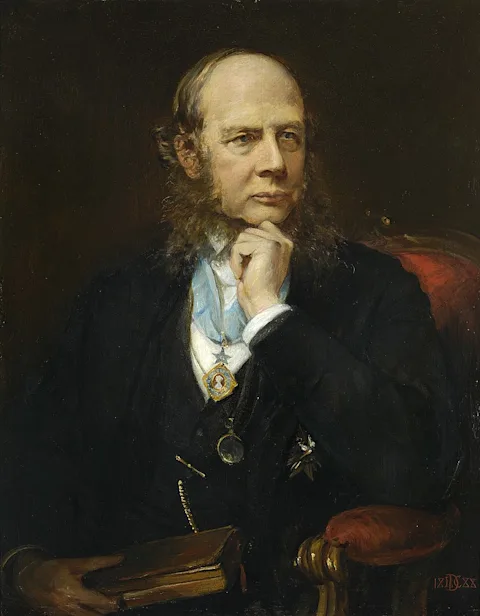
Sir Henry Sumner Maine 1822–1888
Sir Henry Sumner Maine (1822-1888) was one of the great intellects of the Victorian era. He trained as a lawyer, taught Civil Law at Cambridge University, served at the Inns of Court in London, worked on law reform in India, and was a professor of Jurisprudence at Oxford University. He wrote several books including Ancient Law (1861) and Popular Government (1885).
Related People
James Fitzjames Stephen
Author
Stephen, a British legal historian, Anglo-Indian administrator, judge, and author noted for his criminal-law reform proposals was a close friend of Maine. In 1855, he became a contributor to the Saturday Review, in company with Maine, and when he accepted the post of legal member of the Colonial Council in India, his friend Maine was his immediate predecessor in this office.
Max Weber
Author
Weber was a German sociologist and philosopher best known for his ideas on social stratification and the sociology of religion. Both Maine and Weber believed that society was evolving in a particular direction, with law and rationalization playing key roles in this process. However, while Maine focused on the evolution of law from status to contract, Weber focused on the evolution of society from traditional to rational.
Savigny is a German philosopher and the father of the Historical school. Maine agreed with Savigny’s views, but he went beyond Savigny in understanding law by comparative studies of legal institutions in primitive as well as progressive societies.


Critical Responses
Works that answer or challenge this text.
 Article
Maine's Ancient Law in the Light of Primitive Societies
Robert RedfieldVisit site ↗In this essay, Redfield examines Maine’s book and its contribution to the understanding of primitive law and primitive society. He argues that Maine’s book is still the pre-eminent work on the origin and nature of primitive legal institutions, but that it is limited in its scope. Redfield suggests that Maine’s focus on the law of the earliest classical civilizations, such as Greece and Rome, is too narrow and that it fails to take into account the diversity of primitive societies.
Connected Readings
What to read next.
 Book
The Golden Bough
James George FrazerVisit site ↗This seminal work in anthropology and comparative religion explores the similarities between ancient myths, rituals, and customs. It provides additional insights into the beliefs and practices of early societies, complementing the themes discussed in "Ancient Law."
 Book
Primitive Culture
Edward Burnett TylorVisit site ↗In this influential work, Tylor examines the origins and development of culture, religion, and society in primitive cultures, which aligns with the subject matter explored by Sir Henry Sumner Maine.
 Book
Systems of Consanguinity and Affinity of the Human Family
Lewis Henry MorganVisit site ↗This book delves into the kinship systems of various societies, providing valuable information on social structures and legal arrangements present in early human groups.
 Book
The Origin of the Family, Private Property, and the State
Friedrich EngelsVisit site ↗Engels' work analyzes the historical development of the family, property, and political institutions, touching on some themes related to the evolution of law and society.
 Book
The Division of Labor in Society
Emile DurkheimVisit site ↗Durkheim, a French sociologist, explored the evolution of law and its relationship to social solidarity in his works.This book and his ideas on mechanical and organic solidarity are relevant to the study of legal development and social organization in ancient societies.
More in Political Theory
See all >The Political Writings of Jean Jacques Rousseau vol. 1
Jean-Jacques RousseauThe Writings of Thomas Paine, Vol. I (1774-1779)
Thomas PaineDissertations on Early Law and Custom
Sir Henry Sumner MaineThe Political Writings of Jean Jacques Rousseau, 2 vols.
Jean-Jacques RousseauLeviathan (1909 ed)
Thomas HobbesPatriarcha, or the Natural Power of Kings
Sir Robert FilmerThe Man versus the State (1885 ed.)
Herbert SpencerThe Man versus the State, with Six Essays on Government, Society and Freedom (LF ed.)
Herbert SpencerSelect Works of Edmund Burke, vol. 1
Edmund Burke