

Ludwig von Mises
1881–1973 · 25 titles


Collection
34 items in this collection
Liberty Fund will be publishing a collection of 9 volumes of the works of the great Austrian economist Ludwig von Miises.
In this collection
25 titles, earliest first.
Ludwig von Mises · 1912
The Theory of Money and Credit opened new economic vistas. It integrated monetary theory into the main body of economic analysis for the first time, providing fresh new insights into the nature of money and its role in…
Ludwig von Mises · 1919
Nation, State, and Economy, published less than a year after Austria’s defeat in World War I, examines and compares prewar and postwar economic conditions and explicates Mises’s theory that each country’s prosperity…
Ludwig von Mises · 1922
This is a newly annotated edition of the classic first published in German in 1922. It is the definitive refutation of nearly every type of socialism ever devised. Mises presents a wide-ranging analysis of society,…
Ludwig von Mises · 1933
Epistemological Problems of Economics presents Ludwig von Mises’s views on the logical and epistemological features of social interpretation as well as his argument that the Austrian theory of value is the core element…
Ludwig von Mises · 1940
Interventionism provides Mises’s analysis of the problems of government interference in business from the Austrian School perspective. Written in 1940, before the United States was officially involved in World War II,…
Ludwig von Mises · 1944
Originally published by Yale University Press in 1944, Bureaucracy is a classic fundamental examination of the nature of bureaucracies and free markets in juxtaposition to various political systems.
Ludwig von Mises · 1944
Published in 1944, during World War II, Omnipotent Government was written and published after Mises arrived in the United States. In this volume Mises provides in economic terms an explanation of the international…
Ludwig von Mises · 1952
In this anthology, Mises offers an articulate and accessible introduction to and critique of two topics he considers especially important: inflation and government interventionism.
Ludwig von Mises · 1956
In The Anti-capitalistic Mentality, Ludwig von Mises explains the causes of the irrational fear and hatred many intellectuals and others feel for capitalism. Written during the heyday of twentieth-century socialism,…
Ludwig von Mises · 1957
Theory and History is primarily a critique of Karl Marx, his materialism, and his prediction of the inevitability of socialism. This book discusses the theory of economics, i.e., the study of purposive human action, and…
Ludwig von Mises · 1962
The great Austrian economist Ludwig von Mises provides a concise and tightly-argued one volume defense of classical liberalism, focusing on the core concepts of private property, limited government, peace, and the free…
Ludwig von Mises · 1962
Written toward the end of Mises’s life, his last monograph, The Ultimate Foundation of Economic Science, returned to economics as a science based on human action.
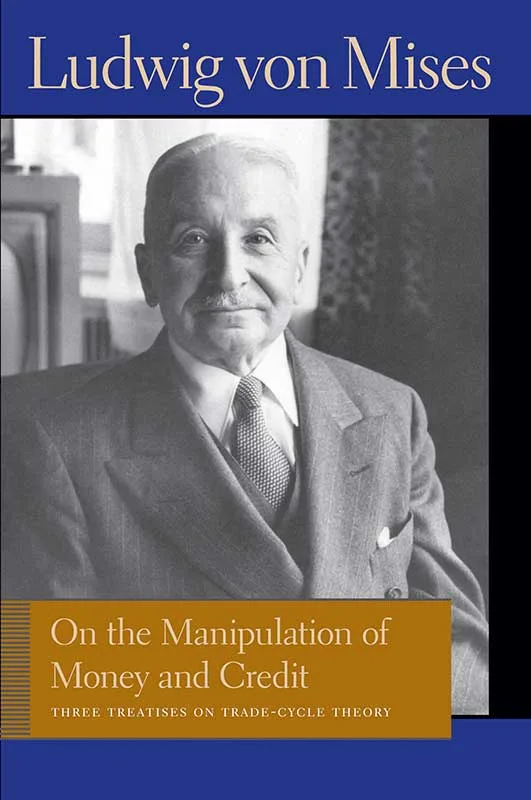
Ludwig von Mises · 1978
On the Manipulation of Money and Credit includes some of Mises’s most important contributions to monetary and trade-cycle theories. “Stabilization of the Monetary Unit from the Viewpoint of Theory,” discusses the…
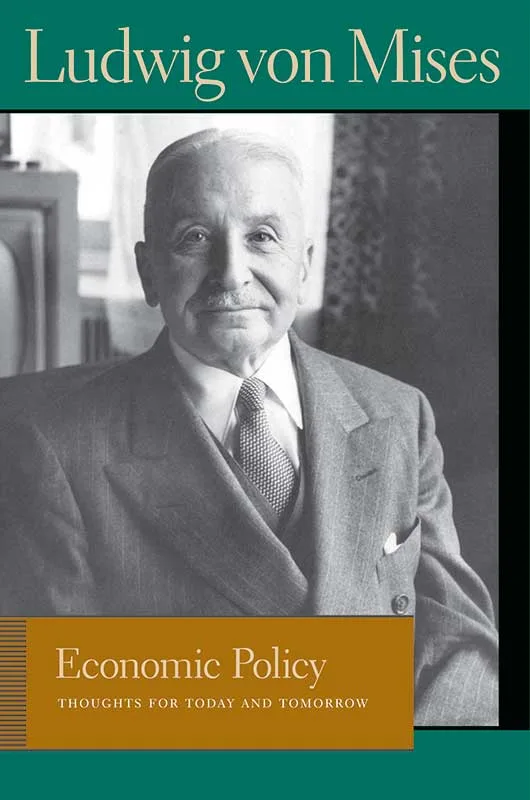
Ludwig von Mises · 1979
Economic Policy contains six lectures Ludwig von Mises delivered in 1959 for the Centro de Estudios sobre la Libertad in Argentina. This volume serves as an excellent introduction to what Mises sees as the simple truths…
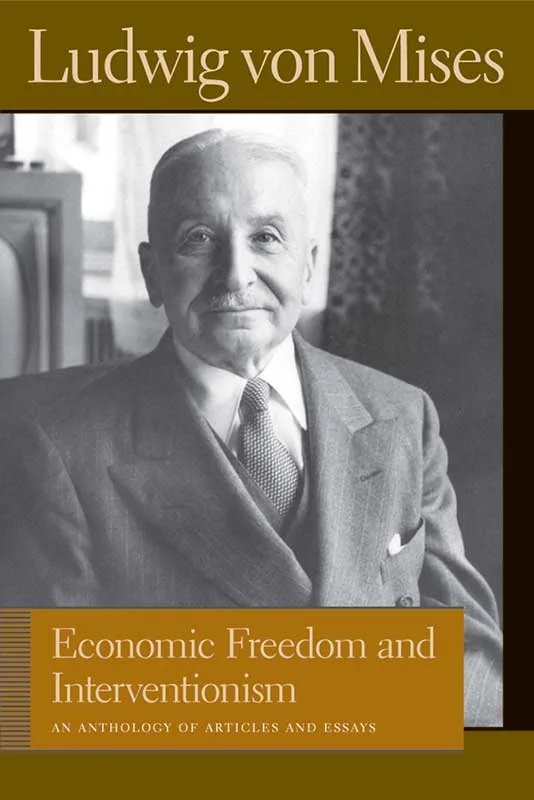
Ludwig von Mises · 1990
Economic Freedom and Interventionism is a primer of the thought of Ludwig von Mises and an anthology of his writings. This volume contains forty-seven articles edited by Mises scholar Bettina Bien Greaves. Among them…

Ludwig von Mises · 1996
In the foreword to Human Action: A Treatise on Economics, Mises explains complex market phenomena as “the outcomes of countless conscious, purposive actions, choices, and preferences of individuals, each of whom was…
Ludwig von Mises · 1996
In the foreword to Human Action: A Treatise on Economics, Mises explains complex market phenomena as “the outcomes of countless conscious, purposive actions, choices, and preferences of individuals, each of whom was…
Ludwig von Mises · 1996
In the foreword to Human Action: A Treatise on Economics, Mises explains complex market phenomena as “the outcomes of countless conscious, purposive actions, choices, and preferences of individuals, each of whom was…
Ludwig von Mises · 1996
In the foreword to Human Action: A Treatise on Economics, Mises explains complex market phenomena as “the outcomes of countless conscious, purposive actions, choices, and preferences of individuals, each of whom was…
Ludwig von Mises · 1996
The 4th and final volume contains a brief appendix by Mises on the work of Boehm-Bawerk and a glossary of terms prepared by the editor.
Ludwig von Mises · 2000
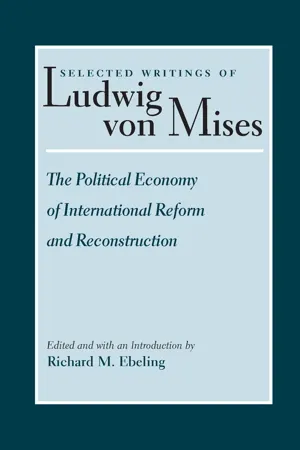
Vol. 3 of a three volume collection of Mises' essays found in Moscow in 1996. Vol. 3 contains essays on postwar reconstruction, American foreign trade policy, monetary policy, and plans for European union.
Ludwig von Mises · 2002
Vol. 2 of a three volume collection of Mises' essays found in Moscow in 1996. Vol. 2 contains essays on inflation, interventionism, the great depression, Austrian economic policy, autarchy, the theory of Austrian…
Ludwig von Mises · 2012
A three volume collection of Mises's writings from the so-called "lost papers" found in a Moscow archive in 1996. These were seized by the Gestapo and then taken back to Russia after the war by the Russian government.
Ludwig von Mises · 2012
Vol. 1 of a three volume collection. The articles that comprise this book include Mises’s policy memoranda, essays, and speeches that were found in a formerly secret KGB archive in Moscow. They deal with Mises’s…
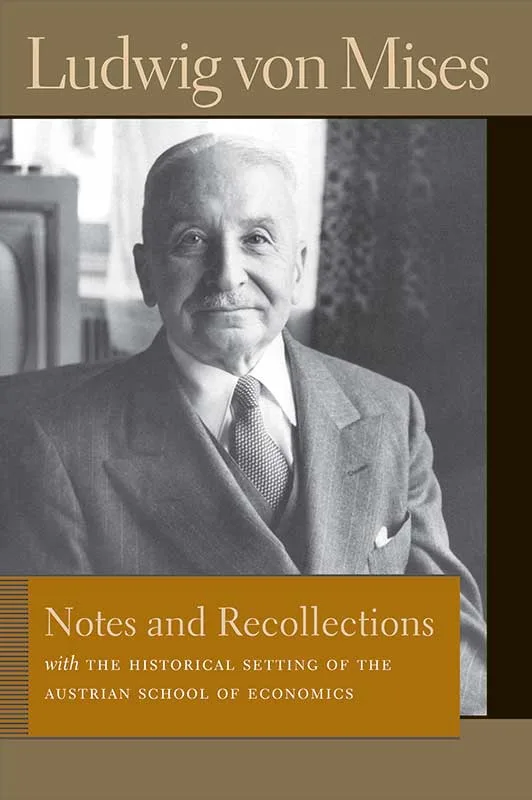
Ludwig von Mises · 2013
This volume contains Mises' brief memoir Notes and Recollections he wrote just prior to migrating to the U.S. in 1940 and an essay on the history of the Austrian school of economics from 1962. His memoir is accompanied…
In this collection
Authors, editors and translators of these titles, most titles first.
1881–1973 · 25 titles

1917–2019 · 19 titles

b. 1950 · 4 titles

1899–1992 · 1 title

b. 1937 · 1 title
b. 1906 · 1 title
1887–1939 · 1 title

1924–2018 · 1 title
1906–1984 · 1 title
Passages from titles in this collection, chosen by OLL editors.
Interventionism does not want to abolish private ownership of the means of production but only to restrict it. It declares, on the one hand, that unlimited private ownership of the means of production is harmful to society; but it maintains, on the other hand, that public ownership of the means of production—socialism—is, either in general or at least for the time being, impractical. Thus it wants to create some third way: a state of society that is midway between private ownership of the means of production, on the one hand, and collective ownership of the means of production, on the other hand. In this way the “excesses” and damages of capitalism are supposed to be prevented, while the advantages of free initiative and vitality, which socialism cannot provide, are preserved.
How far we are today from the rules of international law developed in the age of limited warfare! Modern war is merciless, it does not spare pregnant women or infants; it is indiscriminate killing and destroying. It does not respect the rights of neutrals. Millions are killed, enslaved, or expelled from the dwelling places in which their ancestors lived for centuries. Nobody can foretell what will happen in the next chapter of this endless struggle.
It is important to realize that what those benefited by these measures (tariffs) consider an advantage for themselves lasts only for a limited time. In the long run the privilege accorded to a definite class of producers loses its power to create specific gains. The privileged branch attracts newcomers, and their competition tends to eliminate the specific gains derived from the privilege. Thus the eagerness of the law’s pet children to acquire privileges is insatiable. They continue to ask for new privileges because the old ones lose their power.
As has been pointed out already, there is no such tendency toward monopolization. It is a fact that with many commodities in many countries monopoly prices prevail, and moreover, some articles are sold at monopoly prices on the world market. However, almost all of these instances of monopoly prices are the outgrowth of government interference with business. They were not created by the interplay of the factors operating on a free market. They are not products of capitalism, but precisely of the endeavors to counteract the forces determining the height of the market prices. It is a distortion of fact to speak of monopoly capitalism. It would be more appropriate to speak of monopoly interventionism or of monopoly statism.
Economic theory. Demography
473 titles · 88 publications · 293 people

Language and Literature
282 titles · 6 publications · 321 people
Language and Literature
112 titles · 156 people

Economic theory. Demography
6 titles · 30 publications · 28 people

History of the Americas
343 titles · 67 publications · 239 people

Political Science
13 titles · 1 publication · 17 people