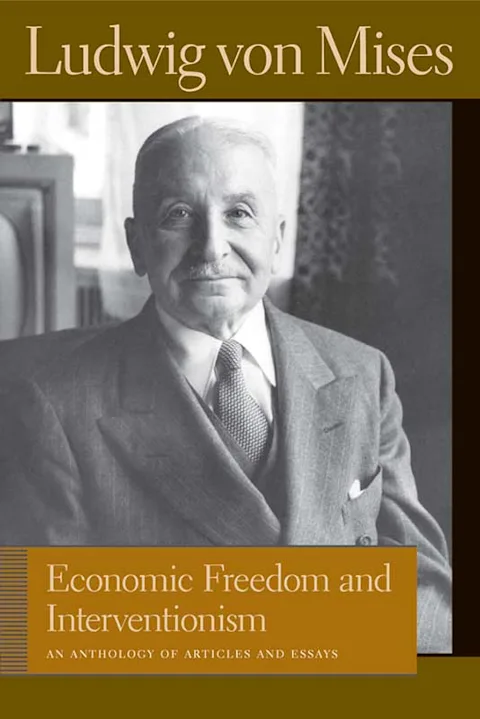
Economic Freedom and Interventionism
- Ludwig von Mises(author)
- Bettina Bien Greaves(editor)
Economic Freedom and Interventionism is a primer of the thought of Ludwig von Mises and an anthology of his writings. This volume contains forty-seven articles edited by Mises scholar Bettina Bien Greaves. Among them are Mises’s expositions of the role of government, his discussion of inequality of wealth, inflation, socialism, welfare, economic education, and his exploration of the “deeper” significance of economics as it affects seemingly noneconomic relations between human beings.
Key Quotes
Passages from this text chosen by OLL editors.
- Money & Banking“
This country, and with it most of the Western world, is presently going through a period of inflation and credit expansion. As the quantity of money in circulation and deposits subject to check increases, there prevails a general tendency for the prices of commodities and services to rise. Business is booming.
Yet such a boom, artificially engineered by monetary and credit expansion, cannot last forever. It must come to an end sooner or later. For paper money and bank deposits are not a proper substitute for nonexisting capital goods.
Economic theory has demonstrated in an irrefutable way that a prosperity created by an expansionist monetary and credit policy is illusory and must end in a slump, an economic crisis. It has happened again and again in the past, and it will happen in the future, too. - Taxation“
The financial embarrassment of the main European countries is predominantly caused by the bankruptcy of the nationalized public utilities. The deficit of these enterprises is incurable. A further rise in their rates would bring about a drop in total net proceeds. The traffic could not bear it. Daily experience proves clearly to everybody but the most bigoted fanatics of socialism that governmental management is inefficient and wasteful. But it is impossible to sell these enterprises back to private capital because the threat of a new expropriation by a later government would deter potential buyers.
In a capitalist country the railroads and the telegraph and telephone companies pay considerable taxes. In the countries of the mixed economy, the yearly losses of these public enterprises are a heavy drain upon the nation’s purse. They are not taxpayers, but tax-eaters.
Under the conditions of today, the nationalized public utilities of Europe are not merely feasting on taxes paid by the citizens of their own country; they are also living at the expense of the American taxpayer. A considerable part of the foreign-aid billions is swallowed by the deficits of Europe’s nationalization experiments...
About This Edition
Citation
Mises, Ludwig von. Economic Freedom and Interventionism: An Anthology of Articles and Essays, selected and edited by Bettina Bien Greaves (Indianapolis: Liberty Fund, 2007).
Mises, Ludwig von. Economic Freedom and Interventionism. Edited by Bettina Bien Greaves, Liberty Fund, 2007. Online Library of Liberty, https://oll.libertyfund.org/titles/greaves-economic-freedom-and-interventionism.
Mises, L. v. (2007). Economic Freedom and Interventionism. Liberty Fund. https://oll.libertyfund.org/titles/greaves-economic-freedom-and-interventionism
@book{mises2007interventionism,
  author = {Ludwig von Mises},
  editor = {Bettina Bien Greaves},
  title = {Economic Freedom and Interventionism},
  publisher = {Liberty Fund},
  address = {Indianapolis},
  year = {2007},
  url = {https://oll.libertyfund.org/titles/greaves-economic-freedom-and-interventionism},
  note = {Online Library of Liberty}
}TY - BOOK AU - Mises, Ludwig von A2 - Greaves, Bettina Bien TI - Economic Freedom and Interventionism PY - 2007 CY - Indianapolis PB - Liberty Fund UR - https://oll.libertyfund.org/titles/greaves-economic-freedom-and-interventionism DB - Online Library of Liberty ER -
Copyright
The copyright to this edition, in both print and electronic forms, is held by Liberty Fund, Inc.

About the author
Ludwig von Mises 1881–1973
Ludwig von Mises (1881-1973) was the acknowledged leader of the Austrian School of economic thought, a prodigious originator in economic theory, and a prolific author. Mises’ writings and lectures encompassed economic theory, history, epistemology, government, and political philosophy. His contributions to economic theory include important clarifications on the quantity theory of money, the theory of the trade cycle, the integration of monetary theory with economic theory in general, and a demonstration that socialism must fail because it cannot solve the problem of economic calculation.
Mises was the first scholar to recognize that economics is part of a larger science in human action, a science which Mises called “praxeology”. Mises wrote many works on two related economic themes: 1. monetary economics, inflation, and the role of government, and 2. the differences between government-controlled economies and free trade. His influential work on economic freedoms, their causes and consequences, brought him to highlight the interrelationships between economic and non-economic freedoms in societies, and the appropriate role for government.
See also our collection of extracts, essays, and other resources on Mises.
More in Economic theory. Demography
See all >The Collected Works of Frédéric Bastiat. Vol. 2: The Law, The State, and Other Political Writings, 1843-1850
Frédéric BastiatCost and Choice: An Inquiry in Economic Theory, Vol. 6 of the Collected Works
James M. BuchananAn Essay on the Principle of Population, vol. 1 [1826, 6th ed.]
Thomas Robert MalthusUniversal Economics
Armen A. AlchianCan Capitalism Survive?
Benjamin A. RoggeAn Essay on the Principle of Population [1798, 1st ed.]
Thomas Robert Malthus“The Use of Knowledge in Society” (1945)
Friedrich August von HayekDas Kapital. Kritik der politischen Oekonomie. Buch 1 (1867)
Karl MarxDas Kapital. Kritik der politischen Ökonomie. Buch III, zweiter Theil (1894)
Karl Marx