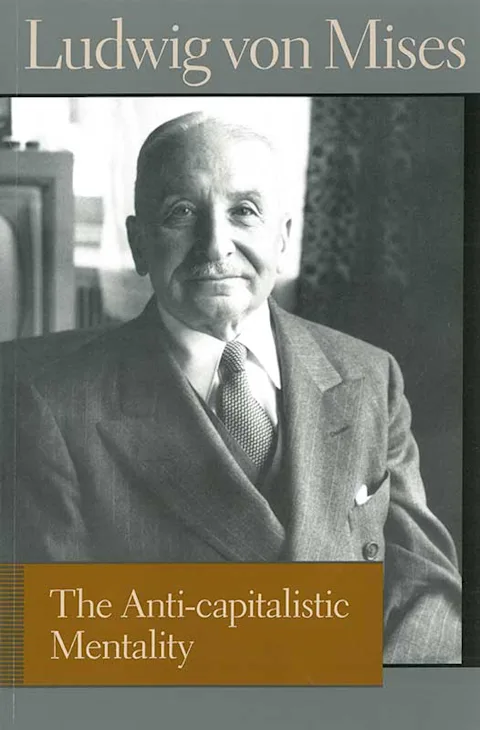
The Anti-capitalist Mentality
- Ludwig von Mises(author)
- Bettina Bien Greaves(editor)
In The Anti-capitalistic Mentality, Ludwig von Mises explains the causes of the irrational fear and hatred many intellectuals and others feel for capitalism. Written during the heyday of twentieth-century socialism, this work provides the reader with lucid and compelling insights into human reactions to capitalism.
About This Edition
Citation
Mises, Ludwig von. The Anti-capitalist Mentality, edited and with a preface by Bettina Bien Greaves (Indianapolis: Liberty Fund, 2006).
Mises, Ludwig von. The Anti-capitalistic Mentality. Edited by Bettina Bien Greaves, Liberty Fund, 2006. Online Library of Liberty, https://oll.libertyfund.org/titles/greaves-the-anti-capitalistic-mentality.
Mises, L. v. (2006). The Anti-capitalistic Mentality. Liberty Fund. https://oll.libertyfund.org/titles/greaves-the-anti-capitalistic-mentality
@book{mises2006mentality,
  author = {Ludwig von Mises},
  editor = {Bettina Bien Greaves},
  title = {The Anti-capitalistic Mentality},
  publisher = {Liberty Fund},
  address = {Indianapolis},
  year = {2006},
  url = {https://oll.libertyfund.org/titles/greaves-the-anti-capitalistic-mentality},
  note = {Online Library of Liberty}
}TY - BOOK AU - Mises, Ludwig von A2 - Greaves, Bettina Bien TI - The Anti-capitalistic Mentality PY - 2006 CY - Indianapolis PB - Liberty Fund UR - https://oll.libertyfund.org/titles/greaves-the-anti-capitalistic-mentality DB - Online Library of Liberty ER -
Copyright
The copyright to this edition, in both print and electronic forms, is held by Liberty Fund, Inc.

About the author
Ludwig von Mises 1881–1973
Ludwig von Mises (1881-1973) was the acknowledged leader of the Austrian School of economic thought, a prodigious originator in economic theory, and a prolific author. Mises’ writings and lectures encompassed economic theory, history, epistemology, government, and political philosophy. His contributions to economic theory include important clarifications on the quantity theory of money, the theory of the trade cycle, the integration of monetary theory with economic theory in general, and a demonstration that socialism must fail because it cannot solve the problem of economic calculation.
Mises was the first scholar to recognize that economics is part of a larger science in human action, a science which Mises called “praxeology”. Mises wrote many works on two related economic themes: 1. monetary economics, inflation, and the role of government, and 2. the differences between government-controlled economies and free trade. His influential work on economic freedoms, their causes and consequences, brought him to highlight the interrelationships between economic and non-economic freedoms in societies, and the appropriate role for government.
See also our collection of extracts, essays, and other resources on Mises.
Related People
A fellow Austrian School economist and a prominent colleague and continuation of Mises’s work. Hayek provides a natural partner thinker to Mises, especially when thinking about the intellectual roots and implications of the opposition to capitalism.
Murray N. Rothbard
Author
Rothbard is a later generation Austrian economist who built upon Mises’s ideas and pushed them further in libertarian/anarcho-capitalist directions.
Israel M. Kirzner
Author
Kirzner was a student of Mises and a prominent economist in the Austrian School focused on entrepreneurship and market discovery.


Critical Responses
Works that answer or challenge this text.
 Book
The Servile State
Hillaire BellocVisit site ↗Bxamines capitalism and socialism from a distributist/Catholic-social perspective, arguing that capitalism tends toward a “servile” arrangement in which most people are dependent and subordinate. It offers a critique of both modern capitalism and state socialism, in contrast to Mises’s defense of the market.
 Book
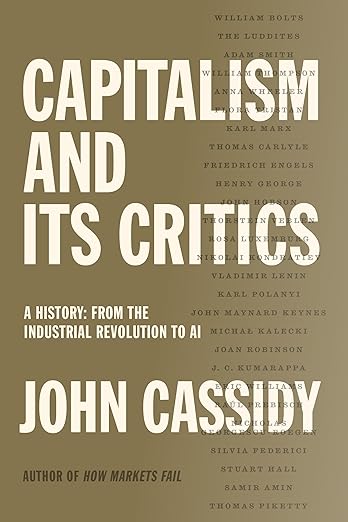
Capitalism and Its Critics
John CassidyVisit site ↗A recent overview of criticisms of capitalism — including historical, institutional, cultural and environmental critiques. It provides a contemporary context and many angles that challenge or complicate Mises’s narrative.
Connected Readings
What to read next.
 Book
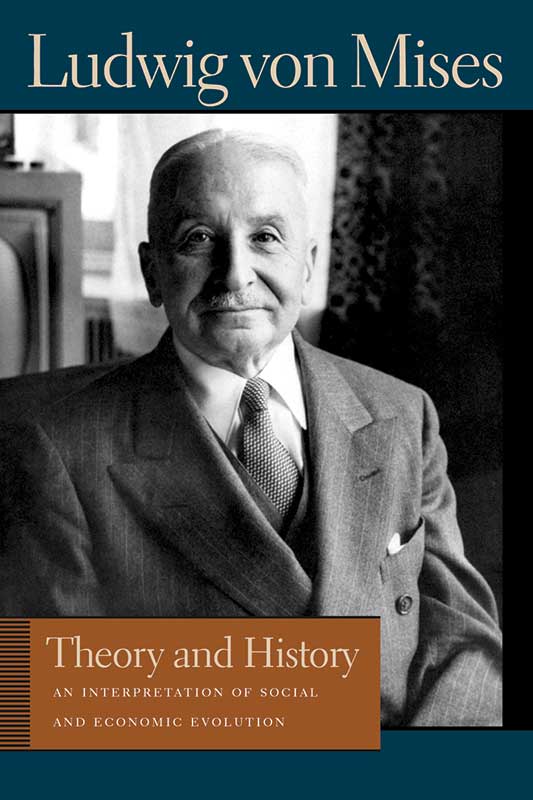
Theory and History: An Interpretation of Social and Economic Evolution (LF ed.)
Ludwig von MisesView title >A more theoretical and methodological work of Mises, where he delves into the foundations of social science, human action (praxeology), and critiques of historicism.
 Book
Human Action: A Treatise on Economics, in 4 vols. (LF ed.)
Ludwig von MisesView title >Mises’s magnum opus — a sweeping system of economics built on human choice and praxeology. It shows how markets, money, and institutions arise from purposeful action. Anti-Capitalistic Mentality is a cultural defense of capitalism; Human Action is the technical foundation that underpins it.
 Book
Man, Economy, and State
Murray RothbardVisit site ↗A full reconstruction of microeconomics inspired by Mises, but with Rothbard’s radical clarity and detail. Rothbard brings Misesian economics to life with examples and stronger libertarian emphasis.
 What to read next.
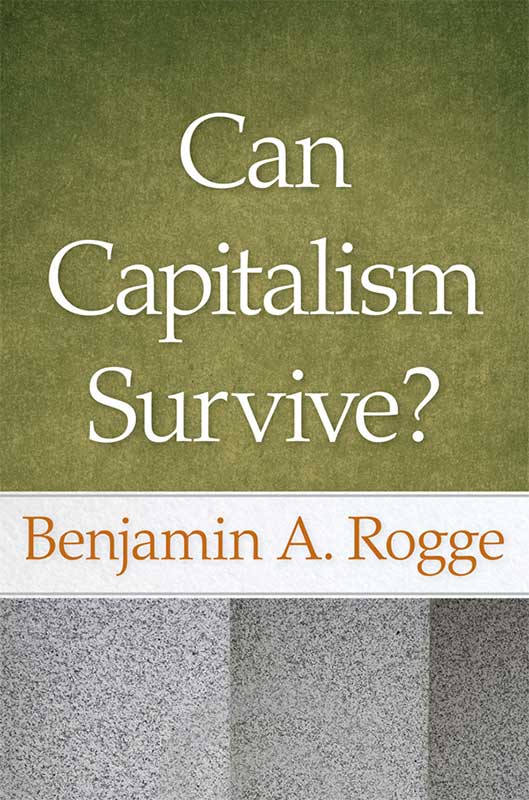
Can Capitalism Survive?
Benjamin A. RoggeView title >Rogge argued that many critics of capitalism emphasise its failings (inequality, crises, moral collapse) but seldom recognise how capitalism depends on cultural and institutional underpinnings. Rogge warns that when those underpinnings weaken—when business is demonised, when education becomes anti-capitalistic, when government interference grows unchecked—then the system loses its support base and its legitimacy.
More in Socialism. Communism. Anarchism
See all >A Manifesto. Fabian Tracts No. 2 (1884)
George Bernard ShawSocialism: An Economic and Sociological Analysis
Ludwig von MisesCapital: A Critique of Political Economy. Volume I: The Process of Capitalist Production
Karl MarxThe Natural and Artificial Right of Property Contrasted
Thomas HodgskinSocialistic Fallacies
Yves GuyotA Plea for Liberty: An Argument against Socialism and Socialistic Legislation (LF ed.)
Thomas MackayThe Tyranny of Socialism
Yves GuyotA Plea for Liberty: An Argument against Socialism and Socialistic Legislation (1891 ed.)
Auberon HerbertIdeal Empires and Republics
Sir Francis Bacon