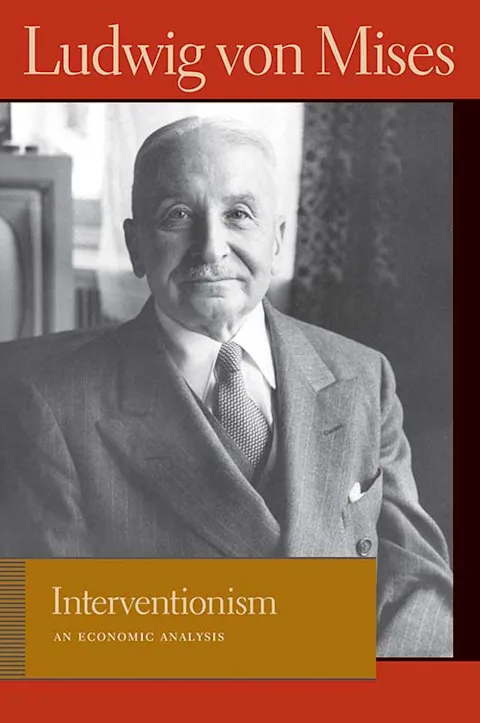
Interventionism: An Economic Analysis
- Ludwig von Mises(author)
- Bettina Bien Greaves(editor)
Interventionism provides Mises’s analysis of the problems of government interference in business from the Austrian School perspective. Written in 1940, before the United States was officially involved in World War II, this book offers a rare insight into the war economies of Hitler’s Germany and Mussolini’s Italy.
About This Edition
Citation
Mises, Ludwig von. Interventionism: An Economic Analysis, Edited with a Foreword by Bettina Bien Greaves (Indianapolis: Liberty Fund, 2011).
Mises, Ludwig von. Interventionism: An Economic Analysis. Edited by Bettina Bien Greaves, Liberty Fund, 2011. Online Library of Liberty, https://oll.libertyfund.org/titles/greaves-interventionism-an-economic-analysis.
Mises, L. v. (2011). Interventionism: An Economic Analysis. Liberty Fund. https://oll.libertyfund.org/titles/greaves-interventionism-an-economic-analysis
@book{mises2011analysis,
  author = {Ludwig von Mises},
  editor = {Bettina Bien Greaves},
  title = {Interventionism: An Economic Analysis},
  publisher = {Liberty Fund},
  address = {Indianapolis},
  year = {2011},
  url = {https://oll.libertyfund.org/titles/greaves-interventionism-an-economic-analysis},
  note = {Online Library of Liberty}
}TY - BOOK AU - Mises, Ludwig von A2 - Greaves, Bettina Bien TI - Interventionism: An Economic Analysis PY - 2011 CY - Indianapolis PB - Liberty Fund UR - https://oll.libertyfund.org/titles/greaves-interventionism-an-economic-analysis DB - Online Library of Liberty ER -
Copyright
Interventionism was written by Ludwig von Mises in 1940 and is here translated from the original German by Thomas Francis McManus and Heinrich Bund. Editorial additions and index © 1998, 2011 by Liberty Fund, Inc. Interventionism was originally published in 1998 by Foundation for Economic Education, Inc.

About the author
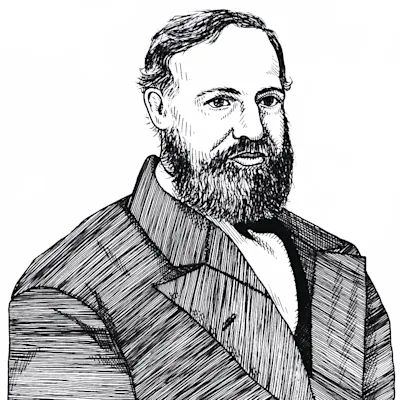
Ludwig von Mises 1881–1973
Ludwig von Mises (1881-1973) was the acknowledged leader of the Austrian School of economic thought, a prodigious originator in economic theory, and a prolific author. Mises’ writings and lectures encompassed economic theory, history, epistemology, government, and political philosophy. His contributions to economic theory include important clarifications on the quantity theory of money, the theory of the trade cycle, the integration of monetary theory with economic theory in general, and a demonstration that socialism must fail because it cannot solve the problem of economic calculation.
Mises was the first scholar to recognize that economics is part of a larger science in human action, a science which Mises called “praxeology”. Mises wrote many works on two related economic themes: 1. monetary economics, inflation, and the role of government, and 2. the differences between government-controlled economies and free trade. His influential work on economic freedoms, their causes and consequences, brought him to highlight the interrelationships between economic and non-economic freedoms in societies, and the appropriate role for government.
See also our collection of extracts, essays, and other resources on Mises.
Related People
Ludwig von Mises
Author
Ludwig von Mises (1881-1973) was the acknowledged leader of the Austrian School of economic thought, a prodigious originator in economic theory, and a prolific author. Mises’ writings and lectures encompassed economic theory, history, epistemology, government, and political philosophy.
A student of Mises, Hayek would become a Nobel laureate and the standard-bearer for the Austrian school of economics.

Critical Responses
Works that answer or challenge this text.
- Liberty Classic
Liberty Classic Review
Walter BlockDecisive Blows
Visit site ↗There is no small book that can take the place of Ludwig von Mises’ magisterial book, Human Action.2 However, if there were a contest for shorter publications that could substitute for it, his own book, Interventionism, would be high up on my list in this regard.
Connected Readings
What to read next.
 Book
Human Action: A Treatise on Economics, in 4 vols. (LF ed.)
Ludwig von MisesMises' Magnum Opus
View title >Mises presents economics—not as a study of material goods, services, and products—but as a study of human actions. He sees the science of human action, praxeology, as a science of reason and logic, which recognizes a regularity in the sequence and interrelationships among market phenomena. Mises defends the methodology of praxeology against the criticisms of Marxists, socialists, positivists, and mathematical statisticians.
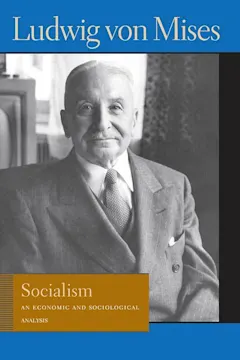 Book
Socialism: An Economic and Sociological Analysis
Ludwig von MisesOn the impossibility of central planning
View title >Mises' "Socialism" is the definitive refutation of nearly every type of socialism ever devised. Mises presents a wide-ranging analysis of society, comparing the results of socialist planning with those of free-market capitalism in all areas of life.
More in Industries. Land use. Labor
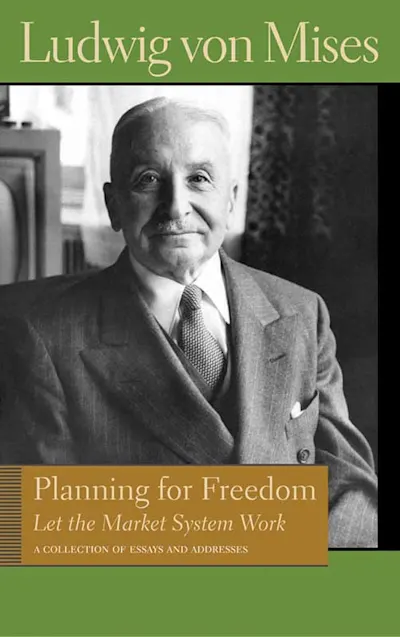
See all >Planning for Freedom: Let the Market System Work. A Collection of Essays and Addresses
Ludwig von MisesLetters on the Factory Act
Nassau William SeniorWhere and Why Public Ownership has Failed
Yves GuyotA Policy of Free Exchange
Thomas Mackay