

Norman P. Barry
1944–2008
Norman Barry was professor of poitical science at University College, Buckingham.


Economic theory. Demography
93 items in this collection
The Austrian School of Economics emerged after the publication in 1871 of a trilogy of works (by Jevons, Walras, and Menger) which introduced the idea of the subjective theory of value and began what has been called "the marginal revolution" in economic thought. Leading theorists in the 20th century were Ludwig von Mises, Friedrich Hayek, Murray Rothbard, and Israel Kirzner.
In this collection
6 titles, earliest first.
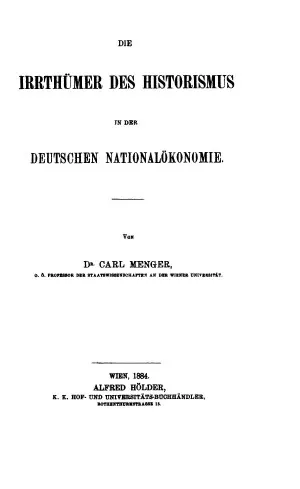
Carl Menger · 1884
One of the founders of the Austrian school of economics and the subjective theory of value takes issue with the historical school’s metholdolgy in economics.
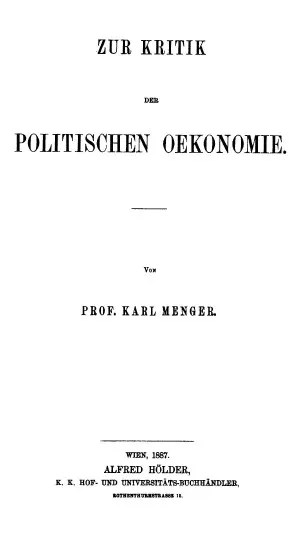
Carl Menger · 1887
An off-print from the journal Zeitschrift fuer das Privat- und oeffentliche Recht der Gegenwart.
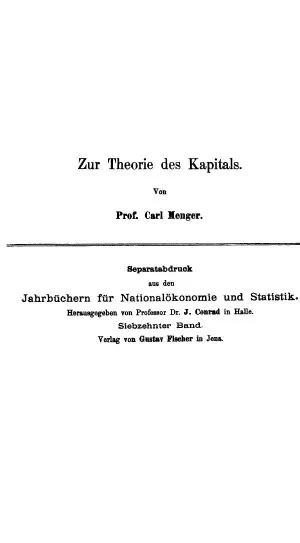
Carl Menger · 1888
An off-print from the journal Jahrbüchern für Nationalökonomie und Statistik.
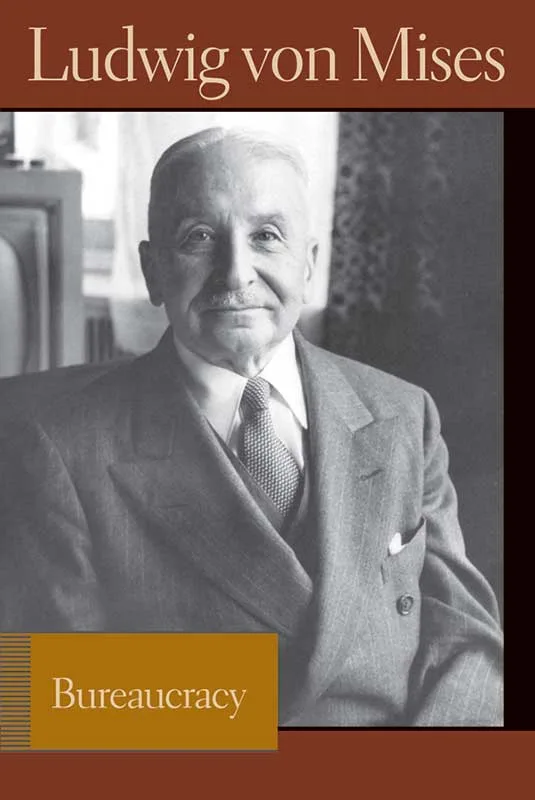
Ludwig von Mises · 1944
Originally published by Yale University Press in 1944, Bureaucracy is a classic fundamental examination of the nature of bureaucracies and free markets in juxtaposition to various political systems.
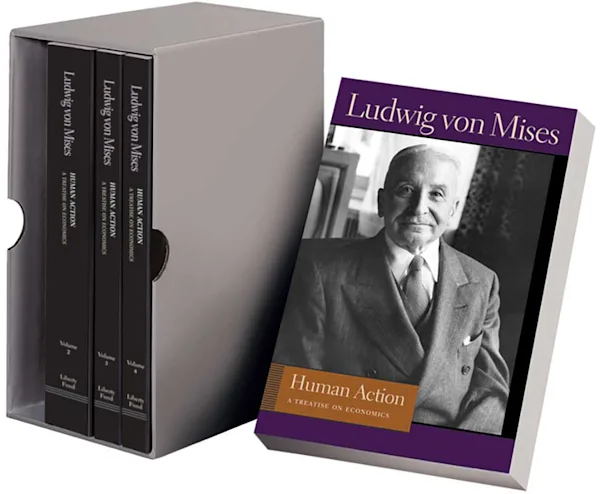
Ludwig von Mises · 1996
In the foreword to Human Action: A Treatise on Economics, Mises explains complex market phenomena as “the outcomes of countless conscious, purposive actions, choices, and preferences of individuals, each of whom was…
Gary S. Becker · 2000
This is a collection of 7 lectures which were given between October 7 and November 13 1999 to celebrate the 100th anniversary of the birth of the Austrian economist Friedrich von Hayek. The lecture series was sponsored…
In this collection
28 people central to Austrian School of Economics.
1944–2008
Norman Barry was professor of poitical science at University College, Buckingham.

b. 1960
Peter Boettke is University Professor of Economics and Philosophy at George Mason University and the BB&T Professor for the Study of…

1851–1914
Eugen von Böhm-Bawerk, Austrian economist at the University of Vienna, and Austrian finance minister, made the modern intertemporal theory…

1680–1734
Richard Cantillon, Irish born but living in Paris as a young man, from circumstances became a banker/broker there, and moved in…

b. 1950
Dr. Richard M. Ebeling is the BB&T Distinguished Professor of Ethics and Free Enterprise Leadership at The Citadel.

1863–1949
Frank Albert Fetter (1863-1949) was the leader in the United States of the early Austrian school of economics.

1917–2019
Bettina Bien Greaves attended Ludwig von Mises’s New York University seminar, compiled Mises: An Annotated Bibliography, and also edited…

1899–1992
Hayek was one of the most important free market economists of the 20th century. He was a member of the Austrian school of economics, taught…

1835–1882
Jevons was born in Liverpool, England and studied chemistry and botany at University College, London before taking up the position of…

b. 1930
Israel Kirzner (b. 1930) is among the foremost scholars in the Austrian School of economic thought. He studied at the University of Cape…

1906–1990
Lachmann was a German born member of the Austrian school of economics founded by Carl Menger and Boehm-Bawerk. He studied at the London…

1802–1884
Longfield was a Fellow of Trinity College, Dubliin and the first professor of Political Economy there. He is regarded as a precursor to the…

1840–1921
Carl Menger (1840-1921) was one of the founders of the Austrian School of economics. Menger, along with Jevons and Walras, published a work…

1881–1973
Ludwig von Mises (1881-1973) was the acknowledged leader of the Austrian School of economic thought, a prodigious originator in economic…

1867–1913
Montemartini was professor of political economy at the University of Padova. He was a supporter of the marginal school of economic thought.…
b. 1944
Moss is a professor of economics at the University of Virginia. He attended Ludwig von Mises' seminars in New York city between 1963-65 and…

b. 1947
Gerald O’Driscoll is a widely quoted expert on international economic issues, including trade, finance and economic development. Formerly…

b. 1937
George Gerald Reisman (1937- ) is Professor Emeritus of Economics at Pepperdine University.

b. 1948
Mario J. Rizzo is Professor of Economics at New York University. He is the director of the program on the Foundations of the Market Economy…

1926–1995
Rothbard was an Austrian economist, economic historian, and libertarian political philosopher.

b. 1950
Joseph T. Salerno received his Ph.D. in economics from Rutgers University. He is the academic vice president of the Ludwig von Mises…
1853–1914
Smart was an English economist and translator who did much to make the works of the Austrian School available to the Engish-speaking world.

1912–1976
Vera Smith was born in England in 1912. She spent her professional life in a variety of research positions and wrote many articles on…
b. 1913
Spadaro was a economist who taught at Fordham University since 1938. He was Dean of the Graduate School of Business and Chairman of the…

b. 1954
Lawrence H. White is a professor of economics at George Mason University and a Distinguished Senior Fellow of the Mercatus Center's F. A.…

1844–1927
Philip H. Wicksteed (1844-1927), English philosopher, theologian, and economist, made important advances in economic method and in the…

1851–1926
An Austrian economist who contributed to the early development of the marginalist or subjectivist school of economic thought in the late…

1924–2018
Leland Yeager was Ludwig von Mises Professor of Economics, Emeritus, at Auburn University.
In this collection
From The Reading Room, Liberty Matters and the library’s other publications.

Giandomenica Becchio and others · 2023
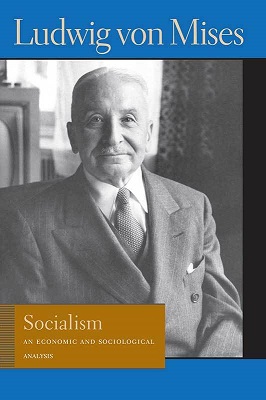
Virgil Henry Storr and others · 2022

Peter J. Boettke and others · 2017
Passages on this subject, chosen by OLL editors.
In a predominantly free society, individuals are in most respects at liberty to act as they choose. That is, in such a society an individual is generally at liberty to take advantage of any opportunity (as he perceives the existence of such an opportunity) in order to improve his position (as he understands the idea of improving his position). He is free to act in isolation, and he is free to engage in acts of exchange with other individuals (whenever he and some other individuals both perceive the opportunity of mutual benefit through trade). As we shall find, such opportunities for mutually advantageous exchange arise constantly in society. Moreover, the exploitation by individuals of these opportunities opens up yet further opportunities of the same kind, both to the individuals themselves and to others in the society. (FROM: THE INDIVIDUAL AND THE MARKET) - Israel Kirzner
Fraser has classified definitions of economics into Type A definitions and Type B definitions. Type A definitions consider economics as investigating a particular department of affairs, while Type B definitions see it as concerned with a particular aspect of affairs in general. The specific department singled out by Type A definitions has usually been wealth or material welfare. The aspect referred to in Type B definitions is the constraint that social phenomena uniformly reveal in the necessity to reconcile numerous conflicting ends under the shadow of an inescapable scarcity of means....
[In recent decades there has been a] trend away from the association of economics with specific “ends” or a specific department of human affairs. In this development the work of [Lionel] Robbins has been consistently pursued to what appears to the writer to be the most adequate solution of the problem.... [T]he contributions of several eminent economists, including Mises and Knight... [called the praxeological outlook]... has a significance that, in the writer’s opinion, has not been sufficiently recognized because it has not yet been brought into historical perspective.
The final question was posed at midnight: “Professor Mises, I agree with you that we are headed for troublous times. Now, let us suppose you were the dictator of these United States. What would you do?”
Quick as a flash came the reply, “I would abdicate!” Here we have the renunciation side of wisdom: man knowing he should not lord it over his fellows and rejecting even the thought.
Few among us are wise enough to know how little we know. Ignorance of limitations is to be expected from every one who does not see beyond himself. The wise man, on the other hand, achieves a measure of self-transcendence: he sees beyond himself, even beyond his environment. Knowing far more than the mill run of us, he measures his knowledge against what might be known and confesses to knowing nearly nothing. Such a rare individual weighs his finite knowledge on the scale of infinite truth, and his awareness of his limitations tells him never to lord it over others. Such a person would renounce any position of authoritarian rulership he might be proffered or, if accidentally finding himself in such a position, he would abdicate—forthwith!
The market process is thus seen to be a leveling process. In a market economy a process of redistribution of wealth is taking place all the time before which those outwardly similar processes which modern politicians are in the habit of instituting, pale into comparative insignificance, if for no other reason than that the market gives wealth to those who can hold it, while politicians give it to their constituents who, as a rule, cannot.
This process of redistribution of wealth is not prompted by a concatenation of hazards. Those who participate in it are not playing a game of chance, but a game of skill. This process, like all real dynamic processes, reflects the transmission of knowledge from mind to mind. It is possible only because some people have knowledge that others have not yet acquired, because knowledge of change and its implications spread gradually and unevenly throughout society.
As has been pointed out already, there is no such tendency toward monopolization. It is a fact that with many commodities in many countries monopoly prices prevail, and moreover, some articles are sold at monopoly prices on the world market. However, almost all of these instances of monopoly prices are the outgrowth of government interference with business. They were not created by the interplay of the factors operating on a free market. They are not products of capitalism, but precisely of the endeavors to counteract the forces determining the height of the market prices. It is a distortion of fact to speak of monopoly capitalism. It would be more appropriate to speak of monopoly interventionism or of monopoly statism.
The principle of sound money that guided nineteenth-century monetary doctrines and policies was a product of classical political economy. It was an essential part of the liberal program as developed by eighteenth-century social philosophy and propagated in the following century by the most influential political parties of Europe and America...It is impossible to grasp the meaning of the idea of sound money if one does not realize that it was devised as an instrument for the protection of civil liberties against despotic inroads on the part of governments. Ideologically it belongs in the same class with political constitutions and bills of rights. The demand for constitutional guarantees and for bills of rights was a reaction against arbitrary rule and the nonobservance of old customs by kings. The postulate of sound money was first brought up as a response to the princely practice of debasing the coinage. It was later carefully elaborated and perfected in the age which—through the experience of the American continental currency, the paper money of the French Revolution and the British restriction period—had learned what a government can do to a nation’s currency system... Thus the sound-money principle has two aspects. It is affirmative in approving the market’s choice of a commonly used medium of exchange. It is negative in obstructing the government’s propensity to meddle with the currency system.
The fundamental social phenomenon is the division of labor and its counterpart human cooperation. Experience teaches man that cooperative action is more efficient and productive than isolated action of self-sufficient individuals. The natural conditions determining man’s life and effort are such that the division of labor increases output per unit of labor expended.
The people of all countries agree that the present state of monetary affairs is unsatisfactory and that a change is highly desirable... The destruction of the monetary order was the result of deliberate actions on the part of various governments. The government-controlled central banks and, in the United States, the government-controlled Federal Reserve System were the instruments applied in this process of disorganization and demolition. Yet without exception all drafts for an improvement of currency systems assign to the governments unrestricted supremacy in matters of currency and design fantastic images of superprivileged superbanks... The inanity of all these plans is not accidental. It is the logical outcome of the social philosophy of their authors.
For more information see:
Economic theory. Demography
473 titles · 88 publications · 293 people

Sociology
62 titles · 3 publications · 35 people

Political Science
13 titles · 1 publication · 17 people
Economic theory. Demography
48 titles · 1 publication · 55 people
Social media
25 titles · 17 publications · 22 people

Social Sciences
18 titles · 22 people