


Author
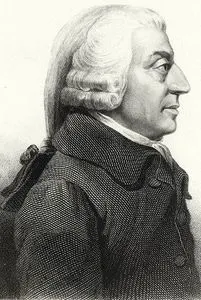
Adam Smith
1723–1790
Adam Smith (1723-1790) is commonly regarded as the first modern economist with the publication in 1776 of The Wealth of Nations. He wrote in a wide range of disciplines: moral philosophy, jurisprudence, rhetoric and literature, and the history of science. He was one of the leading figures in the Scottish Enlightenment.
Biography
Smith also studied the social forces giving rise to competition, trade, and markets. While professor of logic, and later professor of moral philosophy at Glasgow University, he also had the opportunity to travel to France, where he met François Quesnay and the physiocrats; he had friends in business and the government, and drew broadly on his observations of life as well as careful statistical work summarizing his findings in tabular form. He is viewed as the founder of modern economic thought, and his work inspires economists to this day. The economic phrase for which he is most famous, the “invisible hand” of economic incentives, was only one of his many contributions to the modern-day teaching of economics.
See also our collection of extracts, essays, and other resources on Smith.
See also our sister site, AdamSmithWorks.
See the Liberty Matters online discussions on Smith, Hume, and Burke as Policy Liberals and Polity Conservatives and What Adam Smith Means to Me
For additional information about Adam Smith see the following:
- Essays on Adam Smith
- Timeline on the Life and Work of Adam Smith
- in the Library: the classic Life of Adam Smith by John Rae
- at our sister website Econlib: the Concise Encyclopedia of Economics entry on Adam Smith
- in the Goodrich Seminar Room: Adam Smith
Watch the OLL Video Adam Smith and the Wealth of Nations
Works by Adam Smith
7 titles in the library
 View title →
Adam Smith · 1776
An Inquiry Into the Nature and Causes of the Wealth of Nations (Cannan ed.), vol. 1
Cannan’s justly famous early 20th century edition of Smith’s Wealth of Nations with his introduction and notes.
View title →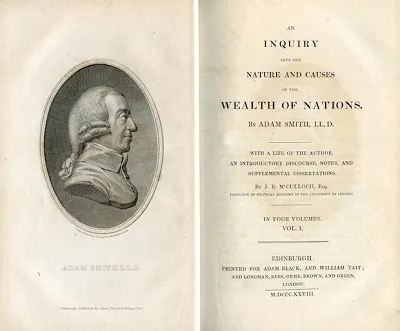 View title →
Adam Smith · 1776
An Inquiry Into the Nature and Causes of the Wealth of Nations (Cannan ed.), vol. 2
Cannan’s justly famous early 20th century edition of Smith’s Wealth of Nations with his introduction and notes.
View title →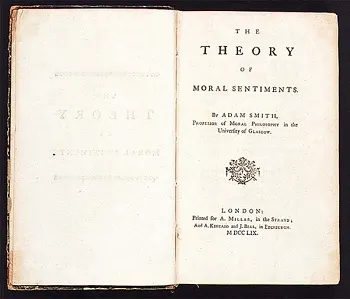 View title →
Adam Smith · 1869
Theory of Moral Sentiments and Essays on Philosophical Subjects (1869)
This edition contains an abridged biographical essay by Dugald Stewart, the Theory of Moral Sentiments, and seven "Essays on Philosophical Subjects."
View title →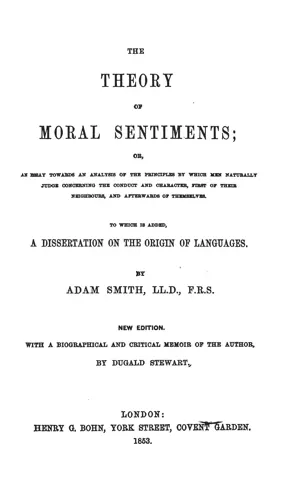 View title →
Adam Smith · 1759
The Theory of Moral Sentiments and on the Origins of Languages (Stewart ed.)
View title → View title →
Adam Smith · 1869
Lectures on Justice, Police, Revenue and Arms (1763)
View title →- View title →
Adam Smith · 1776
An Inquiry into the Nature and Causes of the Wealth of Nations (Cannan ed.), in 2 vols.
Cannan’s justly famous early 20th century edition of Smith’s Wealth of Nations with his introduction and notes.
View title →  View title →
Jeremy Bentham · 1897
British Moralists vol. 1
Vol. 1 contains selections from the work of Shaftesbury, Hutcheson, Butler, Adam Smith, and Bentham.
View title →
Quotes from Adam Smith
45 quotes from the library
- Lectures on Justice, Police, Revenue and Arms (1763)“
It is in Britain alone that any consent of the people is required, and God knows it is but a very figurative metaphoricall consent which is given here. And in Scotland still more than in England, as but very few have a vote for a Member of Parliament | who give this metaphoricall consent; and yet this is not any where reckoned a sufficient cause of rebellion. No doubt the raising of a very exorbitant tax, as the raising as much in peace as in war, or the half or even the fifth of the wealth of the nation, would, as well as any other gross abuse of power, justify resistance in the people.
- An Inquiry Into the Nature and Causes of the Wealth of Nations (Cannan ed.), vol. 1“
In great empires the people who live in the capital, and in the provinces remote from the scene of action, feel, many of them scarce any inconveniency from the war; but enjoy, at their ease, the amusement of reading in the newspapers the exploits of their own fleets and armies. To them this amusement compensates the small difference between the taxes which they pay on account of the war, and those which they had been accustomed to pay in time of peace. They are commonly dissatisfied with the return of peace, which puts an end to their amusement, and to a thousand visionary hopes of conquest and national glory, from a longer continuance of the war.
- Lectures on Justice, Police, Revenue and Arms (1763)“
The Habeas Corpus Act is also a great security against oppression, as by it any one can procure triall at Westminster within 40 days who can afford to transport himself thither. Before this Act the Privy Councill could put any one they pleased into prison and detain him at pleasure without bringing him to triall. Now no one can be imprisoned anywhere but in the county gaol or the nearest to it where the crime is said to have been committed; he cant be sent out of Britain to Jersey, | Guernsey, or the plantations, that is, alway[s] within the extent of the Hab. Corp. Act.—This sufficiently secures the liberty of the people; for tho many could not afford the expense, yet it is not such who will be in greatest danger from the king. The rich and powerfull are most obnoxious to his displeasure; tis rich and not poor folk who are sent to the Bastile in France. No judge can oppose the Habeas Corpus Act; infamy and a high penalty are the punishment which attend it. No influence of the king could ever induce them to make any such attem[p]t. And so strict is this Act that in the time of rebellions or other exigencies of the state, when it is necessary to imprison without such speedy triall, it is commonly taken off for 6 months. But it will never be allowed to be reppealed, as that would destroy in a great measure the liberty of the subject.
- An Inquiry Into the Nature and Causes of the Wealth of Nations (Cannan ed.), vol. 2“
It would be too ridiculous to go about seriously to prove, that wealth does not consist in money or in gold and silver, but in what money purchases.
- The Theory of Moral Sentiments and on the Origins of Languages (Stewart ed.)“
There is, however, another virtue, of which the observance is not left to the freedom of our own wills, which may be extorted by force, and of which the violation exposes to resentment, and consequently to punishment. This virtue is justice: the violation of justice is injury: it does real and positive hurt to some particular persons, from motives which are naturally disapproved of. It is, therefore, the proper object of resentment, and of punishment, which is the natural consequence of resentment.
- An Inquiry Into the Nature and Causes of the Wealth of Nations (Cannan ed.), vol. 1“
Little else is requisite to carry a state to the highest degree of opulence from the lowest barbarism, but peace, easy taxes, and a tolerable administration of justice; all the rest being brought about by the natural course of things. All governments which thwart this natural course, which force things into another channel, or which endeavour to arrest the progress of society at a particular point, are unnatural, and to support themselves are obliged to be oppressive and tyrannical.
- An Inquiry Into the Nature and Causes of the Wealth of Nations (Cannan ed.), vol. 2“
In the payment of the interest of the publick debt, it has been said, it is the right hand which pays the left. [52] The money does not go out of the country. It is only a part of the revenue of one set of the inhabitants which is transferred to another; and the nation is not a farthing the poorer. This apology is founded altogether in the sophistry of the mercantile system, and after the long examination which I have already bestowed upon that system, it may perhaps be unnecessary to say any thing further about it. It supposes, besides, that the whole publick debt is owing to the inhabitants of the country, which happens not to be true; the Dutch, as well as several other foreign nations, having a very considerable share in our publick funds. But though the whole debt were owing to the inhabitants of the country, it would not upon that account be less pernicious.
- Theory of Moral Sentiments and Essays on Philosophical Subjects (1869)“
The man of system, on the contrary, is apt to be very wise in his own conceit; and is often so enamoured with the supposed beauty of his own ideal plan of government, that he cannot suffer the smallest deviation from any part of it. He goes on to establish it completely and in all its parts, without any regard either to the great interests, or to the strong prejudices which may oppose it. He seems to imagine that he can arrange the different members of a great society with as much ease as the hand arranges the different pieces upon a chess–board. He does not consider that the pieces upon the chess–board have no other principle of motion besides that which the hand impresses upon them; but that, in the great chess–board of human society, every single piece has a principle of motion of its own, altogether different from that which the legislature might chuse to impress upon it.
- Education“
The College breaks up in the beginning of June and does not sit down again till the beginning of October. During this interval I propose that he should learn french and Dancing and fencing and that besides he should read with me the best greek, latin and french Authors on Moral Philosophy for two or three hours every morning, so that he will not be idle in the vacation.
- Lectures on Justice, Police, Revenue and Arms (1763)“
Man is an anxious animal and must have his care swept off by something that can exhilarate the spirits. It is alledged that this tax upon beer is an artificial security against drunkeness, but if we attend to it, we shall find that it by no means prevents it. In countries where strong liquors are cheap, as in France and Spain, the people are generally sober. But in northern countries, where they are dear, they do not get drunk with beer but with spirituous liquors. No body presses his friend to a glass of beer unless he choose it.
- Theory of Moral Sentiments and Essays on Philosophical Subjects (1869)“
Are you in earnest resolved never to barter your liberty for the lordly servitude of a court, but to live free, fearless, and independent? (Then...) (n)ever enter the place from whence so few have been able to return; never come within the circle of ambition; nor ever bring yourself into comparison with those masters of the earth who have already engrossed the attention of half mankind before you.
- An Inquiry Into the Nature and Causes of the Wealth of Nations (Cannan ed.), vol. 1“
This division of labour, from which so many advantages are derived, is not originally the effect of any human wisdom, which foresees and intends that general opulence to which it gives occasion. It is the necessary, though very slow and gradual consequence of a certain propensity in human nature which has in view no such extensive utility; the propensity to truck, barter, and exchange one thing for another.
- Theory of Moral Sentiments and Essays on Philosophical Subjects (1869)“
What can be added to the happiness of the man who is in health, who is out of debt, and has a clear conscience? To one in this situation, all accessions of fortune may properly be said to be superfluous; and if he is much elevated upon account of them, it must be the effect of the most frivolous levity. This situation, however, may very well be called the natural and ordinary state of mankind. Notwithstanding the present misery and depravity of the world, so justly lamented, this really is the state of the greater part of men. The greater part of men, therefore, cannot find any great difficulty in elevating themselves to all the joy which any accession to this situation can well excite in their companion. (TMS I.iii.1.4)
- Theory of Moral Sentiments and Essays on Philosophical Subjects (1869)“
This disposition to admire, and almost to worship, the rich and the powerful, and to despise, or, at least, to neglect persons of poor and mean condition, though necessary both to establish and to maintain the distinction of ranks and the order of society, is, at the same time, the great and most universal cause of the corruption of our moral sentiments. (TMS I.iii.3.1)
- Theory of Moral Sentiments and Essays on Philosophical Subjects (1869)“
The opinion which we entertain of our own character depends entirely on our judgments concerning our past conduct. It is so disagreeable to think ill of ourselves, that we often purposely turn away our view from those circumstances which might render that judgment unfavourable. He is a bold surgeon, they say, whose hand does not tremble when he performs an operation upon his own person; and he is often equally bold who does not hesitate to pull off the mysterious veil of self-delusion, which covers from his view the deformities of his own conduct. Rather than see our own behaviour under so disagreeable an aspect, we too often, foolishly and weakly, endeavour to exasperate anew those unjust passions which had formerly misled us; we endeavour by artifice to awaken our old hatreds, and irritate afresh our almost forgotten resentments: we even exert ourselves for this miserable purpose, and thus persevere in injustice, merely because we once were unjust, and because we are ashamed and afraid to see that we were so. (TMS III.iv.4)
- The Theory of Moral Sentiments and on the Origins of Languages (Stewart ed.)“
Man naturally desires, not only to be loved, but to be lovely; or to be that thing which is the natural and proper object of love. He naturally dreads, not only to be hated, but to be hateful; or to be that thing which is the natural and proper object of hatred. He desires, not only praise, but praiseworthiness; or to be that thing which, though it should be praised by nobody, is, however, the natural and proper object of praise. He dreads, not only blame, but blame-worthiness; or to be that thing which, though it should be blamed by nobody, is, however, the natural and proper object of blame. (TMS III.ii.1)
- An Inquiry Into the Nature and Causes of the Wealth of Nations (Cannan ed.), vol. 1“
This frugality and good conduct, however, is upon most occasions, it appears from experience, sufficient to compensate, not only the private prodigality and misconduct of individuals, but the public extravagance of government. The uniform, constant, and uninterrupted effort of every man to better his condition, the principle from which public and national, as well as private opulence is originally derived, is frequently powerful enough to maintain the natural progress of things towards improvement, in spite both of the extravagance of government and of the greatest errors of administration. Like the unknown principle of animal life, it frequently restores health and vigour to the constitution, in spite, not only of the disease, but of the absurd prescriptions of the doctor. (WN II.iii.31)
- The Theory of Moral Sentiments and on the Origins of Languages (Stewart ed.)“
The man whose public spirit is prompted altogether by humanity and benevolence, will respect the established powers and privileges even of individuals, and still more those of the great orders and societies, into which the state is divided. Though he should consider some of them as in some measure abusive, he will content himself with moderating what he often cannot annihilate without great violence. When he cannot conquer the rooted prejudices of the people by reason and persuasion, he will not attempt to subdue them by force; but will religiously observe what, by Cicero, is justly called the divine maxim of Plato, never to use violence to his country no more than to his parents. He will accommodate, as well as he can, his public arrangements to the confirmed habits and prejudices of the people; and will remedy, as well as he can, the inconveniencies which may flow from the want of those regulations which the people are averse to submit to. When he cannot establish the right, he will not disdain to ameliorate the wrong; but like Solon, when he cannot establish the best system of laws, he will try to establish the best that the people can bear. (TMS VI.ii.2.16)
- An Inquiry Into the Nature and Causes of the Wealth of Nations (Cannan ed.), vol. 2“
Every individual is continually exerting himself to find out the most advantageous employment for whatever capital he can command. It is his own advantage, indeed, and not that of the society, which he has in view. But the study of his own advantage naturally, or rather necessarily leads him to prefer that employment which is most advantageous to the society. (IV.2.4)
- Theory of Moral Sentiments and Essays on Philosophical Subjects (1869)“
How selfish soever man may be supposed, there are evidently some principles in his nature, which interest him in the fortune of others, and render their happiness necessary to him, though he derives nothing from it except the pleasure of seeing it. (I.i.1.1)
- An Inquiry Into the Nature and Causes of the Wealth of Nations (Cannan ed.), vol. 2“
But avarice and ambition in the rich, in the poor the hatred of labour and the love of present ease and enjoyment, are the passions which prompt to invade property, passions much more steady in their operation, and much more universal in their influence. Wherever there is great property, there is great inequality. For one very rich man, there must be at least five hundred poor, and the affluence of the few supposes the indigence of the many. The affluence of the rich excites the indignation of the poor, who are often both driven by want, and prompted by envy, to invade his possessions. It is only under the shelter of the civil magistrate that the owner of that valuable property, which is acquired by the labour of many years, or perhaps of many successive generations, can sleep a single night in security. He is at all times surrounded by unknown enemies, whom, though he never provoked, he can never appease, and from whose injustice he can be protected only by the powerful arm of the civil magistrate continually held up to chastise it. The acquisition of valuable and extensive property, therefore, necessarily requires the establishment of civil government. Where there is no property, or at least none that exceeds the value of two or three days labour, civil government is not so necessary. (WN V.ii.2)
- An Inquiry Into the Nature and Causes of the Wealth of Nations (Cannan ed.), vol. 2“
Consumption is the sole end and purpose of all production; and the interest of the producer ought to be attended to, only so far as it may be necessary for promoting that of the consumer. The maxim is so perfectly self-evident, that it would be absurd to attempt to prove it. But in the mercantile system, the interest of the consumer is almost constantly sacrificed to that of the producer; and it seems to consider production, and not consumption, as the ultimate end and object of all industry and commerce. (IV.viii.49)
- Theory of Moral Sentiments and Essays on Philosophical Subjects (1869)“
Happiness consists in tranquillity and enjoyment. Without tranquillity there can be no enjoyment; and where there is perfect tranquillity there is scarce any thing which is not capable of amusing. But in every permanent situation, where there is no expectation of change, the mind of every man, in a longer or shorter time, returns to its natural and usual state of tranquillity. In prosperity, after a certain time, it falls back to that state; in adversity, after a certain time, it rises up to it. (FROM: Chap. III.—: Of the Influence and Authority of Conscience) - Adam Smith
- An Inquiry Into the Nature and Causes of the Wealth of Nations (Cannan ed.), vol. 2“
That wealth consists in money, or in gold and silver, is a popular notion which naturally arises from the double function of money, as the instrument of commerce, and as the measure of value. In consequence of its being the instrument of commerce, when we have money we can more readily obtain whatever else we have occasion for, than by means of any other commodity. The great affair, we always find, is to get money. When that is obtained, there is no difficulty in making any subsequent purchase. In consequence of its being the measure of value, we estimate that of all other commodities by the quantity of money which they will exchange for. We say of a rich man that he is worth a great deal, and of a poor man that he is worth very little money. A frugal man, or a man eager to be rich, is said to love money; and a careless, a generous, or a profuse man, is said to be indifferent about it. To grow rich is to get money; and wealth and money, in short, are, in common language, considered as in every respect synonymous. (IV.i.1) - Adam Smith
- The Theory of Moral Sentiments and on the Origins of Languages (Stewart ed.)“
These natural hopes, and fears, and suspicions, were propagated by sympathy, and confirmed by education; and the gods were universally represented and believed to be the rewarders of humanity and mercy, and the avengers of perfidy and injustice. And thus religion, even in its rudest form, gave a sanction to the rules of morality, long before the age of artificial reasoning and philosophy. That the terrors of religion should thus enforce the natural sense of duty, was of too much importance to the happiness of mankind, for nature to leave it dependent upon the slowness and uncertainty of philosophical researches. (FROM: Chap. V.—: Of the Influence and Authority of the general Rules of Morality, and that they are justly regarded as the Laws of the Deity) - Adam Smith
- An Inquiry Into the Nature and Causes of the Wealth of Nations (Cannan ed.), vol. 2“
The discipline of colleges and universities is in general contrived, not for the benefit of the students, but for the interest, or more properly speaking, for the ease of the masters. Its object is, in all cases, to maintain the authority of the master, and whether he neglects or performs his duty, to oblige the students in all cases to behave to him as if he performed it with the greatest diligence and ability. It seems to presume perfect wisdom and virtue in the one order, and the greatest weakness and folly in the other. Where the masters, however, really perform their duty, there are no examples, I believe, that the greater part of the students ever neglect theirs. No discipline is ever requisite to force attendance upon lectures which are really worth the attending, as is well known wherever any such lectures are given.
- The Theory of Moral Sentiments and on the Origins of Languages (Stewart ed.)“
The love of our country seems, in ordinary cases, to involve in it two different principles; first, a certain respect and reverence for that constitution or form of government which is actually established; and secondly, an earnest desire to render the condition of our fellow-citizens as safe, respectable, and happy as we can. He is not a citizen who is not disposed to respect the laws and to obey the civil magistrate; and he is certainly not a good citizen who does not wish to promote, by every means in his power, the welfare of the whole society of his fellow citizens.
- An Inquiry Into the Nature and Causes of the Wealth of Nations (Cannan ed.), vol. 2“
By means of glasses, hotbeds, and hotwalls, very good grapes can be raised in Scotland, and very good wine too can be made of them at about thirty times the expense for which at least equally good can be brought from foreign countries. Would it be a reasonable law to prohibit the importation of all foreign wines, merely to encourage the making of claret and burgundy in Scotland?
- An Inquiry Into the Nature and Causes of the Wealth of Nations (Cannan ed.), vol. 1“
It is not from the benevolence of the butcher, the brewer, or the baker, that we expect our dinner, but from their regard to their own interest. We address ourselves, not to their humanity but to their self-love, and never talk to them of our own necessities but of their advantages. Nobody but a beggar chuses to depend chiefly upon the benevolence of his fellow-citizens. Even a beggar does not depend upon it entirely. The charity of well-disposed people, indeed, supplies him with the whole fund of his subsistence. But though this principle ultimately provides him with all the necessaries of life which he has occasion for, it neither does nor can provide him with them as he has occasion for them. The greater part of his occasional wants are supplied in the same manner as those of other people, by treaty, by barter, and by purchase. With the money which one man gives him he purchases food. The old cloaths which another bestows upon him he exchanges for other old cloaths which suit him better, or for lodging, or for food, or for money, with which he can buy either food, cloaths, or lodging, as he has occasion.
- Lectures on Justice, Police, Revenue and Arms (1763)“
By this we may see what a miserable life the slaves must have led; their life and their property intirely at the mercy of another, and their liberty, if they could be said to have any, at his disposall also. But besides these hardships which are commonly taken notice of by writers, they laboured under severall others which are not so generally attended to. (FROM LJ(A) iii.94) - Adam Smith
- The Theory of Moral Sentiments and on the Origins of Languages (Stewart ed.)“
Beneficence is always free, it cannot be extorted by force, the mere want of it exposes to no punishment; because the mere want of beneficence tends to do no real positive evil. It may disappoint of the good which might reasonably have been expected, and upon that account it may justly excite dislike and disapprobation: it cannot, however, provoke any resentment which mankind will go along with.
- Theory of Moral Sentiments and Essays on Philosophical Subjects (1869)“
In many governments the candidates for the highest stations are above the law; and, if they can attain the object of their ambition, they have no fear of being called to account for the means by which they acquired it. They often endeavour, therefore, not only by fraud and falsehood, the ordinary and vulgar arts of intrigue and cabal; but sometimes by the perpetration of the most enormous crimes, by murder and assassination, by rebellion and civil war, to supplant and destroy those who oppose or stand in the way of their greatness.
- Theory of Moral Sentiments and Essays on Philosophical Subjects (1869)“
Every independent state is divided into many different orders and societies, each of which has its own particular powers, privileges, and immunities. Every individual is naturally more attached to his own particular order or society, than to any other. His own interest, his own vanity, the interest and vanity of many of his friends and companions, are commonly a good deal connected with it. He is ambitious to extend its privileges and immunities. He is zealous to defend them against the encroachments of every other order of society.
- Theory of Moral Sentiments and Essays on Philosophical Subjects (1869)“
Even when the order of society seems to require that we should oppose them, we can hardly bring ourselves to do it. That kings are servants of the people, to be obeyed, resisted, deposed, or punished, as the public conveniency may require, is the doctrine of reason and philosophy; but it is not the doctrine of nature. Nature would teach us to submit to them for their own sake, to tremble and bow down before their exalted station, to regard their smile as a reward sufficient to compensate any services, and to dread their displeasure, though no other evil were to follow from it, as the severest of all mortifications. To treat them in any respect as men, to reason and dispute with them upon ordinary occasions, requires such resolution, that there are few men whose magnanimity can support them in it, unless they are likewise assisted by similarity and acquaintance.
- An Inquiry Into the Nature and Causes of the Wealth of Nations (Cannan ed.), vol. 2“
Were all nations to follow the liberal system of free exportation and free importation, the different states into which a great continent was divided would so far resemble the different provinces of a great empire. As among the different provinces of a great empire the freedom of the inland trade appears, both from reason and experience, not only the best palliative of a dearth, but the most effectual preventative of a famine; so would the freedom of the exportation and importation trade be among the different states into which a great continent was divided.
- An Inquiry Into the Nature and Causes of the Wealth of Nations (Cannan ed.), vol. 2“
The discipline of colleges and universities is in general contrived, not for the benefit of the students, but for the interest, or more properly speaking, for the ease of the masters. Its object is, in all cases, to maintain the authority of the master, and whether he neglects or performs his duty, to oblige the students in all cases to behave to him as if he performed it with the greatest diligence and ability. It seems to presume perfect wisdom and virtue in the one order, and the greatest weakness and folly in the other. Where the masters, however, really perform their duty, there are no examples, I believe, that the greater part of the students ever neglect theirs. No discipline is ever requisite to force attendance upon lectures which are really worth the attending, as is well known wherever any such lectures are given.
- An Inquiry Into the Nature and Causes of the Wealth of Nations (Cannan ed.), vol. 2“
In France there are both stamp–duties and duties upon registration. The former are considered as a branch of the aides or excise, and in the provinces where those duties take place, are levied by the excise officers. The latter are considered as a branch of the domain of the crown, and are levied by a different set of officers. Those modes of taxation, by stamp–duties and by duties upon registration, are of very modern invention. In the course of little more than a century, however, stamp–duties have, in Europe, become almost universal, and duties upon registration extremely common. There is no art which one government sooner learns of another than that of draining money from the pockets of the people.
- An Inquiry Into the Nature and Causes of the Wealth of Nations (Cannan ed.), vol. 1“
Every body must be sensible how much labour is abridged and facilitated by the application of proper machinery. By means of the plough two men, with the assistance of three horses, will cultivate more ground than twenty could do with the spade. A miller and his servant, with a wind or water mill, will at their ease grind more corn than eight men could do, with the severest labour, by hand mills. To grind corn in a hand mill was the severest work to which the antients commonly applied their slaves, and to which they seldome condemned them unlessl when they had been guilty of some very great fault. A hand mill, however, is a very ingenuous machine which greatly facilitates labour, and by which a great deal of more work can be performed than when the corn is either to be beat in a mortar, or with the bare hand, unassisted by any machinery, to be rubbed into pouder between two hard stones, as is the practice not only of all barbarous nations but of some remote provinces in this country. It was the division of labour which probably gave occasion to the invention of the greater part of those machines, by which labour is so much facilitated and abridged. When the whole force of the mind is directed to one particular object, as in consequence of the division of labour it must be, the mind is more likely to discover the easiest methods of attaining that object than when its attention is dissipated among a great variety of things. He was probably a farmer who first invented the original, rude form of the plough. The improvements which were afterwards made upon it might be owing sometimes to the ingenuity of the plow wright when that business had become a particular occupation, and sometimes to that of the farmer.
- An Inquiry Into the Nature and Causes of the Wealth of Nations (Cannan ed.), vol. 2“
To expect, indeed, that the freedom of trade should ever be entirely restored in Great Britain, is as absurd as to expect that an Oceana or Utopia should ever be established in it. Not only the prejudices of the publick, but what is much more unconquerable, the private interests of many individuals, irresistibly oppose it. Were the officers of the army to oppose with the same zeal and unanimity any reduction in the number of forces, with which master manufacturers set themselves against every law that is likely to increase the number of their rivals in the home market; were the former to animate their soldiers, in the same manner as the latter enflame their workmen, to attack with violence and outrage the proposers of any such regulation; to attempt to reduce the army would be as dangerous as it has now become to attempt to diminish in any respect the monopoly which our manufacturers have obtained against us. This monopoly has so much increased the number of some particular tribes of them, that, like an overgrown standing army, they have become formidable to the government, and upon many occasions intimidate the legislature. The member of parliament who supports every proposal for strengthening this monopoly, is sure to acquire not only the reputation of understanding trade, but great popularity and influence with an order of men whose numbers and wealth render them of great importance. If he opposes them, on the contrary, and still more if he has authority enough to be able to thwart them, neither the most acknowledged probity, nor the highest rank, nor the greatest publick services can protect him from the most infamous abuse and detraction, from personal insults, nor sometimes from real danger, arising from the insolent outrage of furious and disappointed monopolists.
- Theory of Moral Sentiments and Essays on Philosophical Subjects (1869)“
.. it is with the misfortunes of others that we most commonly as well as most deeply sympathise.—A Historian who related a battle and the effects attending, if he was no way interested would naturally dwell more on the misery and lamentations of the vanquished than on the triumph and exultations of the Victors.
- An Inquiry Into the Nature and Causes of the Wealth of Nations (Cannan ed.), vol. 1“
... by directing that industry in such a manner as its produce may be of the greatest value, he intends only his own gain, and he is in this, as in many other cases, led by an invisible hand to promote an end which was no part of his intention.
- An Inquiry Into the Nature and Causes of the Wealth of Nations (Cannan ed.), vol. 2“
There may be good policy in retaliations of this kind, when there is a probability that they will procure the repeal of the high duties or prohibitions complained of. The recovery of a great foreign market will generally more than compensate the transitory inconveniency of paying dearer during a short time for some sorts of goods. To judge whether such retaliations are likely to produce such an effect, does not, perhaps, belong so much to the science of a legislator, whose deliberations ought to be governed by general principles which are always the same, as to the skill of that insidious and crafty animal, vulgarly called a statesman or politician, whose councils are directed by the momentary fluctuations of affairs. When there is no probability that any such repeal can be procured, it seems a bad method of compensating the injury done to certain classes of our people, to do another injury ourselves, not only to those classes, but to almost all the other classes of them. (Wealth of Nations, Book IV, Chapter 2)
- The Theory of Moral Sentiments and on the Origins of Languages (Stewart ed.)“
Even of the passions derived from the imagination, those which take their origin from a peculiar turn or habit it has acquired, though they may be acknowledged to be perfectly natural, are, however, but little sympathized with. The imaginations of mankind, not having acquired that particular turn, cannot enter into them; and such passions, though they may be allowed to be almost unavoidable in some part of life, are always, in some measure, ridiculous. This is the case with that strong attachment which naturally grows up between two persons of different sexes, who have long fixed their thoughts upon one another. Our imagination not having run in the same channel with that of the lover, we cannot enter into the eagerness of his emotions. If our friend has been injured, we readily sympathize with his resentment, and grow angry with the very person with whom he is angry. If he has received a benefit, we readily enter into his gratitude, and have a very high sense of the merit of his benefactor. But if he is in love, though we may think his passion just as reasonable as any of the kind, yet we never think ourselves bound to conceive a passion of the same kind, and for the same person for whom he has conceived it. The passion appears to every body, but the man who feels it, entirely disproportioned to the value of the object; and love, though it is pardoned in a certain age because we know it is natural, is always laughed at, because we cannot enter into it. All serious and strong expressions of it appear ridiculous to a third person; and though a lover may be good company to his mistress, he is so to nobody else.
- Theory of Moral Sentiments and Essays on Philosophical Subjects (1869)“
We wonder at all extraordinary and uncommon objects, at all the rarer phaenomena of nature, at meteors, comets, eclipses, at singular plants and animals, and at every thing, in short, with which we have before been either little or not at all acquainted; and we still wonder, though forewarned of what we are to see.
- An Inquiry Into the Nature and Causes of the Wealth of Nations (Cannan ed.), vol. 2“
The sovereign himself can never have either interest or inclination to pervert the order of justice, or to oppress the great body of the people. In the capital his presence overawes more or less all his inferior officers, who in the remoter provinces, from whence the complaints of the people are less likely to reach him, can exercise their tyranny with much more safety.