
Society
“In history a great volume is unrolled for our instruction, drawing the materials of future wisdom from the past errors and infirmities of mankind.”
Edmund Burke: Edmund Burke on Learning from Past Errors
Select Works of Edmund Burke, vol. 2

Society
The love of our country seems, in ordinary cases, to involve in it two different principles; first, a certain respect and reverence for that constitution or form of government which is actually established; and secondly, an earnest desire to render the condition of our fellow-citizens as safe, respectable, and happy as we can. He is not a citizen who is not disposed to respect the laws and to obey the civil magistrate; and he is certainly not a good citizen who does not wish to promote, by every means in his power, the welfare of the whole society of his fellow citizens.
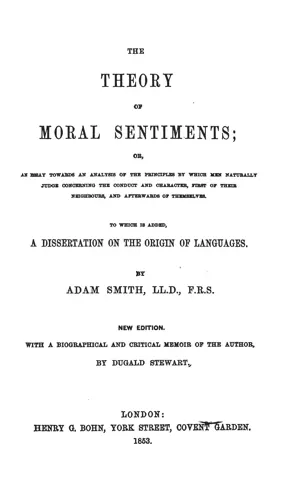
The Scottish moral philosopher Adam Smith (1723–1790) was the author of two books, *The Theory of Moral Sentiments (1759) and An Inquiry into the Nature and Causes of the Wealth of Nations* (1776).
In Part VI, Section 2, Chapter 2 of The Theory of Moral Sentiments, Smith discusses the moral tendencies that underlie the organization of society. In this chapter, Smith observes that most people tend to feel warmly towards communities in which they are members and want them to succeed. People often feel both stronger sympathy and its associated feelings of closeness with the community and cooler sentiments towards neighbouring communities against which theirs might be compared.
The most obvious community into which each of us falls is our country. But we also exist in communities within that country, “orders and societies”, which have their own interests and identities. The established powers and privileges of the national government and the orders and societies that fall underneath it make up the constitution of the country.
Smith says that although we want to defend and promote the powers, privileges, and immunities of the orders and societies in which we are members, we must also understand that the existence and flourishing of these orders and societies depend upon the success of the country as a whole.
Love for our country seems not to be related to our natural love for humanity, since we will prefer the well-being of our country to that of others even if the other country has far more people who could be made happy. Rather,
In other words, we love our country because it provided the environment in which we grew up and formed our ideas (or perhaps, if we are an immigrant, it is where we chose to live), and because its constitution supports the orders and societies in which we live.
The shared interest with our fellow citizens in the success of our country’s institutions facilitates easier sympathy and greater interest in the happiness and well-being of our fellows. It inclines us not only to buy into and obey the laws, but to try to improve the whole society. It is exactly the sort of love of country that might inspire someone to write “a very violent attack” on the commercial system of Great Britain if one thought it might make things better for their fellow Britons.
Read the passage in context, or cite the edition.
“In history a great volume is unrolled for our instruction, drawing the materials of future wisdom from the past errors and infirmities of mankind.”
Select Works of Edmund Burke, vol. 2
“We find, then, that rules of behaviour are not results of conventions at one time or other deliberately made, as people tacitly assume. Contrariwise, they are natural products of social life which have gradually evolved. Apart from detailed proofs of this, we find a general proof in their conformity to the laws of Evolution at large.”
The Principles of Sociology, vol. 2 (1898)
“These names of virtues, with their precepts, were: 1.: Temperance: Eat not to dullness; drink not to elevation. 2.: Silence: Speak not but what may benefit others or yourself; avoid trifling conversation. 3.: Order: Let all your things have their places; let each part of your business have its time. 4.: Resolution: Resolve to perform what you ought; perform without fail what you resolve. 5.: Frugality: Make no expense but to do good to others or yourself; i. e., waste nothing. 6.: Industry: Lose no time; be always employ’d in something useful; cut off all unnecessary actions. 7.: Sincerity: Use no hurtful deceit; think innocently and justly; and, if you speak, speak accordingly. 8.: Justice: Wrong none by doing injuries, or omitting the benefits that are your duty. 9.: Moderation: Avoid extreams; forbear resenting injuries so much as you think they deserve. 10.: Cleanliness: Tolerate no uncleanliness in body, cloaths, or habitation. 11.: Tranquillity: Be not disturbed at trifles, or at accidents common or unavoidable. 12.: Chastity: Rarely use venery but for health or offspring, never to dulness, weakness, or the injury of your own or another’s peace or reputation. 13.: Humility: Imitate Jesus and Socrates. (FROM: CONTINUATION OF THE ACCOUNT OF MY LIFE, BEGUN AT PASSY, NEAR PARIS, 1784)”
The Works of Benjamin Franklin, Vol. I Autobiography, Letters and Misc. Writings 1725-1734