

“But souls which are pregnant—for there certainly are men who are more creative in their souls than in their bodies—conceive that which is proper for the soul to conceive or contain. And what are these conceptions?—wisdom and virtue in general. And such creators are poets and all artists who are deserving of the name inventor. But the greatest and fairest sort of wisdom by far is that which is concerned with the ordering of states and families, and which is called temperance and justice. And he who in youth has the seed of these implanted in him and is himself inspired, when he comes to maturity desires to beget and generate. He wanders about seeking beauty that he may beget offspring—for in deformity he will beget nothing—and naturally embraces the beautiful rather than the deformed body; above all when he finds a fair and noble and well–nurtured soul, he embraces the two in one person, and to such an one he is full of speech about virtue and the nature and pursuits of a good man; and he tries to educate him; and at the touch of the beautiful which is ever present to his memory, even when absent, he brings forth that which he had conceived long before, and in company with him tends that which he brings forth; and they are married by a far nearer tie and have a closer friendship than those who beget mortal children, for the children who are their common offspring are fairer and more immortal. Who, when he thinks of Homer and Hesiod and other great poets, would not rather have their children than ordinary human ones? Who would not emulate them in the creation of children such as theirs, which have preserved their memory and given them everlasting glory?”
Philosophy
Adam Smith, Selfishness, and Sympathy
How selfish soever man may be supposed, there are evidently some principles in his nature, which interest him in the fortune of others, and render their happiness necessary to him, though he derives nothing from it except the pleasure of seeing it. (I.i.1.1)
Context
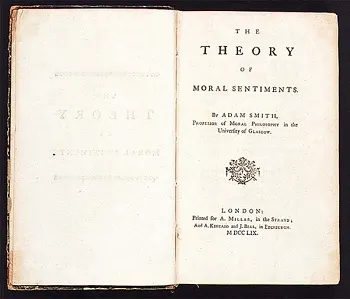
The Scottish moral philosopher Adam Smith (1723–1790) was the author of two books, The Theory of Moral Sentiments (1759) and An Inquiry into the Nature and Causes of the Wealth of Nations (1776).
Smith begins The Theory of Moral Sentiments with this famous opening paragraph:
Further thoughts
Those who are unfamiliar with Adam Smith’s first book and think of him only as the father of economics and the defence of self-serving market action may be surprised to read these lines. The apparent contradiction between Smith’s work in The Theory of Moral Sentiments and the impression that people hold of Smith as someone who promotes self-interest over concern for others is sometimes called the “Adam Smith Problem.”
Many familiar with both works see this passage as quintessentially Smithian. And everyone reading these lines may be struck by how long standing is the concern that people are essentially selfish.
The Theory of Moral Sentiments builds on this observation. The book details Smith’s moral sentimentalism, which roots his theories of morality and moral psychology in observations of the emotions that people experience as members of society.
For Smith, people learn to be moral through the development of a moral sense. Beginning in childhood and through repeated experience, we develop rules for how to behave based on our reactions to each other. Over time, these rules form guidelines for proper conduct and morality. This is in sharp contrast to the idea that people are inherently selfish, and builds on the theories of his friend David Hume and his teacher Francis Hutchenson.
Visit our sister site, AdamSmithWorks for a classroom bellringer based on this quote and a comic based on these lines.
More on Philosophy
- Philosophy
- Philosophy
“Hence it is evident that the state is a creation of nature, and that man is by nature a political animal. And he who by nature and not by mere accident is without a state, is either above humanity, or below it; he is the ‘Tribeless, lawless, hearthless one,’ whom Homera denounces—the outcast who is a lover of war; he may be compared to a bird which flies alone.”
- Philosophy
“The Specters may impose on us, whilst we refuse to turn ’em every way, and view their Shapes and Complexions in every light. For that which can be shewn only in a certain Light, is questionable. Truth, ’tis suppos’d, may bear all Lights: and one of those principal Lights or natural Mediums, by which Things are to be view’d, in order to a thorow Recognition, is Ridicule it-self, or that Manner of Proof by which we discern whatever is liable to just Raillery in any Subject. So much, at least, is allow’d by All, who at any time appeal to this Criterion. The gravest Gentlemen, even in the gravest Subjects, are suppos’d to acknowledg this: and can have no Right, ’tis thought, to deny others the Freedom of this Appeal; whilst they are free to censure like other Men, and in their gravest Arguments make no scruple to ask, Is it not Ridiculous? (FROM: PART I, SECTION I)”
Anthony Ashley Cooper, Earl of Shaftesbury: Shaftesbury on Raillery and Truth
Characteristicks of Men, Manners, Opinions, Times, vol. 1


