“The College breaks up in the beginning of June and does not sit down again till the beginning of October. During this interval I propose that he should learn french and Dancing and fencing and that besides he should read with me the best greek, latin and french Authors on Moral Philosophy for two or three hours every morning, so that he will not be idle in the vacation.”
Education
Adam Smith on compulsory attendance in the classroom (1776)
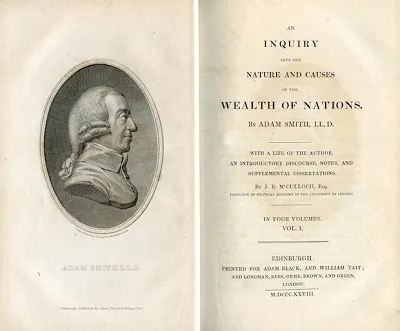
The discipline of colleges and universities is in general contrived, not for the benefit of the students, but for the interest, or more properly speaking, for the ease of the masters. Its object is, in all cases, to maintain the authority of the master, and whether he neglects or performs his duty, to oblige the students in all cases to behave to him as if he performed it with the greatest diligence and ability. It seems to presume perfect wisdom and virtue in the one order, and the greatest weakness and folly in the other. Where the masters, however, really perform their duty, there are no examples, I believe, that the greater part of the students ever neglect theirs. No discipline is ever requisite to force attendance upon lectures which are really worth the attending, as is well known wherever any such lectures are given.

Context
Here Adam Smith (1723-1790) argues that the use of compulsion in schools is used primarily for the benefit of the teacher and the administration, not the students. Good lectures are usually well attended:
Further thoughts
Adam Smith has some sharp words to say on the matter of compulsory attendance at school. The "force and restraint" which is common for schools to use to require attendance in the classroom is, in his view, primarily for the benefit of the "master" and is designed to "pardon a great deal of incorrectness in the performance of his duty" and "to conceal from the publick a good deal of gross negligence." As an experienced teacher himself, he knows that the best way to encourage attendance is to give good lectures. The only exception to this principle are those children aged less than 13 who might require additional "incentives" to attend classes.
Found in
Read the passage in context, or cite the edition.
More on Education
- Education
- Education
“The reading of these speeches added much to my limited stock of language, and enabled me to give tongue to many interesting thoughts which had often flashed through my mind and died away for want of words in which to give them utterance. The mighty power and heart-searching directness of truth penetrating the heart of a slave-holder, compelling him to yield up his earthly interests to the claims of eternal justice, were finely illustrated in the dialogue; and from the speeches of Sheridan I got a bold and powerful denunciation of oppression and a most brilliant vindication of the rights of man. Here was indeed a noble acquisition. If I had ever wavered under the consideration that the Almighty, in some way, had ordained slavery, and willed my enslavement for His own glory, I wavered no longer. I had now penetrated to the secret of all slavery and all oppression, and had ascertained their true foundation to be in the pride, the power, and the avarice of man. With a book in my hand so redolent of the principles of liberty, with a perception of my own human nature, and the facts of my past and present experience, I was equal to a contest with the religious advocates of slavery, whether white or black,—for blindness in this matter was not confined to the white people.”
Frederick Douglass: The ex-slave Frederick Douglass reveals that reading speeches by English politicians produced in him a deep love of liberty and hatred of oppression (1882)
The Life and Times of Frederick Douglass: From 1817-1882
- Education
“... despite their differences the Revolutionary generation did achieve independence, they did write a number of strikingly similar state constitutions, and they did draft and put into operation the federal Constitution. What underlay and made possible these monumental accomplishments, however, was not a universally accepted set of philosophical principles. Rather, I suggest, most Americans shared a common matrix of ideas and assumptions about government and society, about liberty and property, about politics and law. These ideas and assumptions, together with the belief (however inaccurate) that they shared a common historical heritage, made their achievements possible. They derived those ideas and assumptions, as well as their perception of their heritage, from a variety of sources, but the principal wellspring was the printed word. [Reading Habits of Early Americans]”
Forrest McDonald: Forrest McDonald discusses the reading habits of colonial Americans and concludes that their thinking about politics and their shared values was based upon their wide reading, especially of history (1978)
Literature of Liberty, January/March 1978, vol. 1, No. 1