

The Online Library of Liberty

Search the library

Press Enter to see all results. Esc closes.

Economics

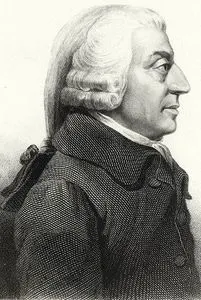
Adam Smith on the Butcher, the Brewer, and the Baker

It is not from the benevolence of the butcher, the brewer, or the baker, that we expect our dinner, but from their regard to their own interest. We address ourselves, not to their humanity but to their self-love, and never talk to them of our own necessities but of their advantages. Nobody but a beggar chuses to depend chiefly upon the benevolence of his fellow-citizens. Even a beggar does not depend upon it entirely. The charity of well-disposed people, indeed, supplies him with the whole fund of his subsistence. But though this principle ultimately provides him with all the necessaries of life which he has occasion for, it neither does nor can provide him with them as he has occasion for them. The greater part of his occasional wants are supplied in the same manner as those of other people, by treaty, by barter, and by purchase. With the money which one man gives him he purchases food. The old cloaths which another bestows upon him he exchanges for other old cloaths which suit him better, or for lodging, or for food, or for money, with which he can buy either food, cloaths, or lodging, as he has occasion.

— Adam Smith, An Inquiry Into the Nature and Causes of the Wealth of Nations (Cannan ed.), vol. 1

Context

Further thoughts

  • Economics
    “One argument used by a very enlightened member of Parliament, during a late discussion on the rate of interest charged by the Bank, was rather a singular one: he said that the Bank of France, and other banks on the Continent, lent at a low rate, and therefore the Bank of England should do so. I can see no connexion between his premises and conclusion. The Bank of France ought to be governed by the market rate of interest and the rate of profits in France; the Bank of England by the market rate of interest and the rate of profit in England. One may be very different from the other. From the whole of his argument, I should infer that he considered a low rate of interest, in itself, beneficial to a country. The very contrary, I imagine, is the truth. A low rate of interest is a symptom of a great accumulation of capital; but it is also a symptom of a low rate of profits, and of an advancement to a stationary state; at which the wealth and resources of a country will not admit of increase. As all savings are made from profits, as a country is most happy when it is in a rapidly progressive state, profits and interest cannot be too high. It would be a poor consolation, indeed, to a country for low profits and low interest, that landlords were enabled to raise money on mortgage with diminished sacrifices. Nothing contributes so much to the prosperity and happiness of a country as high profits. (FROM: ON PROTECTION TO AGRICULTURE: Section V.: On the Effect produced on the Price of Corn by Mr Peel's Bill for restoring the Ancient Standard.)”

    David Ricardo: David Ricardo and the Happiness of a Country

    The Works of David Ricardo (McCulloch ed. 1846, 1888)

  • Economics
    “Motivating nearly all behavior is the inevitable existence of “scarcity”—simply put, our wants and desires exceed what is available to satisfy them. Most of what you enjoy is acquired by your efforts, accompanied by strain, sweat, and anxiety. However, no matter how successful are your efforts, you want even more. (FROM: SCARCITY)”
  • Economics
    “A right of free speech is not an “economically free” right. It uses scarce resources. “Free speech” means the right to communicate with your own resources to other willing listeners—without political intervention about what you say. I can’t force you to hear or read my “speech” any more than I can force you to give me your wealth. I can’t take property of others to communicate, nor can I regard the attention of other people as “free” to me. I must use my own, or rented, resources to communicate, and then only to willing persons. Both these critical features, (1) use of one’s owned or rented resources by the speaker and (2) a willing listener, are often ignored. (FROM: ALERT! FREE SPEECH IS NOT “FREE RESOURCES”)”