
Society
“In history a great volume is unrolled for our instruction, drawing the materials of future wisdom from the past errors and infirmities of mankind.”
Edmund Burke: Edmund Burke on Learning from Past Errors
Select Works of Edmund Burke, vol. 2

Society
This disposition to admire, and almost to worship, the rich and the powerful, and to despise, or, at least, to neglect persons of poor and mean condition, though necessary both to establish and to maintain the distinction of ranks and the order of society, is, at the same time, the great and most universal cause of the corruption of our moral sentiments. (TMS I.iii.3.1)
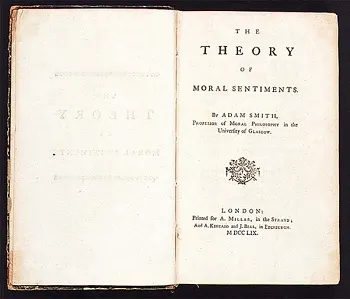
The Scottish moral philosopher Adam Smith (1723–1790) was the author of two books, The Theory of Moral Sentiments (1759) and An Inquiry into the Nature and Causes of the Wealth of Nations (1776).
Smith’s Theory of Moral Sentiments lays out the way Smith believes we learn (and build) systems of morality. For Smith, people learn to be moral through the development of a moral sense. Beginning in childhood and through repeated experience, we develop rules for how to behave based on our reactions to each other. Over time, these rules form guidelines for proper conduct and morality.
Smith says that we want others to react with sympathy to our actions, and that we enjoy sympathizing with the reactions of others. Because our moral system is based on observation of others, says Smith, it encourages a preference for observable traits.
Because “it is agreeable to sympathize with joy” (TMS I.iii.1.5), people tend to look favourably on those whose lives seem pleasant. Because they look favourably on such circumstances, they seek them for themselves so that others will look favourably upon them, too. In contrast, it’s unpleasant to sympathize with sorrow, and for strangers, who cannot offer the comfort of friendship, to witness our pain or misfortune.
Smith believes that this encourages us to look with undue approbation on those whose success and status are obvious to the world, and to hide in shame when we are in poverty or misfortune. In Part 1, section 3, chapter 3 of Theory of Moral Sentiments, Smith writes:
It’s clear that Smith believes that although this disposition is natural, it is bad. People will be more likely to give attention and approbation to powerful people than they are to give similar attention to people who are generous, wise, and just, even though those traits are morally relevant, while power is not.
Smith also believes that this tendency supports hierarchies such as the aristocracy, or perhaps simply the authority of government officials. In Smith’s time, the aristocracy was the order through which society was governed. Whether Smith believed that this was the best way for ordering society or simply the way his society was ordered is something scholars continue to debate today.
Visit our sister site, AdamSmithWorks for a classroom bellringer based on this quote.
“In history a great volume is unrolled for our instruction, drawing the materials of future wisdom from the past errors and infirmities of mankind.”
Select Works of Edmund Burke, vol. 2
“We find, then, that rules of behaviour are not results of conventions at one time or other deliberately made, as people tacitly assume. Contrariwise, they are natural products of social life which have gradually evolved. Apart from detailed proofs of this, we find a general proof in their conformity to the laws of Evolution at large.”
The Principles of Sociology, vol. 2 (1898)
“These names of virtues, with their precepts, were: 1.: Temperance: Eat not to dullness; drink not to elevation. 2.: Silence: Speak not but what may benefit others or yourself; avoid trifling conversation. 3.: Order: Let all your things have their places; let each part of your business have its time. 4.: Resolution: Resolve to perform what you ought; perform without fail what you resolve. 5.: Frugality: Make no expense but to do good to others or yourself; i. e., waste nothing. 6.: Industry: Lose no time; be always employ’d in something useful; cut off all unnecessary actions. 7.: Sincerity: Use no hurtful deceit; think innocently and justly; and, if you speak, speak accordingly. 8.: Justice: Wrong none by doing injuries, or omitting the benefits that are your duty. 9.: Moderation: Avoid extreams; forbear resenting injuries so much as you think they deserve. 10.: Cleanliness: Tolerate no uncleanliness in body, cloaths, or habitation. 11.: Tranquillity: Be not disturbed at trifles, or at accidents common or unavoidable. 12.: Chastity: Rarely use venery but for health or offspring, never to dulness, weakness, or the injury of your own or another’s peace or reputation. 13.: Humility: Imitate Jesus and Socrates. (FROM: CONTINUATION OF THE ACCOUNT OF MY LIFE, BEGUN AT PASSY, NEAR PARIS, 1784)”
The Works of Benjamin Franklin, Vol. I Autobiography, Letters and Misc. Writings 1725-1734