

The Online Library of Liberty

Search the library

Press Enter to see all results. Esc closes.

Money & Banking

Adam Smith on money as an instrument of commerce as well as a measure of value

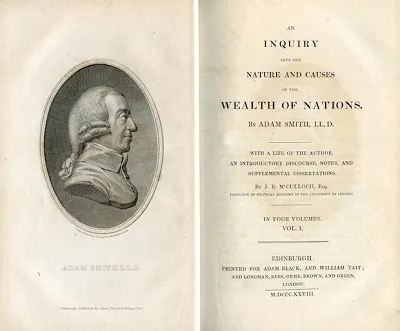
That wealth consists in money, or in gold and silver, is a popular notion which naturally arises from the double function of money, as the instrument of commerce, and as the measure of value. In consequence of its being the instrument of commerce, when we have money we can more readily obtain whatever else we have occasion for, than by means of any other commodity. The great affair, we always find, is to get money. When that is obtained, there is no difficulty in making any subsequent purchase. In consequence of its being the measure of value, we estimate that of all other commodities by the quantity of money which they will exchange for. We say of a rich man that he is worth a great deal, and of a poor man that he is worth very little money. A frugal man, or a man eager to be rich, is said to love money; and a careless, a generous, or a profuse man, is said to be indifferent about it. To grow rich is to get money; and wealth and money, in short, are, in common language, considered as in every respect synonymous. (IV.i.1) - Adam Smith

— Adam Smith, An Inquiry Into the Nature and Causes of the Wealth of Nations (Cannan ed.), vol. 2

Context

Further thoughts

More on Money & Banking

  • Money & Banking
    “It is worthy of observation, that every case of failure in finances, since the system of paper began, has produced a revolution in governments, either total or partial. A failure in the finances of France produced the French revolution. A failure in the finance of the assignats broke up the revolutionary government, and produced the present French Constitution. A failure in the finances of the Old Congress of America, and the embarrassments it brought upon commerce, broke up the system of the old confederation, and produced the federal Constitution. If, then, we admit of reasoning by comparison of causes and events, the failure of the English finances will produce some change in the government of that country.”
  • Money & Banking
    “Economics recommends neither inflationary nor deflationary policy. It does not urge the governments to tamper with the market’s choice of a medium of exchange. It establishes only the following truths: 1. By committing itself to an inflationary or deflationary policy a government does not promote the public welfare, the commonweal, or the interests of the whole nation. It merely favors one or several groups of the population at the expense of other groups. 2. It is impossible to know in advance which group will be favored by a definite inflationary or deflationary measure and to what extent. These effects depend on the whole complex of the market data involved. They also depend largely on the speed of the inflationary or deflationary movements and may be completely reversed with the progress of these movements. 3. At any rate, a monetary expansion results in misinvestment of capital and overconsumption. It leaves the nation as a whole poorer, not richer. These problems are dealt with in Chapter 20. 4. Continued inflation must finally end in the crack-up boom, the complete breakdown of the currency system. 5. Deflationary policy is costly for the treasury and unpopular with the masses. But inflationary policy is a boon for the treasury and very popular with the ignorant. Practically, the danger of deflation is but slight and the danger of inflation tremendous.”
  • Money & Banking
    “The principle of sound money that guided nineteenth-century monetary doctrines and policies was a product of classical political economy. It was an essential part of the liberal program as developed by eighteenth-century social philosophy and propagated in the following century by the most influential political parties of Europe and America...It is impossible to grasp the meaning of the idea of sound money if one does not realize that it was devised as an instrument for the protection of civil liberties against despotic inroads on the part of governments. Ideologically it belongs in the same class with political constitutions and bills of rights. The demand for constitutional guarantees and for bills of rights was a reaction against arbitrary rule and the nonobservance of old customs by kings. The postulate of sound money was first brought up as a response to the princely practice of debasing the coinage. It was later carefully elaborated and perfected in the age which—through the experience of the American continental currency, the paper money of the French Revolution and the British restriction period—had learned what a government can do to a nation’s currency system... Thus the sound-money principle has two aspects. It is affirmative in approving the market’s choice of a commonly used medium of exchange. It is negative in obstructing the government’s propensity to meddle with the currency system.”