Adam Smith and our Propensity to Deceive rather than to Think ill of Ourselves
The opinion which we entertain of our own character depends entirely on our judgments concerning our past conduct. It is so disagreeable to think ill of ourselves, that we often purposely turn away our view from those circumstances which might render that judgment unfavourable. He is a bold surgeon, they say, whose hand does not tremble when he performs an operation upon his own person; and he is often equally bold who does not hesitate to pull off the mysterious veil of self-delusion, which covers from his view the deformities of his own conduct. Rather than see our own behaviour under so disagreeable an aspect, we too often, foolishly and weakly, endeavour to exasperate anew those unjust passions which had formerly misled us; we endeavour by artifice to awaken our old hatreds, and irritate afresh our almost forgotten resentments: we even exert ourselves for this miserable purpose, and thus persevere in injustice, merely because we once were unjust, and because we are ashamed and afraid to see that we were so. (TMS III.iv.4)
Context
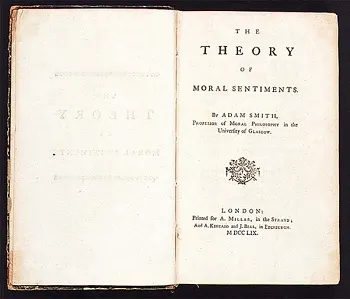
The Scottish moral philosopher Adam Smith (1723–1790) was the author of two books, The Theory of Moral Sentiments (1759) and An Inquiry into the Nature and Causes of the Wealth of Nations (1776).
In his discussion of how people judge themselves in Part 3, chapter 4 of The Theory of Moral Sentiments, Smith writes:
Further thoughts
In this section, Smith discusses how general rules of morality are formed and when and why those rules are needed.
Smith advocates the cultivation of our “impartial spectator”—a sense of how we ought to be judged by someone who isn’t rooting for or against us. But strong emotions can make it impossible to step back and judge ourselves more cooly, leading us to act in ways that, once the emotion has passed, we would rather not have acted.
Our wish not to be blameworthy is so strong that, as Smith notes in the above quotation, when we do make mistakes we are more inclined to defend ourselves than to admit that we’ve behaved badly. We may even try to replicate the emotions that overtook our best judgement so as to more easily sympathize with the version of us that made the mistake than the impartial spectator who would condemn it. If Smith is right, this describes an especially bleak problem with morality if a lot of people make mistakes.
Moral rules emerge based on our reactions and observations of the reactions of others to the decisions made by those around us. Smith says that people naturally form these rules in order to avoid making moral mistakes. Even when our emotions are too strong for sympathy to point us in the right direction, a general rule, especially if it’s become habitual, can sometimes break through the passionate throes of emotion, as well as guiding those who simply lack the proper sentiments. Regard for and observation of moral rules is what Smith calls a sense of Duty—the overarching topic of Part 3 of The Theory of Moral Sentiments.
Visit our sister site, AdamSmithWorks for a classroom bellringer based on this quote.