

Thomas Robert Malthus
1766–1834 · 5 titles


Economics
13 items in this collection
In the late 18th and early 19th centuries a debate arose over the impact that rapidly increasing population would have on the standard of living. The pessimistic school, represented by Malthus, argued that population would inevitably increase at a geometric rate, whilst agricultural output would only increase arithmetically. Thus, the standard of living of ordinary people would suffer unless they practised some kiind of family planning and restraint. The optimists, many of whom were free market economists, argued that human ingenuity, more scientific agricultural practises, and efficiencies of the free market would cope with expanding populations and that, in fact, life would get much better for ordinary people.
In this collection
7 titles, earliest first.
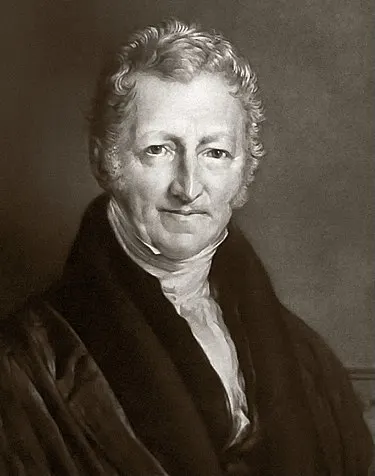
Thomas Robert Malthus · 1798
This is the first edition of Malthus’s Essay on the Principle of Population. In this work Malthus argues that there is a disparity between the rate of growth of population (which increases geometrically) and the rate of…
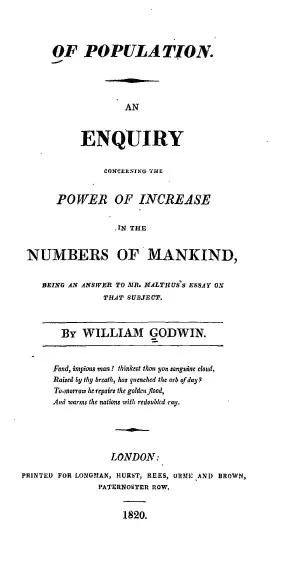
William Godwin · 1820
A lengthy and belated reply to Malthus by the radical individualist Godwin. Whereas Malthus took a pessimistic view of the pressures of population growth, Godwin was more optimistic about the capacity of people to limit…
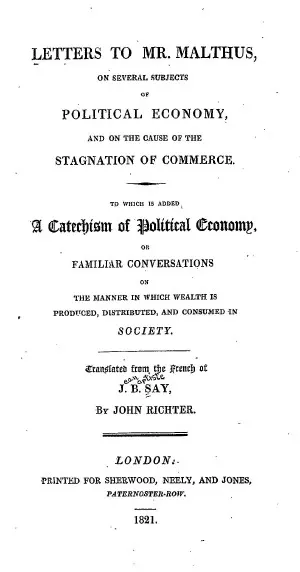
Jean-Baptiste Say · 1821
Say replies to Malthus’s negative views about the impact of population on the well-being of workers, and provides a popularization of his economic views.
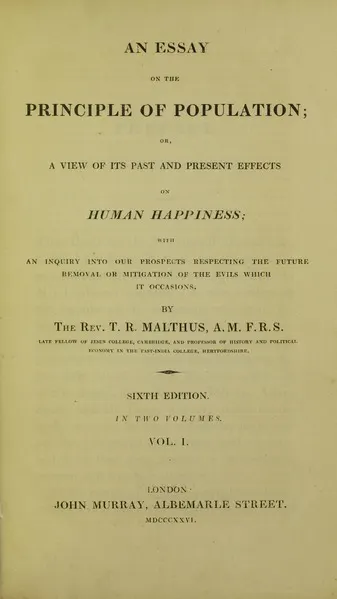
Thomas Robert Malthus · 1826
This is the 6th expanded edition of Essay on the Principle of Population. In this work Malthus argues that there is a disparity between the rate of growth of population (which increases geometrically) and the rate of…
Thomas Robert Malthus · 1826
Vol. 1 of the 6th expanded edition of Essay on the Principle of Population. In this work Malthus argues that there is a disparity between the rate of growth of population (which increases geometrically) and the rate of…
Thomas Robert Malthus · 1826
Vol. 2 of the 6th expanded edition of Essay on the Principle of Population. In this work Malthus argues that there is a disparity between the rate of growth of population (which increases geometrically) and the rate of…
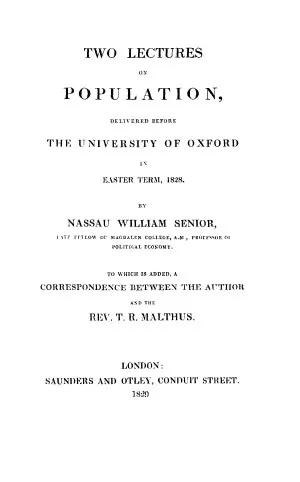
Thomas Robert Malthus · 1829
Senior generally agrees with Malthus on population but there are some differences which are brought out in the correspondence between them.
In this collection
Authors, editors and translators of these titles, most titles first.
1766–1834 · 5 titles

1767–1832 · 1 title
1 title

1790–1864 · 1 title

1756–1836 · 1 title
Passages on this subject, chosen by OLL editors.
As you may recall, Dicey dates the change in public opinion in Britain away from individualism and toward collectivism at about 1870-90. Dicey answers his question by essentially reversing it, saying that in its original form, it may be a foolish question. Perhaps the relevant question is not why people turned away from individualism toward collectivism, but how they were induced to accept the queer notion of individualism in the first place. The argument for a free society, he goes on to say, is a very subtle and sophisticated argument. At every point, it depends on the indirect rather than the direct effect of the policy followed. If one is concerned to remedy clear evils in a society, as everyone is, the natural reaction is to say, “let’s do something about it,” and the “us” in this statement will in a large number of cases be translated into the “government,” so the natural reaction is to pass a law. The argument that maybe the attempt to correct this particular evil by extending the hand of the government will have indirect effects whose aggregate consequences may be far worse than any direct benefits that flow from the action taken is, after all, a rather sophisticated argument. And yet, this is the kind of argument that underlies a belief in a free or laisser-faire society. (FROM: Is a Free Society Stable?) - Milton Friedman
Economic theory. Demography
473 titles · 88 publications · 293 people

Economics
47 titles · 1 publication · 51 people
Economics
36 titles · 8 publications · 46 people
Economics
31 titles · 24 people · 4 quotes

Economics
30 titles · 7 publications · 32 people

Economics
13 titles · 24 people · 8 quotes