


Author
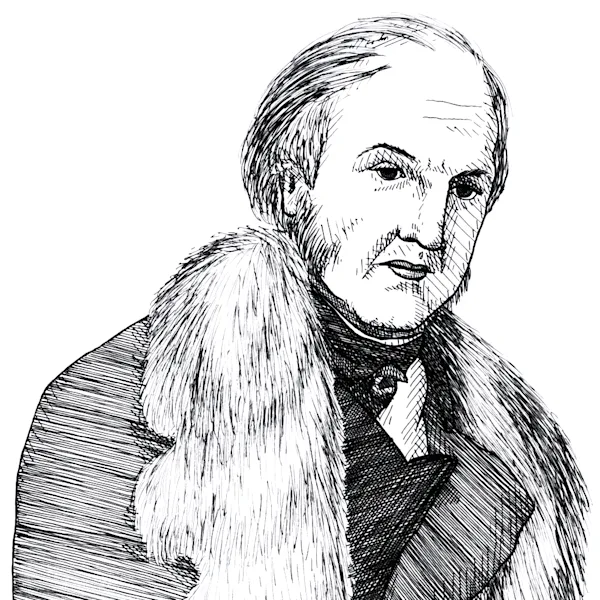
Nassau William Senior
1790–1864
Nassau W. Senior (1790-1864) was a British economist who taught at Oxford University and worked on the marginal aspects of inputs to production. He argued that capital accumulation is a cost of production, and drew careful distinctions between wealth and welfare. His contributions to the Whig party as an advisor included arguments about work hours and wages. Along with Edwin Chadwick, he wrote the revised Poor Law Commissioners’ Report of 1834.
Biography
Nassau W. Senior (1790-1864) was a British economist who taught at Oxford University and worked on the marginal aspects of inputs to production. He argued that capital accumulation is a cost of production, and drew careful distinctions between wealth and welfare. His contributions to the Whig party as an advisor included arguments about work hours and wages. Along with Edwin Chadwick, he wrote the revised Poor Law Commissioners’ Report of 1834.
Works by Nassau William Senior
10 titles in the library
Nassau William Senior · 1830
Three Lectures on the Cost of Obtaining Money
Senior gave these lectures at the University of Oxford in Trinity Term 1829. The Third Lecture is on "Some Effects of Government Paper Money" and deals with a number of historical episodes of hyper inflation.
Nassau William Senior · 1837
Letters on the Factory Act
A collection of letters written by Senior on the Factory Act along with replies by Horner, Ashworth, and Thomson.
Nassau William Senior · 1850
Political Economy (1850 ed.)
This work is a summary statement of the nature of economic thought by one of the leading theorists of the English classical school in the mid-19th century.
Nassau William Senior · 1872
Correspondence and Conversations of Alexis de Tocqueville with Nassau William Senior from 1834-1859, vol. 2 (1834-1851)
Volume 2 of a two volume collection of journal entries and letters between Tocqueville and Nassau Senior between 1834 and 1859. Vol. 2 contains material from 1851 and 1859.
Nassau William Senior · 1872
Correspondence and Conversations of Alexis de Tocqueville with Nassau William Senior from 1834-1859, 2 vols. (1872)
A two volume collection of journal entries and letters between Tocqueville and Nassau Senior between 1834 and 1859. Vol. 1 contains material from 1834 to 1851. Vol. 2 contains material from 1851 to 1859.
Nassau William Senior · 1852
Four Introductory Lectures on Political Economy
Four lectures on political economy which Senior gave at the University of Oxford in 1847. They cover the retardation of the progress of political economy, political economy as a “mental study” and as a positive science.
Nassau William Senior · 1828
Three Lectures on the Transmission of Precious Metals
In a rather grumpy “advertisement” Senior tells us that he rather unwillingly had to give a formal lecture as Professor of Political Economy at Oxford University and have it published. The books contains a lecture on…
Thomas Robert Malthus · 1829
Two Lectures on Population
Senior generally agrees with Malthus on population but there are some differences which are brought out in the correspondence between them.
Nassau William Senior · 1834
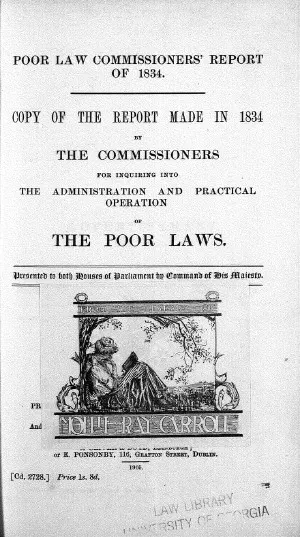
Poor Law Commissioners’ Report of 1834
A path-breaking British Parliamentary report, primarily written by Nassau Senior and Edwin Chadwick, into the state of public charity in Britain. It was one of the key pieces of reformist legislation during the…
Nassau William Senior · 1830
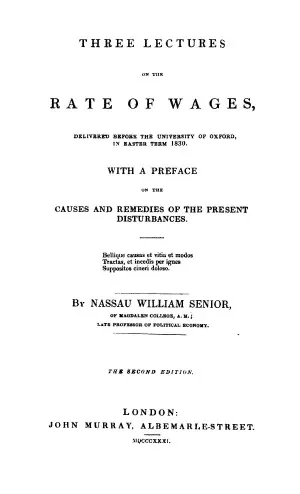
Three Lectures on the Rate of Wages
Lectures given by Senior at the University of Oxford in 1830 to offer insights into the cause and solution of recent rioting by labourers in England.
Quotes from Nassau William Senior
3 quotes from the library