

H.B. Acton
1908–1974
H.B. Acton (1908-1974) taught at Bedford College (London), the University of Edinburgh, and the University of Chicago; was editor of…


Economics
58 items in this collection
Modern socialism emerged in the 1830s and 1840s in France and England at a time when classical liberalism was beginning to have an impact with reforms such as the First Electoral Reform Act of 1832 and the success of the Anti-Corn Law League. The success of socialist ideas in the revolutions of 1848 meant that classical liberals increasingly had to turn their attention to combatting calls for government intervention in the economy from the "Left" as Frederic Bastiat did in the last few years of his life. As classical liberalism began to decline in the late 19th century it fell to a handful of radical individualists like Thomas Mackay and Herbert Spencer to oppose the gradualist, Fabian school of socialism in Britain, and to strict laissez-faire advocates like Eugen Richter in the German parliament. It was only after the rise of the Bolsheviks to power in Russia after the First World War that the most coherent and devastating critique of socialism appeared in the work of Ludwig von Mises and later in that of Friedrich Hayek.
In this collection
36 titles, earliest first.
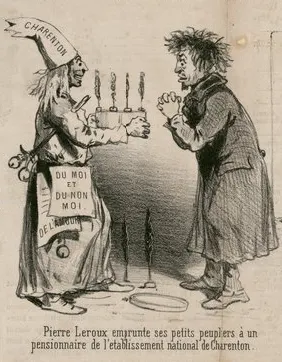
Amédée de Noé · 1848
A panel of six anti-socialist cartoons which ridicules the ideas of Pierre-Joseph Proudhon, Pierre Leroux, Étienne Cabet, Victor Considerant, Alexandre Auguste Ledru-Rollin, and Louis Napoléon Bonaparte.
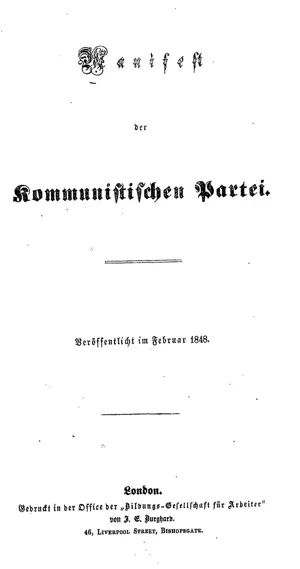
Friedrich Engels · 1848
Written in late 1847 and published during the February Revolution in 1848, this pamphlet outlines Marx's theory of history and his demands for revolution and the dictatorship of the proletariat.
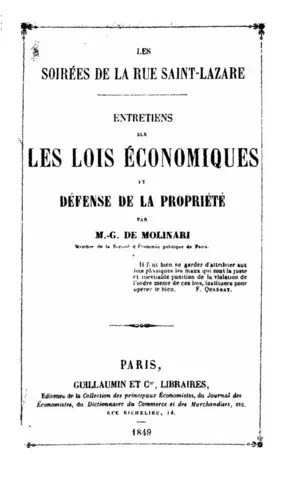
Gustave de Molinari · 1849
Following the rise of socialism in France during the 1840s and the 1848 Revolution, Molinari wrote this fictitious “dialogue” between an economist, a conservative, and a socialist, to expose the folly of socialism,…
John Stuart Mill · 1850
Vol. 5 of the 33 vol. Collected Works contains a number of Mill’s essays on economic topics, including the Chapters on Socialism.
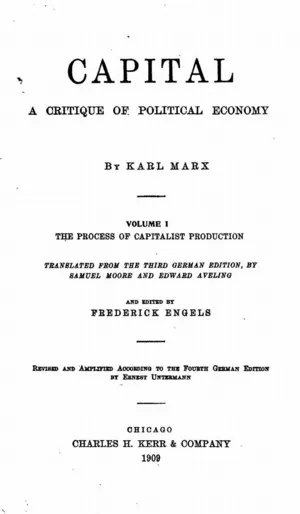
Karl Marx · 1867
Vol. I of the major work of criticism of the capitalist system by one of the leading theorists of socialism. Only vol. 1 appeared in Marx’s lifetime; the other two vols. were published postumously by Engels. Marx prided…
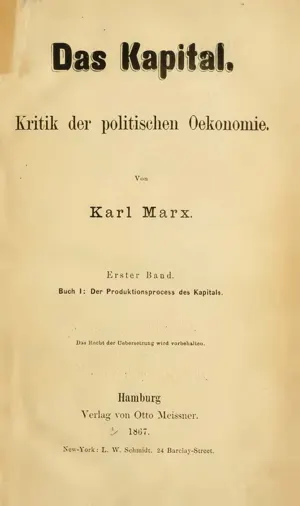
Karl Marx · 1867
This is the first German edition of volume 1 of Karl Marx’s multi-volume work Das Kapital. Kritik der politischen Ökonomie which appeared between 1867 and 1894. Only this volume appeared in Marx’s lifetime. The others…
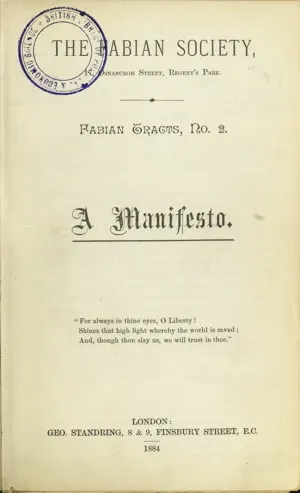
George Bernard Shaw · 1884
The “Fabian Society” was founded in England in 1884 with the aim of bringing about a socialist society by means of intellectual debate, the publication of books and pamphlets, and the “permeation” of socialist ideas…

Herbert Spencer · 1884
This volume contains the four essays that Spencer published as The Man Versus the State in 1884 as well as five essays added by later publishers. In addition, it provides “The Proper Sphere of Government,” an important…
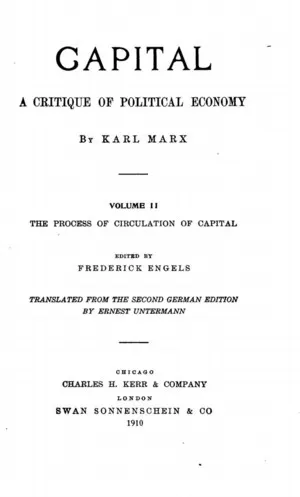
Karl Marx · 1885
Vol. II of the major work of criticism of the capitalist system by one of the leading theorists of 19th century socialism. Only vol. 1 appeared in Marx’s lifetime; the other two vols. were published postumously by…
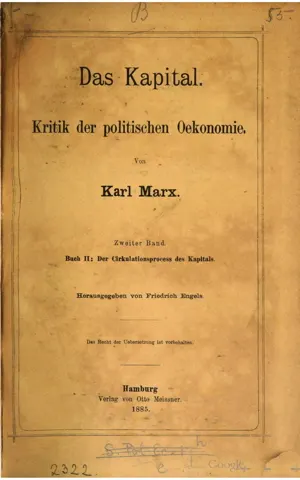
Karl Marx · 1885
This is the first German edition of volume 2 of Karl Marx’s multi-volume work Das Kapital. Kritik der politischen Ökonomie (1867-1894) which appeared in 1885. Here we have a facsimile PDF of the 1885 edition. An HTML…
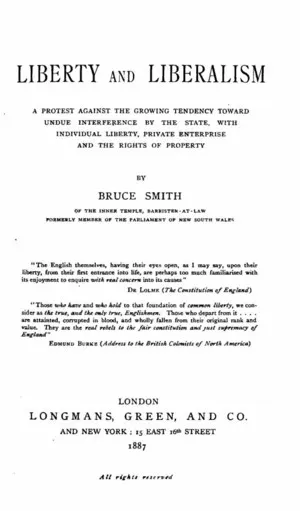
Bruce Smith · 1887
Smith was a follower of Herbert Spencer and the English Liberty and Property Defence League. His book is a critique of the growing intervention of the state in economic and civil matters in Australia and elsewhere in…
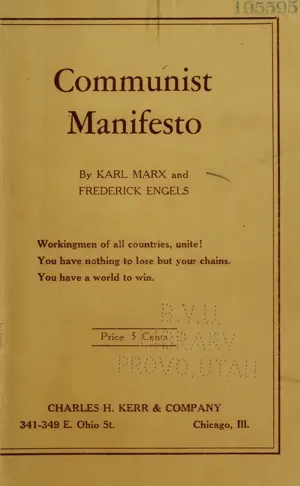
Friedrich Engels · 1888
The classic late-19th century translation of the Communist Manifesto done with the assistance of Engels. See also: - the German original - an HTML version of the English translation
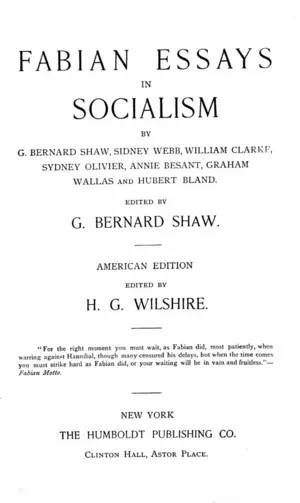
George Bernard Shaw · 1889
This collection of essays by the so-called "Fabian Socialists" (who advocated socialism by means of gradual political and economic reform instead of by revolution as preferred by the Marxists) prompted a vigorous…
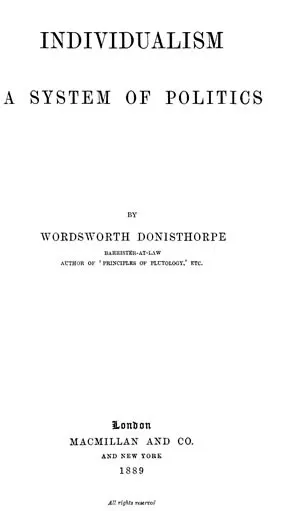
Wordsworth Donisthorpe · 1889
Donisthorpe provides a theory of politics from the individualist standpoint in the tradition of Herbert Spencer and Auberon Herbert. He also attacks the rise of socialism which he regards as the greatest threat to…
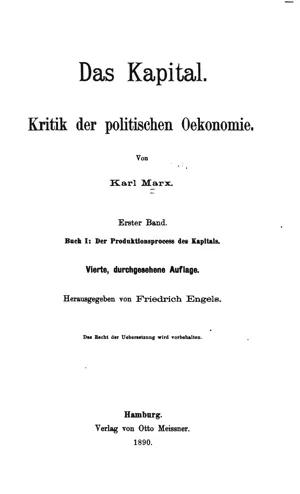
Karl Marx · 1890
This is the fourth German edition of volume 1 of Karl Marx’s multi-volume work Das Kapital. Kritik der politischen Ökonomie (1867-1894) which appeared in 1890. Only this volume appeared in Marx’s lifetime - see the…
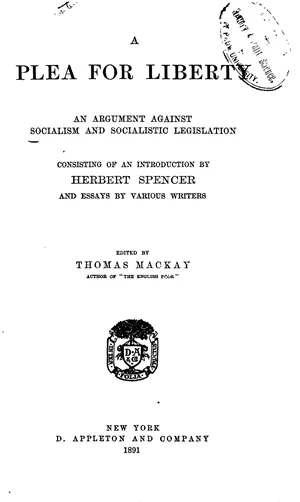
Auberon Herbert · 1891
This collection of essays was originally published in 1891 in response to a collection of Fabian Essays on Socialism which advocated policies which would eventually lead to the modern welfare state. The theoretical and…

Thomas Mackay · 1891
This collection of essays was originally published in 1891 in response to a collection of Fabian Essays on Socialism which advocated policies which would eventually lead to the modern welfare state. The theoretical and…
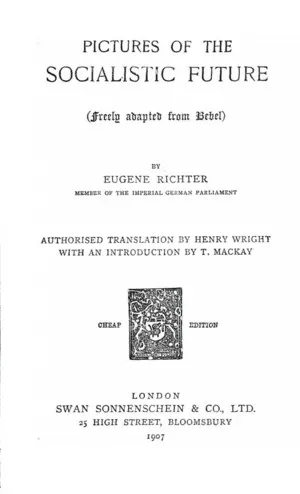
Eugen Richter · 1893
Pictures of the Socialistic Future is Richter’s satire of what would happen to Germany if the socialism espoused by the trade unionists, social democrats, and Marxists was actually put into practice. It is thus a late…
Yves Guyot · 1893
One of several books Guyot wrote attacking socialism in the late 19th and early 20th centuries. In this volume, in the tradition of Bastiat, he criticises what he calls “socialistic sophisms,” socialistic legislation,…
Thomas Mackay · 1894
The companion volume to A Plea for Liberty which continued the argument against the Fabian Socialists and for a policy of strict non-intervention in the economy by the government.
Karl Marx · 1894
Vol. III of the major work of criticism of the capitalist system by one of the leading theorists of socialism. Only vol. 1 appeared in Marx’s lifetime; the other two vols. were published postumously by Engels. Marx…
Karl Marx · 1894
This is a German edition of volume 3 part 1 of Karl Marx’s multi-volume work Das Kapital. Kritik der politischen Ökonomie (1867-1894) which appeared in 1894. Here we have a facsimile PDF of the 1894 edition. An HTML…
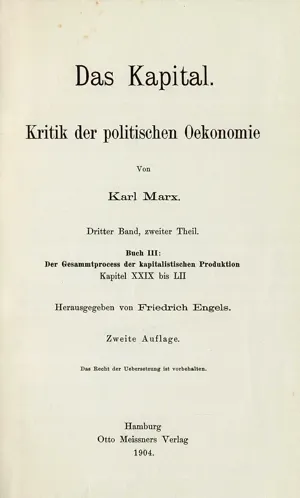
Karl Marx · 1894
This is a German edition of volume 3 part 2 of Karl Marx’s multi-volume work Das Kapital. Kritik der politischen Ökonomie (1867-1894) which appeared in 1894. Here we have a facsimile PDF of the 1894 edition. An HTML…
Karl Marx · 1895
This is a German edition of Karl Marx’s multi-volume work Das Kapital. Kritik der politischen Ökonomie which appeared between 1867 and 1894. Only the first volume appeared in Marx’s lifetime. The others were edited and…
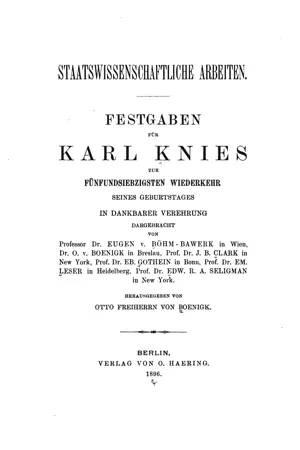
1896
The German original of Böhm-Bawerk's devastating review of Karl Marx's Das Kapital volume 3 which had appeared posthumously in 1894. An HTML version of his essay can found here. An English translation of this can be…
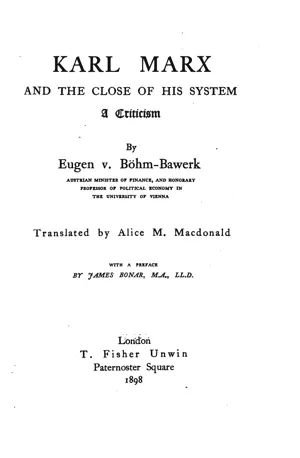
Eugen von Böhm-Bawerk · 1898
A translation of Böhm-Bawerk's devastating review of Karl Marx's Das Kapital vol. 3 which had been published posthumously in 1894 by Engels. An HTML version of the text can be found here. The German language original…
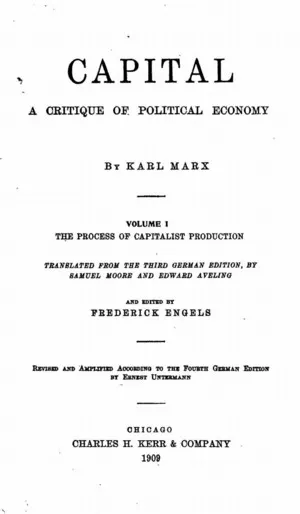
Karl Marx · 1909
A three volume criticism of the capitalist system by one of the leading theorists of socialism. Only vol. 1 appeared in Marx’s lifetime (1867); the other two vols. were published posthumously by Engels (1885, 1894).…
Yves Guyot · 1910
Guyot wrote sseveral books attacking socialism in the late 19th and early 20th centuries. Here he provides a brief history of socialist ideas, especially utopian thinking from Plato to Paraguay, and an extensive…
Yves Guyot · 1912
One of several books Guyot wrote attacking socialism in the late 19th and early 20th centuries. In this volume, drawing upon his experience as the French Minister for Public Works, Guyot discusses the differences…
William Graham Sumner · 1914
A large collection of Sumner’s shorter writings, newspaper and magazine articles, speeches, etc. on socialism, economic growth, the social question, legislation, democracy, and sociology.
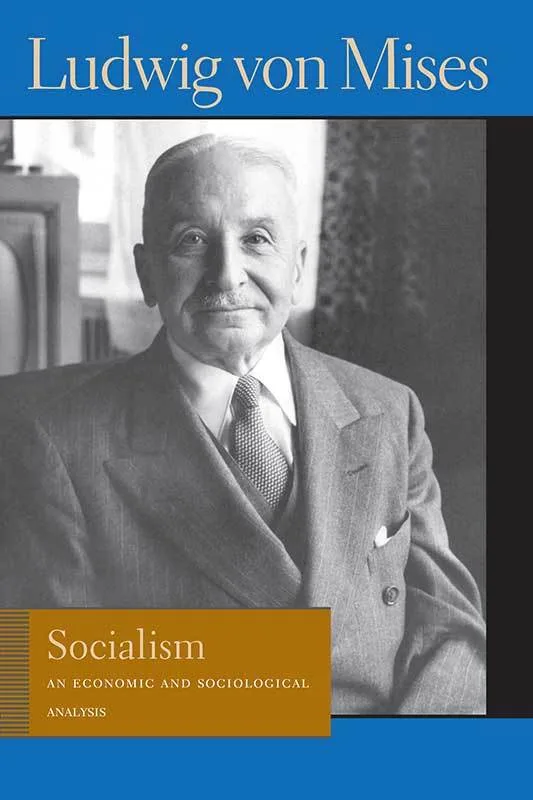
Ludwig von Mises · 1922
This is a newly annotated edition of the classic first published in German in 1922. It is the definitive refutation of nearly every type of socialism ever devised. Mises presents a wide-ranging analysis of society,…
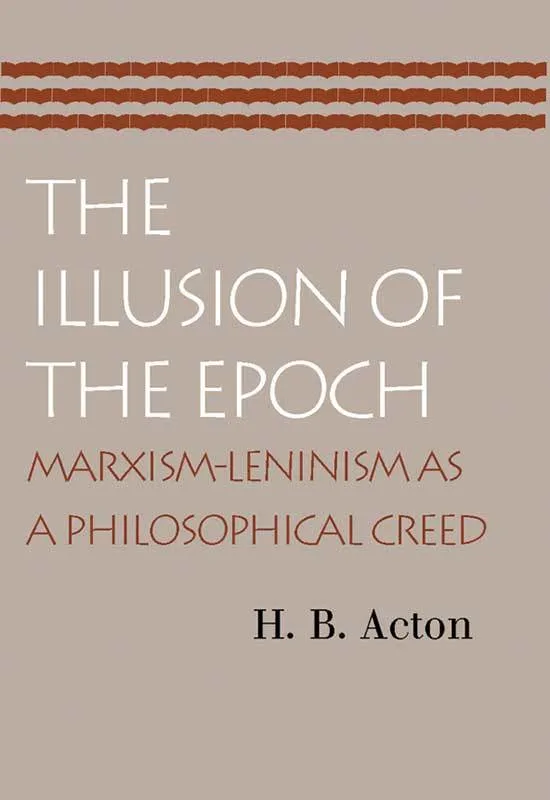
H.B. Acton · 1955
Written nearly fifty years ago, at a time when the world was still wrestling with the concepts of Marx and Lenin, The Illusion of the Epoch is the perfect resource for understanding the roots of Marxism-Leninism and its…
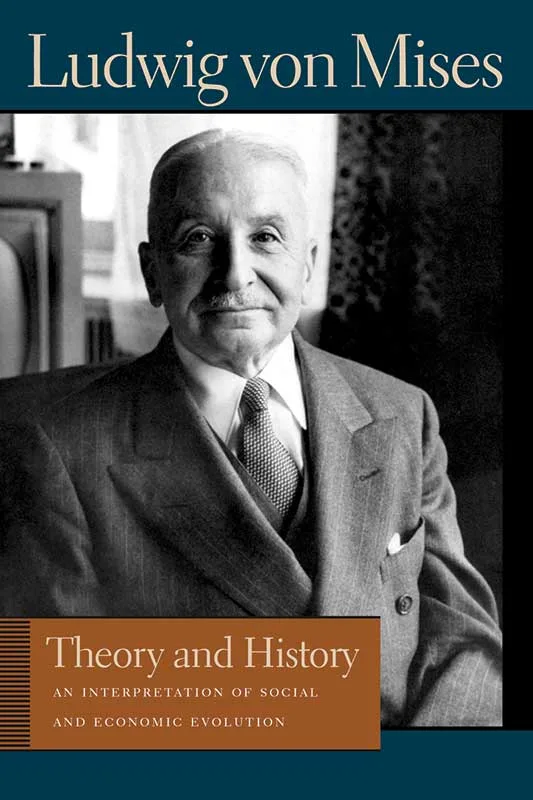
Ludwig von Mises · 1957
Mises applies his theory of methodological individualism to an analysis of history. Along the way he debunks other theories of history which are based upon notions of race, dialectical materialism (Marxism), and…
Ludwig von Mises · 1957
Theory and History is primarily a critique of Karl Marx, his materialism, and his prediction of the inevitability of socialism. This book discusses the theory of economics, i.e., the study of purposive human action, and…
Frédéric Bastiat · 1996
The Foundation for Economic Education's translation of Bastiat’s series of short essays in which he tries to correct common misunderstandings about the free market.

Ljubo Sirc · 2003
Sirc draws upon his experiences of fighting in the Resistance and the Yugoslav Army, his political opposition and arrest under communism to discuss the economics of socialism and life under communism.
In this collection
12 people central to Socialism and the Classical Liberal Critique.
1908–1974
H.B. Acton (1908-1974) taught at Bedford College (London), the University of Edinburgh, and the University of Chicago; was editor of…

1810–1871
One of the authors in the volume of anti-socialist essays edited by Thomas Mackay and published by the Liberty and Property Defence League.

1847–1914
Wordsworth Donisthorpe (1847-1914). Very little is known about the private life of Donisthorpe other than his father was a prosperous…

1761–1805
One of the authors in the volume of anti-socialist essays edited by Thomas Mackay and published by the Liberty and Property Defence League.

One of the authors in the volume of anti-socialist essays edited by Thomas Mackay and published by the Liberty and Property Defence League.

1833–1910
One of the authors in the volume of anti-socialist essays edited by Thomas Mackay and published by the Liberty and Property Defence League.…

1849–1912
Thomas Mackay (1849-1912) was a successful Scottish wine merchant who retired early from business so he could devote himself entirely to…

1900–1989
One of the authors in the volume of anti-socialist essays edited by Thomas Mackay and published by the Liberty and Property Defence League.…
One of the authors in the volume of anti-socialist essays edited by Thomas Mackay and published by the Liberty and Property Defence League.
1834–1923
One of the authors in the volume of anti-socialist essays edited by Thomas Mackay and published by the Liberty and Property Defence League.

1860–1927
John St Loe Strachey (1860–1927) was a British journalist and newspaper proprietor. Between 1887 and 1925, he was editor of The Spectator.…
1857–1909
One of the authors in the volume of anti-socialist essays edited by Thomas Mackay and published by the Liberty and Property Defence League.
In this collection
From The Reading Room, Liberty Matters and the library’s other publications.
Virgil Henry Storr and others · 2022
Passages on this subject, chosen by OLL editors.
For all its theories about systems and (all) its efforts it appears that socialism, however indulgent it is toward itself, cannot avoid catching a glimpse of the monster which is legal plunder. But what does it do? It cleverly shrouds it from all eyes, even its own, under the seductive names of fraternity, solidarity, organization, and association. And because we do not ask so much of the law since we require only justice from it, (socialism) presumes that we are rejecting fraternity, solidarity, organization, and association and hurls the epithet “Individualist!” at us. It ought to know, therefore, that what we are rejecting is not natural organization, but coerced organization.
Interventionism does not want to abolish private ownership of the means of production but only to restrict it. It declares, on the one hand, that unlimited private ownership of the means of production is harmful to society; but it maintains, on the other hand, that public ownership of the means of production—socialism—is, either in general or at least for the time being, impractical. Thus it wants to create some third way: a state of society that is midway between private ownership of the means of production, on the one hand, and collective ownership of the means of production, on the other hand. In this way the “excesses” and damages of capitalism are supposed to be prevented, while the advantages of free initiative and vitality, which socialism cannot provide, are preserved.
For additional information about Socialism and the Classical Liberal Critique see the following:
Socialism. Communism. Anarchism
4 titles · 16 people
Economic theory. Demography
473 titles · 88 publications · 293 people
Economics
13 titles · 24 people · 8 quotes

Economics
30 titles · 7 publications · 32 people
Economics
31 titles · 24 people · 4 quotes

Economics
47 titles · 1 publication · 51 people