The Online Library of Liberty

Search the library

Press Enter to see all results. Esc closes.

Liberty

Milton Friedman and the Free Society

As you may recall, Dicey dates the change in public opinion in Britain away from individualism and toward collectivism at about 1870-90. Dicey answers his question by essentially reversing it, saying that in its original form, it may be a foolish question. Perhaps the relevant question is not why people turned away from individualism toward collectivism, but how they were induced to accept the queer notion of individualism in the first place. The argument for a free society, he goes on to say, is a very subtle and sophisticated argument. At every point, it depends on the indirect rather than the direct effect of the policy followed. If one is concerned to remedy clear evils in a society, as everyone is, the natural reaction is to say, “let’s do something about it,” and the “us” in this statement will in a large number of cases be translated into the “government,” so the natural reaction is to pass a law. The argument that maybe the attempt to correct this particular evil by extending the hand of the government will have indirect effects whose aggregate consequences may be far worse than any direct benefits that flow from the action taken is, after all, a rather sophisticated argument. And yet, this is the kind of argument that underlies a belief in a free or laisser-faire society. (FROM: Is a Free Society Stable?) - Milton Friedman

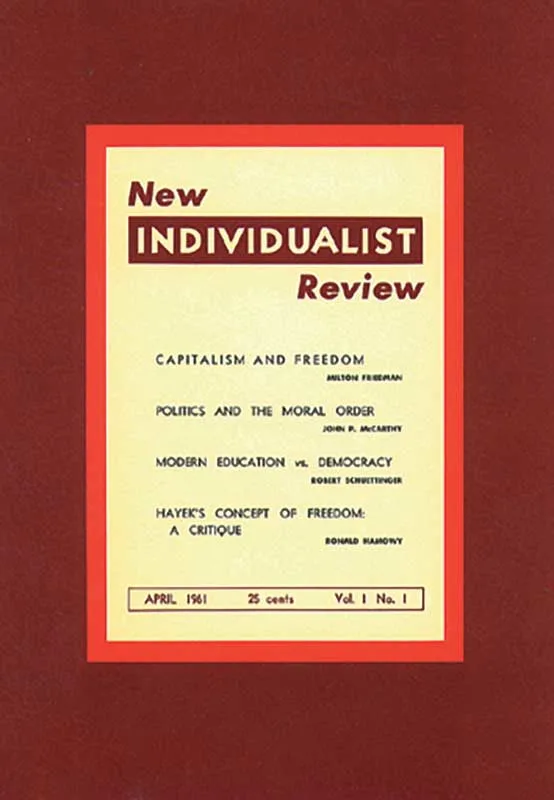
— Milton Friedman, New Individualist Review

Context

Further thoughts

  • Liberty
    “(Some) think it best, that every thing, which is not properly of a civil nature, should be entirely overlooked by the civil magistrate; that it is for the advantage of the society, upon the whole, that all those things be left to take their own natural course, and that the legislature cannot interfere in them, without defeating its own great object, the public good.”
  • Liberty
    “We have, therefore, on this occasion, peculiar reasons for thanksgiving—But let us remember that we ought not to satisfy ourselves with thanksgivings. Our gratitude, if genuine, will be accompanied with endeavours to give stability to the deliverance our country has obtained, and to extend and improve the happiness with which the Revolution has blest us—Let us, in particular, take care not to forget the principles of the Revolution. ... I would farther direct you to remember, that though the Revolution was a great work, it was by no means a perfect work; and that all was not then gained which was necessary to put the kingdom in the secure and complete possession of the blessings of liberty.”
  • Liberty
    “Article I - Men are born and remain free and equal in rights. Social distinctions can be founded only on the common utility. Article II - The goal of any political association is the conservation of the natural and imprescriptible [i.e., inviolable] rights of man. These rights are liberty, property, safety and resistance against oppression. Article III - The principle of any sovereignty resides essentially in the Nation. No body, no individual can exert authority which does not emanate expressly from it. Article IV - Liberty consists of doing anything which does not harm others: thus, the exercise of the natural rights of each man has only those borders which assure other members of the society the enjoyment of these same rights. These borders can be determined only by the law.”