Economic Harmonies (FEE ed.)
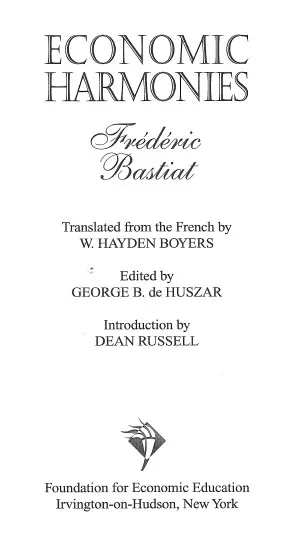
- Frédéric Bastiat(author)
- George B. de Huszar(editor)
- W Hayden Boyers(translator)
This is the translation by the Foundation for Economic Education of Bastiat’s longest and best known work Economic Harmonies. A new translation of this work by Liberty Fund is in progress. See the Summary of the Bastiat Project for details.
Key Quotes
Passages from this text chosen by OLL editors.
- Origin of Government“
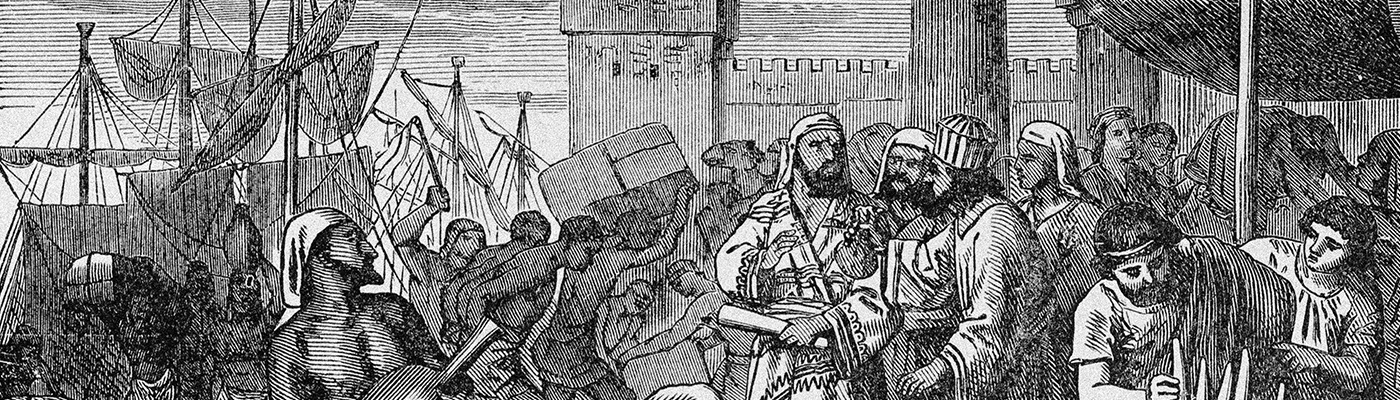
... [in the ancient world] a very small number of men managed to live without working, supported by the labor of the oppressed masses. This small leisured group made their slaves construct sumptuous palaces, vast castles, or somber fortresses. They loved to surround themselves with all the sensuous pleasures of life and with all the monuments of art. They delighted in discoursing on philosophy and cosmogony; and, above all, they carefully cultivated the two sciences to which they owed their supremacy and their enjoyments: the science of force and the science of fraud.
For beneath this aristocracy were the countless multitudes occupied in creating, for themselves, the means of sustaining life and, for their oppressors, the means of surfeiting them with pleasures. Since the historians never make the slightest mention of these multitudes, we forget their existence; they do not count for us at all. We have eyes only for the aristocracy.
[in ancient life] ... the only difference was that the labor that a few men had managed to escape fell crushingly on the oppressed masses, to the great detriment of justice, liberty, property, wealth, equality, and progress... - Socialism & Interventionism“
The moving parts are men, that is, beings capable of learning, reflecting, reasoning, of making errors and of correcting them, and consequently of making the mechanism itself better or worse. They are capable of pain and pleasure, and in that respect they are not only the wheels, but the springs of the machine. They are also the motive forces, for the source of the power is in them. They are more than that, for they are the ultimate object and raison d’être of the mechanism, since in the last analysis the problems of its operation must be solved in terms of their individual pain or pleasure.*
Now, it has been observed, and, alas, the observation has not been a difficult one to make, that in the operation, the evolution, and even the progress (by those who accept the idea that there has been progress) of this powerful mechanism, many moving parts were inevitably, fatally, crushed; that, for a great number of human beings, the sum of unmerited sufferings far exceeded the sum of enjoyments.
About This Edition
Citation
Bastiat, Frédéric. Economic Harmonies, trans by W. Hayden Boyers, ed. George B. de Huszar, introduction by Dean Russell (Irvington-on-Hudson: Foundation for Economic Education, 1996).
Bastiat, Frédéric. Economic Harmonies (FEE ed.). Edited by George B. de Huszar, translated by W Hayden Boyers, Foundation for Economic Education, 1996. Online Library of Liberty, https://oll.libertyfund.org/titles/bastiat-economic-harmonies-boyers-trans.
Bastiat, F. (1996). Economic Harmonies (FEE ed.). Foundation for Economic Education. https://oll.libertyfund.org/titles/bastiat-economic-harmonies-boyers-trans
@book{bastiat1996trans,
  author = {Frédéric Bastiat},
  editor = {George B. de Huszar},
  title = {Economic Harmonies (FEE ed.)},
  publisher = {Foundation for Economic Education},
  address = {Irvington-on-Hudson},
  year = {1996},
  url = {https://oll.libertyfund.org/titles/bastiat-economic-harmonies-boyers-trans},
  note = {Online Library of Liberty}
}TY - BOOK AU - Bastiat, Frédéric A2 - Huszar, George B. de A3 - Boyers, W Hayden TI - Economic Harmonies (FEE ed.) PY - 1996 CY - Irvington-on-Hudson PB - Foundation for Economic Education UR - https://oll.libertyfund.org/titles/bastiat-economic-harmonies-boyers-trans DB - Online Library of Liberty ER -
Copyright
Published online with the kind permission of the copyright holders, the Foundation for Economic Education.

About the author
Frédéric Bastiat 1801–1850
Frédéric Bastiat (1801-1850) was one of the leading advocates of free markets and free trade in the mid-19th century. He was inspired by the activities of Richard Cobden and the organization of the Anti-Corn Law League in Britain in the 1840s and tried to mimic their success in France.
More in Economic theory. Demography
See all >The Collected Works of Frédéric Bastiat. Vol. 2: The Law, The State, and Other Political Writings, 1843-1850
Frédéric BastiatCost and Choice: An Inquiry in Economic Theory, Vol. 6 of the Collected Works
James M. BuchananAn Essay on the Principle of Population, vol. 1 [1826, 6th ed.]
Thomas Robert MalthusUniversal Economics
Armen A. AlchianCan Capitalism Survive?
Benjamin A. RoggeAn Essay on the Principle of Population [1798, 1st ed.]
Thomas Robert Malthus“The Use of Knowledge in Society” (1945)
Friedrich August von HayekDas Kapital. Kritik der politischen Oekonomie. Buch 1 (1867)
Karl MarxDas Kapital. Kritik der politischen Ökonomie. Buch III, zweiter Theil (1894)
Karl Marx