New Individualist Review
- Milton Friedman(author, introduction)
- Ronald Hamowy(author)
- Friedrich August von Hayek(author)
- Ralph Raico(author, editor)
- Murray N. Rothbard(author)
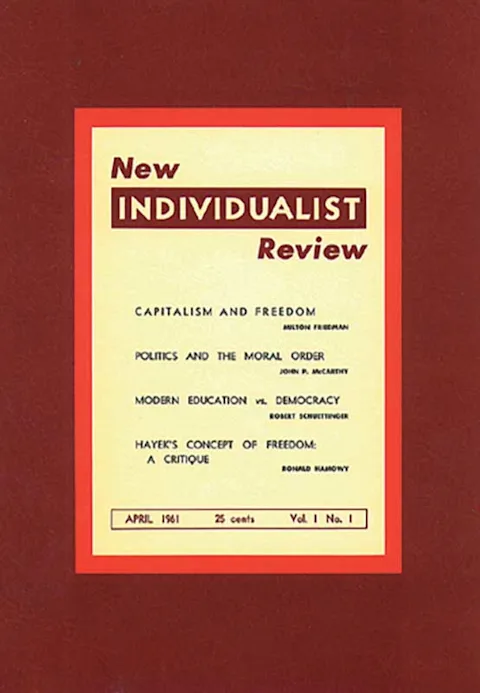
Initially sponsored by the University of Chicago Chapter of the Intercollegiate Society of Individualists, the New Individualist Review was more than the usual “campus magazine.” It declared itself “founded in a commitment to human liberty.” Between 1961 and 1968, seventeen issues were published which attracted a national audience of readers.
Key Quotes
Passages from this text chosen by OLL editors.
- Socialism & Interventionism“
Now, a third and final trait, one which, in my eyes, best describes socialists of all schools and shades, is a profound opposition to personal liberty and scorn for individual reason, a complete contempt for the individual. They unceasingly attempt to mutilate, to curtail, to obstruct personal freedom in any and all ways. They hold that the State must not only act as the director of society, but must further be master of each man, and not only master, but keeper and trainer. [“Excellent.”] For fear of allowing him to err, the State must place itself forever by his side, above him, around him, better to guide him, to maintain him, in a word, to confine him. They call, in fact, for the forfeiture, to a greater or less degree, of human liberty, [Further signs of assent.] to the point where, were I to attempt to sum up what socialism is, I would say that it was simply a new system of serfdom. [Lively assent.]
- Liberty“
As you may recall, Dicey dates the change in public opinion in Britain away from individualism and toward collectivism at about 1870-90. Dicey answers his question by essentially reversing it, saying that in its original form, it may be a foolish question. Perhaps the relevant question is not why people turned away from individualism toward collectivism, but how they were induced to accept the queer notion of individualism in the first place. The argument for a free society, he goes on to say, is a very subtle and sophisticated argument. At every point, it depends on the indirect rather than the direct effect of the policy followed. If one is concerned to remedy clear evils in a society, as everyone is, the natural reaction is to say, “let’s do something about it,” and the “us” in this statement will in a large number of cases be translated into the “government,” so the natural reaction is to pass a law. The argument that maybe the attempt to correct this particular evil by extending the hand of the government will have indirect effects whose aggregate consequences may be far worse than any direct benefits that flow from the action taken is, after all, a rather sophisticated argument. And yet, this is the kind of argument that underlies a belief in a free or laisser-faire society. (FROM: Is a Free Society Stable?) - Milton Friedman
- Economics“
That division of labor on which our economic system rests is the best example of such a daily renewed order. In the order created by the market, the participants are constantly induced to respond to events of which they do not directly know, in a way which secures a continuous flow of production, a coordination of the quantities of the different things so that the even flow is not interrupted and everything is produced at least as cheaply as anybody can still provide the last quantities for which others are prepared to pay the costs. That it is an order which consists of the adaptation to the multitudinous circumstances which no single person can know completely is one reason why its existence is not perceived by simple inspection. It is embodied in such relations as those between prices and costs of commodities and the corresponding distribution of resources; and we can confirm that such an order in fact exists only after we have reconstructed its principles in our minds. (FROM: Kinds of Order in Society) - F. A. Hayek
- The State“
VIEWED AS a means to the end of political freedom, economic arrangements are essential because of the effect which they have on the concentration or the deconcentration of power. A major thesis of the new liberal is that the kind of economic organization that provides economic freedom directly, namely, organization of economic activities through a largely free market and private enterprise, in short through competitive capitalism, is also a necessary though not a sufficient condition for political freedom. The central reason why this is true is because such a form of economic organization separates economic power from political power and in this way enables the one to be an offset to the other. (FROM: Capitalism and Freedom) - Milton Friedman
About This Edition
Citation
New Individualist Review, editor-in-chief Ralph Raico, introduction by Milton Friedman (Indianapolis: Liberty Fund, 1981).
Friedman, Milton, et al. New Individualist Review. Edited by Ralph Raico, Liberty Fund, 1981. Online Library of Liberty, https://oll.libertyfund.org/titles/friedman-new-individualist-review.
Friedman, M., Hamowy, R., Hayek, F. A. v., Raico, R., & Rothbard, M. N. (1981). New Individualist Review. Liberty Fund. https://oll.libertyfund.org/titles/friedman-new-individualist-review
@book{friedman1981review,
  author = {Milton Friedman and Ronald Hamowy and Friedrich August von Hayek and Ralph Raico and Murray N. Rothbard},
  editor = {Ralph Raico},
  title = {New Individualist Review},
  publisher = {Liberty Fund},
  address = {Indianapolis},
  year = {1981},
  url = {https://oll.libertyfund.org/titles/friedman-new-individualist-review},
  note = {Online Library of Liberty}
}TY - BOOK AU - Friedman, Milton AU - Hamowy, Ronald AU - Hayek, Friedrich August von AU - Raico, Ralph AU - Rothbard, Murray N. A2 - Raico, Ralph TI - New Individualist Review PY - 1981 CY - Indianapolis PB - Liberty Fund UR - https://oll.libertyfund.org/titles/friedman-new-individualist-review DB - Online Library of Liberty ER -
Copyright
The copyright to this publication is held by Liberty Fund, Inc. The New Individualist Review is prohibited for use in any publication, journal, or periodical without written consent of J. M. Cobb, J. M. S. Powell, or David Levy.

About the author
Milton Friedman 1912–2006
Milton Friedman (1912-2007) was the author of many books and articles in economics, including A Theory of the Consumption Function, The Optimum Quantity of Money and Other Essays, and (with A. J. Schwartz) A Monetary History of the United States, Monetary Statistics of the United States, and Monetary Trends in the United States and the United Kingdom. Friedman also wrote extensively on public policy, always with a primary emphasis on the preservation and extension of individual freedom.
More in Political Theory
See all >The Political Writings of Jean Jacques Rousseau vol. 1
Jean-Jacques RousseauThe Writings of Thomas Paine, Vol. I (1774-1779)
Thomas PaineDissertations on Early Law and Custom
Sir Henry Sumner MaineAncient Law
Sir Henry Sumner MaineThe Political Writings of Jean Jacques Rousseau, 2 vols.
Jean-Jacques RousseauLeviathan (1909 ed)
Thomas HobbesPatriarcha, or the Natural Power of Kings
Sir Robert FilmerThe Man versus the State (1885 ed.)
Herbert SpencerThe Man versus the State, with Six Essays on Government, Society and Freedom (LF ed.)
Herbert Spencer