


Author
Milton Friedman
1912–2006
Milton Friedman (1912-2007) was the author of many books and articles in economics, including A Theory of the Consumption Function, The Optimum Quantity of Money and Other Essays, and (with A. J. Schwartz) A Monetary History of the United States, Monetary Statistics of the United States, and Monetary Trends in the United States and the United Kingdom. Friedman also wrote extensively on public policy, always with a primary emphasis on the preservation and extension of individual freedom.
Biography
His most important books in this field are (with Rose D. Friedman) Capitalism and Freedom (University of Chicago Press, 1962); Bright Promises, Dismal Performance (Thomas Horton and Daughters, 1983), which consists mostly of reprints of columns he wrote for Newsweek from 1966 to 1983; (with Rose D. Friedman) Free to Choose (Harcourt Brace Jovanovich, 1980), and (with Rose D. Friedman) Tyranny of the Status Quo (Harcourt Brace Jovanovich, 1984).
See also the following podcasts on our sister website Econtalk:
- Friedman on Capitalism and Freedom (4 Sept 2006)
- Milton Friedman on Money (28 August 2006)
At our sister website Econlib:
- the Concise Encyclopedia of Economics entry on Friedman
Watch the OLL Video The Intellectual Portrait Series: A Conversation with Milton Friedman
Works by Milton Friedman
2 titles in the library
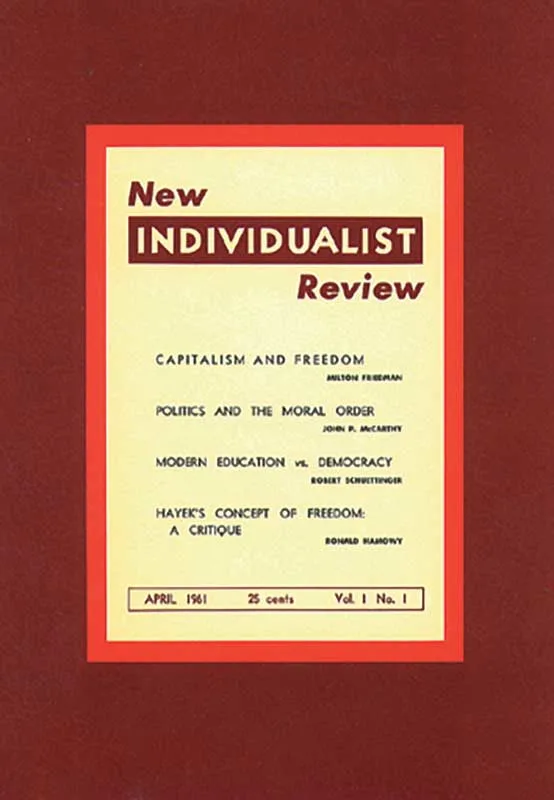
Milton Friedman · 1961
New Individualist Review
Initially sponsored by the University of Chicago Chapter of the Intercollegiate Society of Individualists, the New Individualist Review was more than the usual “campus magazine.” It declared itself “founded in a…
Milton Friedman · 2003
The Intellectual Portrait Series: A Conversation with Milton Friedman
Milton Friedman discusses his economic ideas with Gary S. Becker. Recipient of the 1976 Nobel Memorial Prize in Economics, Milton Friedman was a leader of the Chicago school of monetary economics. He was also the Paul…
Introduced by Milton Friedman
2 titles in the library

Leonard E. Read · 1958
“I, Pencil: My Family Tree” as told to Leonard E. Read, Dec. 1958
A charming story which explains how something as apparently simple as a pencil is in fact the product of a very complex economic process based upon the division of labor, international trade, and comparative advantage.
Milton Friedman · 1961
New Individualist Review
Initially sponsored by the University of Chicago Chapter of the Intercollegiate Society of Individualists, the New Individualist Review was more than the usual “campus magazine.” It declared itself “founded in a…
Quotes from Milton Friedman
2 quotes from the library