

David Ricardo
1772–1823 · 11 titles


Economics
14 items in this collection
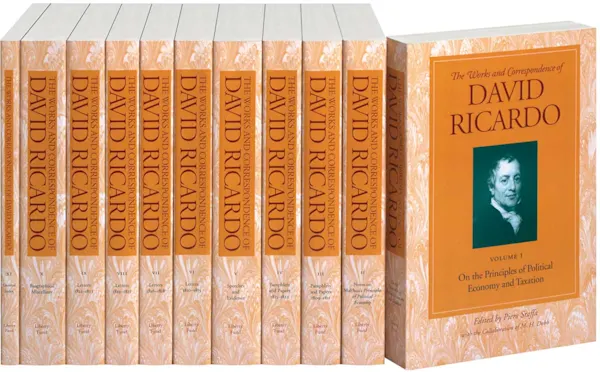
The Works and Correspondence of David Ricardo, ed. Piero Sraffa with the Collaboration of M.H. Dobb (Indianapolis: Liberty Fund, 2005), 11 vols. - This eleven-volume set was prepared under the auspices of the Royal Economic Society by Piero Sraffa and printed by Cambridge University Press in 19511973. It contains all of Ricardos published and unpublished writings, and provides great insight into the early era of political economics by chronicling Ricardos significant contributions to modern economics. The edition has been widely acclaimed as the best example, prior to the Glasgow edition of Adam Smiths writings, of scholarly editing applied to the work of an economist. It contains a general index and includes four volumes dedicated to his personal correspondence with such economic luminaries as Malthus, Jean-Baptiste Say, and James Mill, the father of John Stuart Mill.
In this collection
11 titles, earliest first.
David Ricardo · 1795
This volume is a collection of personal correspondence and recollections that focus on Ricardo’s life outside of his political economic endeavors. These missives concern Ricardo's character, his amiable and generous…
David Ricardo · 1809
This volume focuses on Ricardo’s shorter essays printed in the Morning Chronicle, which deal with his thoughts on the inflationary monetary policy of the Bank of England and the Bullion Crises. In these essays, the…
David Ricardo · 1810
The last volume of this collection is a comprehensive index to the previous ten volumes of The Works and Correspondence of David Ricardo.
David Ricardo · 1810
Volume 6 is the introductory volume to the four volumes containing relevant letters between Ricardo and many influential thinkers of his age. Many of these letters influenced the development of Ricardo’s ideas on…
David Ricardo · 1815
This volume contains a collection of assorted short essays written for publication in the latter part of David Ricardo’s life from 1815 to 1823. These essays include: An Essay on the Influence of a low Price of Corn on…
David Ricardo · 1816
Volume 7 is the second volume of four volumes comprising the collection of Ricardo's letters. It spans the years of Ricardo’s life from 1816 to 1818. This period saw the development and initial defense of his most…
David Ricardo · 1817
On the Principles of Political Economy and Taxation provides analysis of the allocation of money between capitalists, landowners, and agricultural workers in Britain. Through this analysis, Ricardo came to advocate free…
David Ricardo · 1819
Speeches and Evidence contains the texts of Ricardo’s numerous speeches. It consists of his speeches given in the House of Commons and evidentiary advocacies before Parliamentary committees. The introduction provides…
David Ricardo · 1819
This period of Ricardo’s life witnessed his entrance into Parliament as a member of the House of Commons where he became an influential advocate of free trade through his opposition to Britain’s restrictive “Corn laws.”…
David Ricardo · 1820
David Ricardo and T. R. Malthus were friends despite a contentious divergence of opinion on many political economic issues. This volume contains the formal remnants of their differences. Ricardo analyzes,…
David Ricardo · 1821
The letters in this volume continue to cover Ricardo’s correspondence while a member of the House of Commons and provide subtle refinements and elaborations to his political economic thoughts. This volume includes a…
In this collection
Authors, editors and translators of these titles, most titles first.
1772–1823 · 11 titles

1898–1983 · 11 titles
1900–1976 · 4 titles
Passages from titles in this collection, chosen by OLL editors.
Whatever might be his gains after such a principle (of redistribution) had been admitted would be held by a very insecure tenure, and the chance of his making any future gains would be greatly diminished; for the quantity of employment in the country must depend, not only on the quantity of capital, but upon its advantageous distribution, and, above all, on the conviction of each capitalist that he will be allowed to enjoy unmolested the fruits of his capital, his skill, and his enterprise. To take from him this conviction is at once to annihilate half the productive industry of the country, and would be more fatal to the poor labourer than to the rich capitalist himself. This is so self-evident, that men very little advanced beyond the very lowest stations in the country cannot be ignorant of it ...
There are no taxes which have not a tendency to lessen the power to accumulate. All taxes must either fall on capital or revenue. If they encroach on capital, they must proportionably diminish that fund by whose extent the extent of the productive industry of the country must always be regulated; and if they fall on revenue, they must either lessen accumulation, or force the contributors to save the amount of the tax, by making a corresponding diminution of their former unproductive1 consumption of the necessaries and luxuries of life. Some taxes will produce these effects in a much greater degree than others; but the great evil of taxation is to be found, not so much in any selection of its objects, as in the general amount of its effects taken collectively.
Why should the mere increase of money have any other effect than to lower its value? How would it cause any increase in the production of commodities?
This is true taking all commodities together, —but fashion or other causes may create an increased demand for one article and consequently the demand for some one or more of others must diminish. Will not this operate on prices?…
In this conclusion I perfectly agree if the author means the mass of prices, but a hundred articles might have risen, whilst another hundred might have fallen in consequence of increased or decreased demand, increased or decreased knowledge in the best means of producing them. Nay the mass of prices might remain the same tho’ each individual article had risen in consequence of taxation.
Money cannot call forth goods, —but goods can call forth money…
Economic theory. Demography
473 titles · 88 publications · 293 people

Language and Literature
282 titles · 6 publications · 321 people
Language and Literature
112 titles · 156 people

Economics
47 titles · 1 publication · 51 people
Economics
36 titles · 8 publications · 46 people
Economics
31 titles · 24 people · 4 quotes