


Author
David Ricardo
1772–1823
David Ricardo (1772-1823) was born in London of parents recently emigrated from Amsterdam, where he was educated as a youth in yeshivas. He returned to London and made a large fortune as a stockbroker, and eventually was elected to Parliament; but he also enjoyed reading about economics.
Biography
He was ultimately inspired by Smith’s The Nature and Causes of the Wealth of Nations, and, using his background in the stock market and his natural incisive ability, actively disagreed with the mercantilist views on gold accumulation and the pricing of gold. He eventually took on some of Smith’s inconsistencies, and in the process developed the role of comparative advantage in international trade. He is one of the early describers of what has become known as “Ricardian equivalence” - the condition that real interest rates are influenced by government spending, but not necessarily by the way the government finances that spending (via borrowing or taxation). His contributions to the economics of rent, monetary theory, and the theory of value influenced economists of his day and since. [The image comes from “The Warren J. Samuels Portrait Collection at Duke University.”]
See also our collection of extracts, essays, and other resources on Ricardo.
For additional information about David Ricardo see the following:
- Essays on Ricardo
- Timeline on the Life and Work of David Ricardo
- at our sister website Econlib: the Concise Encyclopedia of Economics entry on Ricardo
Works by David Ricardo
13 titles in the library
David Ricardo · 1819
The Works and Correspondence of David Ricardo, Vol. 8 Letters 1819-June 1821
This period of Ricardo’s life witnessed his entrance into Parliament as a member of the House of Commons where he became an influential advocate of free trade through his opposition to Britain’s restrictive “Corn laws.”…
David Ricardo · 1816
The Works and Correspondence of David Ricardo, Vol. 7 Letters 1816-1818
Volume 7 is the second volume of four volumes comprising the collection of Ricardo's letters. It spans the years of Ricardo’s life from 1816 to 1818. This period saw the development and initial defense of his most…
David Ricardo · 1810
The Works and Correspondence of David Ricardo, Vol. 6 Letters 1810-1815
Volume 6 is the introductory volume to the four volumes containing relevant letters between Ricardo and many influential thinkers of his age. Many of these letters influenced the development of Ricardo’s ideas on…
David Ricardo · 1821
The Works and Correspondence of David Ricardo, Vol. 9 Letters 1821-1823
The letters in this volume continue to cover Ricardo’s correspondence while a member of the House of Commons and provide subtle refinements and elaborations to his political economic thoughts. This volume includes a…
David Ricardo · 1819
The Works and Correspondence of David Ricardo, Vol. 5 Speeches and Evidence
Speeches and Evidence contains the texts of Ricardo’s numerous speeches. It consists of his speeches given in the House of Commons and evidentiary advocacies before Parliamentary committees. The introduction provides…
David Ricardo · 1815
The Works and Correspondence of David Ricardo, Vol. 4 Pamphlets and Papers 1815-1823
This volume contains a collection of assorted short essays written for publication in the latter part of David Ricardo’s life from 1815 to 1823. These essays include: An Essay on the Influence of a low Price of Corn on…
David Ricardo · 1817
The Works and Correspondence of David Ricardo, Vol. 1 Principles of Political Economy and Taxation
On the Principles of Political Economy and Taxation provides analysis of the allocation of money between capitalists, landowners, and agricultural workers in Britain. Through this analysis, Ricardo came to advocate free…
David Ricardo · 1809
The Works and Correspondence of David Ricardo, Vol. 3 Pamphlets and Papers 1809-1811
This volume focuses on Ricardo’s shorter essays printed in the Morning Chronicle, which deal with his thoughts on the inflationary monetary policy of the Bank of England and the Bullion Crises. In these essays, the…
David Ricardo · 1820
The Works and Correspondence of David Ricardo, Vol. 2 Notes on Malthus
David Ricardo and T. R. Malthus were friends despite a contentious divergence of opinion on many political economic issues. This volume contains the formal remnants of their differences. Ricardo analyzes,…
David Ricardo · 1795
The Works and Correspondence of David Ricardo, Vol. 10 Biographical Miscellany
This volume is a collection of personal correspondence and recollections that focus on Ricardo’s life outside of his political economic endeavors. These missives concern Ricardo's character, his amiable and generous…
David Ricardo · 1810
The Works and Correspondence of David Ricardo, Vol. 11 General Index
The last volume of this collection is a comprehensive index to the previous ten volumes of The Works and Correspondence of David Ricardo.
David Ricardo · 1951
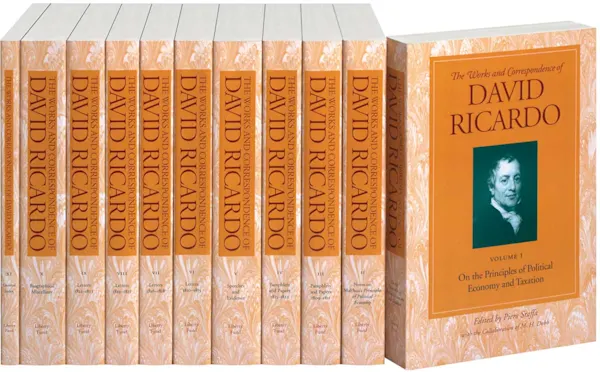
The Works and Correspondence of David Ricardo, 11 vols (Sraffa ed.)
This eleven-volume set of The Works and Correspondence of David Ricardo contains all of Ricardo’s published and unpublished writings, and provides great insight into the early era of political economics by chronicling…
David Ricardo · 1846
The Works of David Ricardo (McCulloch ed. 1846, 1888)
A one volume collection of Ricardo’s most important writings, edited by the great English classical economist J.R McCulloch who has a lengthy introduction on the life and work of Ricardo.
Quotes from David Ricardo
7 quotes from the library