

Ludwig M. Lachmann
1906–1990 · 4 titles

Economic theory. Demography
24 items in this collection
-><-
Studies in Economic Theory was a collection of works edited by Laurence S. Moss and published by the Institute for Humane Studies in the mid- and late-1970s. These books were squarely within the Austrian tradition of economic thought and included the reprinting of classics such as Ludwig Lachmann's Capital and its Structure (1956) and collections of essays by the younger generation of American Austrian economists. Many of the titles in this series will appear on the Online Library of Liberty with the kind permission of the copyright holders, the Institute for Humane Studies.
In this collection
10 titles, earliest first.
Frank A. Fetter · 1897
Rothbard has collected Fetter’s journal articles and book reviews from the period 1897 to 1937 which cover the general topics of capital, interest, and rent.
James M. Buchanan · 1937
A volume in the collection Studies in Economic Theory first published by the Institute for Humane Studies. This is a collection of essays written in the LSE opportunity cost tradition by scholars associated with the…
Ludwig M. Lachmann · 1940
This volume consists of 17 of Ludwig Lachmann’s most important papers published during the period 1940-73. Two of the articles appear here in translation for the first time. Prepared especially for this volume is a new…
Ludwig M. Lachmann · 1956
A reprint of Lachmann’s 1956 classic of Austrian capital theory. In this book Lachmann shows how firms invest to position capital goods with one another, thus creating the complex capital structure. He shows how capital…
Israel M. Kirzner · 1960
Kirzner’s The Economic Point of View is a thoughtful study of how and why economists are successful at sorting out certain issues but less successful at others, issues from welfare to wealth to human actions. Ludwig von…
Ludwig von Mises · 1962
The great Austrian economist Ludwig von Mises provides a concise and tightly-argued one volume defence of classical liberalism, focussing on the core concepts of private property, limited government, peace, and the free…
Israel M. Kirzner · 1976
A collection of papers from a Symposium on the economics of Mises held at the 44th meeting of the Southern Economics Association in Atlanta, Georgia on 15 November, 1974. There are articles by Laurence Moss, Fritz…
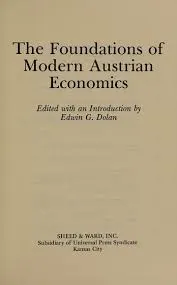
Israel M. Kirzner · 1976
A volume in the collection Studies in Economic Theory, first published by the Institute for Humane Studies. This is a collection of papers given at a conference on Austrian economics in June 1974. They cover the…
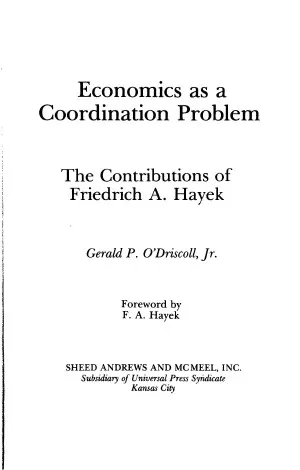
Gerald P. O’Driscoll · 1977
A full-length assessment of the contributions to economics of Friedrich Hayek (Nobel Prize 1974). Hayek is unique for a number of reasons: because of his emphasis on the function of institutions in coordinating the…
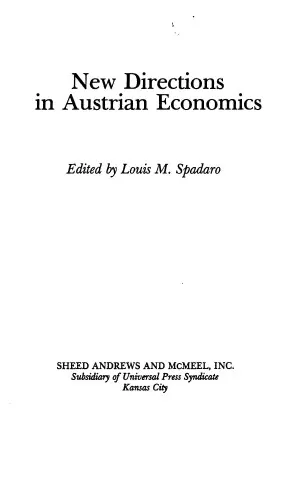
Ludwig M. Lachmann · 1978
A collection of papers which explores methodoogy, econometrics, social cost, monopoly theory, the supply of money, interest theory, and macroeconomics.
In this collection
Authors, editors and translators of these titles, most titles first.
1906–1990 · 4 titles

1926–1995 · 4 titles

b. 1947 · 3 titles

b. 1930 · 3 titles
b. 1944 · 3 titles
b. 1913 · 2 titles

1881–1973 · 2 titles

1 title

1863–1949 · 1 title

1899–1992 · 1 title
1 title

1919–2013 · 1 title

1936–2016 · 1 title

1938–2022 · 1 title
Passages from titles in this collection, chosen by OLL editors.
Fraser has classified definitions of economics into Type A definitions and Type B definitions. Type A definitions consider economics as investigating a particular department of affairs, while Type B definitions see it as concerned with a particular aspect of affairs in general. The specific department singled out by Type A definitions has usually been wealth or material welfare. The aspect referred to in Type B definitions is the constraint that social phenomena uniformly reveal in the necessity to reconcile numerous conflicting ends under the shadow of an inescapable scarcity of means....
[In recent decades there has been a] trend away from the association of economics with specific “ends” or a specific department of human affairs. In this development the work of [Lionel] Robbins has been consistently pursued to what appears to the writer to be the most adequate solution of the problem.... [T]he contributions of several eminent economists, including Mises and Knight... [called the praxeological outlook]... has a significance that, in the writer’s opinion, has not been sufficiently recognized because it has not yet been brought into historical perspective.
The market process is thus seen to be a leveling process. In a market economy a process of redistribution of wealth is taking place all the time before which those outwardly similar processes which modern politicians are in the habit of instituting, pale into comparative insignificance, if for no other reason than that the market gives wealth to those who can hold it, while politicians give it to their constituents who, as a rule, cannot.
This process of redistribution of wealth is not prompted by a concatenation of hazards. Those who participate in it are not playing a game of chance, but a game of skill. This process, like all real dynamic processes, reflects the transmission of knowledge from mind to mind. It is possible only because some people have knowledge that others have not yet acquired, because knowledge of change and its implications spread gradually and unevenly throughout society.
Studies in Economic Theory, Laurence S. Moss, Series Consultant
Economic theory. Demography
473 titles · 88 publications · 293 people

Economic theory. Demography
48 titles · 1 publication · 55 people
Socialism. Communism. Anarchism
4 titles · 16 people

Sociology
62 titles · 3 publications · 35 people
Social media
25 titles · 17 publications · 22 people

Social Sciences
18 titles · 22 people