

Thomas Mackay
1849–1912 · 3 titles


Socialism. Communism. Anarchism
20 items in this collection
In the late 19th century the classical liberal, free market orthodoxy was beginning to be challenged by socialists like George Bernard Shaw, who put together a collection of essays in 1889 advocating greater intervention by the state in the economy. Unlike the Marxists, who desired revolutionary change, the "Fabian socialists" advocated incremental change through the parliamentary system. This volume provoked a reply by supporters of private property and laissez-faire economics led by Thomas Mackay.
In this collection
4 titles, earliest first.
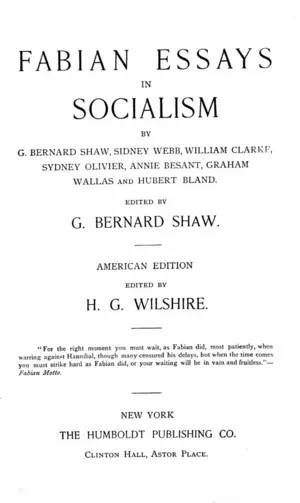
George Bernard Shaw · 1889
This collection of essays by the so-called "Fabian Socialists" (who advocated socialism by means of gradual political and economic reform instead of by revolution as preferred by the Marxists) prompted a vigorous…
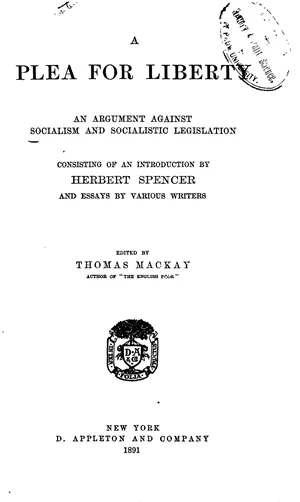
Auberon Herbert · 1891
This collection of essays was originally published in 1891 in response to a collection of Fabian Essays on Socialism which advocated policies which would eventually lead to the modern welfare state. The theoretical and…

Thomas Mackay · 1891
This collection of essays was originally published in 1891 in response to a collection of Fabian Essays on Socialism which advocated policies which would eventually lead to the modern welfare state. The theoretical and…
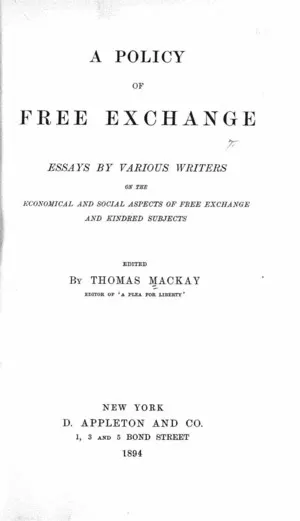
Thomas Mackay · 1894
The companion volume to A Plea for Liberty which continued the argument against the Fabian Socialists and for a policy of strict non-intervention in the economy by the government.
In this collection
Authors, editors and translators of these titles, most titles first.
1849–1912 · 3 titles

1853–1921 · 2 titles

1838–1906 · 2 titles

1761–1805 · 2 titles
1857–1909 · 2 titles
1834–1923 · 2 titles

2 titles

1900–1989 · 2 titles

1833–1910 · 2 titles

1820–1903 · 2 titles
2 titles

1810–1871 · 2 titles

1847–1914 · 2 titles

1856–1950 · 1 title

1861–1927 · 1 title
1 title
Passages from titles in this collection, chosen by OLL editors.
Notwithstanding the very profitable nature of the letter-carrying monopoly, it cannot be said that, at times of great press of business, the public is served with that absence of fuss and effort which ought to characterise a great and wealthy corporation. At Christmas-time the Post Office is completely disorganised. Its customers are pitifully implored not to pay exclusive regard to their own convenience, and to despatch their packages and letters according to a timetable drawn up by the Post Office to suit its own convenience...
It may, however, be pointed out that private carriers do not cry to be let off, but rise to the requirements of the occasion, provide additional facilities, and all the time by prodigal advertisement solicit rather than deprecate the patronage of the public.
In the first place, the Post Office has always been a monopoly. There never was a time when any private agency was permitted to compete with the State in the work of distributing letters. ... I cannot refrain from noticing the breakdown of letter-delivery arrangements which has taken place at Christmas every year since the Christmas card came into fashion. ... One would think that if, by the mere fact of belonging to a department of Government, a preternatural faculty of dealing with statistics were conferred upon officials, the officials of the Post Office ought, after a brief experience, to have been able to foresee and provide for this recurring difficulty. Yet no sooner does Christmas come within measurable distance, than every Post Office is placarded and every newspaper filled, with plaintive appeals from the Postmaster-General to the Christmas card dispatching public, to ‘post early, so as to ensure the punctual delivery of letters!’
I will end by giving what I believe to be the plain reasons why plain men should not be Socialists. It is not because Socialists are innovators or agitators or preach things contrary to the Book of Daniel, or are this, that, or the other, but simply and solely because Socialism is nonsense. Let me try then to put my reasons for not being a Socialist in the simplest possible form—the form which is patronizingly called suitable for children and uneducated persons, but which in reality is the form in which everyone reasons out a subject in his own mind.
Should those who desire, above all things, an improvement in the condition of the labourer become Socialists? No.
Why not? Because Socialism, if carried out, would injure, instead of benefiting, the labourer.
Why would Socialism injure the labourer? For the following reason: If the condition of the working men is to be improved, that is, if they are to have more food, more room in their houses, more clothes, more firing, more of everything they desire, it is evident that there must be more of all these things in the world. That is, there must be more wealth, for these things make up wealth. But in order that there shall be more wealth, i. e. more of the things men need and desire, more must be produced. If ten men have only five loaves between them, and need one each, the only way they can be made comfortable is by getting five more. It follows, therefore, that nothing which decreases the total wealth of the world, which diminishes, that is, the corn grown, the wool clipped, the houses built, the cotton spun, or the coal dug, can improve the condition of the poor. If, then, Socialism would diminish the production of the things needed by mankind it would be injurious.
But would it diminish the wealth of the world, and so makes less to go round? Yes.
For additional information about Socialism and the Classical Liberal Critique see the following:
Economic theory. Demography
473 titles · 88 publications · 293 people
Economics
36 titles · 8 publications · 46 people

Language and Literature
17 titles · 3 publications · 40 people
Economic theory. Demography
48 titles · 1 publication · 55 people
Economic theory. Demography
10 titles · 14 people
Language and Literature
112 titles · 156 people