The Online Library of Liberty

Search the library

Press Enter to see all results. Esc closes.

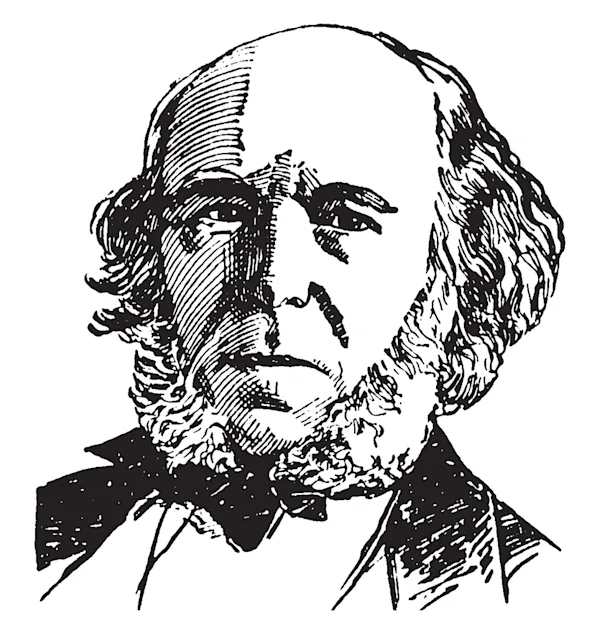
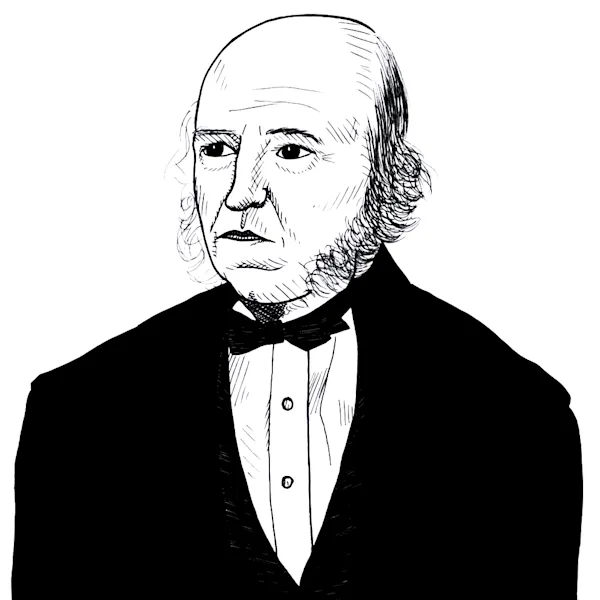
Portrait of Herbert Spencer

Author

Herbert Spencer

1820–1903

See more works by Spencer ›26 titles in the library

Biography

Works by Herbert Spencer

24 titles in the library
Introduced by Herbert Spencer

2 titles in the library

Quotes from Herbert Spencer

20 quotes from the library

  • Political Institutions, being Part V of the Principles of Sociology
    Whence it follows that the desire "not to be dependent on foreigners' is one appropriate to the militant type of society. So long as there is constant danger that the supplies of needful things derived from other countries will be cut off by the breaking out of hostilities, it is imperative that there shall be maintained a power of producing these supplies at home, and that to this end the required structures shall be maintained. Hence there is a manifest direct relation between militant activities and a protectionist policy.
  • The Man versus the State, with Six Essays on Government, Society and Freedom (LF ed.)
    The incident is recalled to me on contemplating the ideas of the so-called “practical” politician, into whose mind there enters no thought of such a thing as political momentum, still less of a political momentum which, instead of diminishing or remaining constant, increases. The theory on which he daily proceeds is that the change caused by his measure will stop where he intends it to stop. He contemplates intently the things his act will achieve, but thinks little of the remoter issues of the movement his act sets up, and still less its collateral issues. … The question of questions for the politician should ever be— "What type of social structure am I tending to produce?” But this is a question he never entertains.
  • The Principles of Sociology, vol. 2 (1898)
    Where the life is permanently peaceful, definite class-divisions do not exist. … As, at first, the domestic relation between the sexes passes into a political relation, such that men and women become, in militant groups, the ruling class and the subject class; so does the relation between master and slave, originally a domestic one, pass into a political one as fast as, by habitual war, the making of slaves becomes general. It is with the formation of a slave-class, that there begins that political differentiation between the regulating structures and the sustaining structures, which continues throughout all higher forms of social evolution.
  • The Principles of Sociology, vol. 2 (1898)
    Making him more despotic at the same time that it augments his kingdom, continuance of this process [of fighting wars] increases his ability to enforce contributions, alike from his original subjects and from tributaries; while the necessity for supplies, now to defend his kingdom, now to invade adjacent kingdoms, is ever made the plea for increasing his demands of established kinds and for making new ones.
  • The Man versus the State, with Six Essays on Government, Society and Freedom (LF ed.)
    (T)hey seem to have read backwards the parable of the talents. Not to the agent of proved efficiency do they consign further duties, but to the negligent and blundering agent. Private enterprise has done much, and done it well. Private enterprise has cleared, drained, and fertilized the country, and built the towns; has excavated mines, laid out roads, dug canals, and embanked railways; has invented, and brought to perfection ploughs, looms, steam-engines, printing-presses, and machines innumerable; has built our ships, our vast manufactories, our docks; has established banks, insurance societies, and the newspaper press; has covered the sea with lines of steam-vessels, and the land with electric telegraphs. Private enterprise has brought agriculture, manufactures, and commerce to their present height, and is now developing them with increasing rapidity. Therefore, do not trust private enterprise. On the other hand, the State so fulfils its judicial function as to ruin many, delude others, and frighten away those who most need succor; its national defences are so extravagantly and yet inefficiently administered as to call forth almost daily complaint, expostulation, or ridicule; and as the nation’s steward, it obtains from some of our vast public estates a minus revenue. Therefore, trust the State. Slight the good and faithful servant, and promote the unprofitable one from one talent to ten.
  • The Principles of Sociology, vol. 2 (1898)
    We find, then, that rules of behaviour are not results of conventions at one time or other deliberately made, as people tacitly assume. Contrariwise, they are natural products of social life which have gradually evolved. Apart from detailed proofs of this, we find a general proof in their conformity to the laws of Evolution at large.
  • Social Statics (1851)
    An argument fatal to the communist theory, is suggested by the fact, that a desire for property is one of the elements of our nature. ... And if a propensity to personal acquisition be really a component of man’s constitution, then that cannot be a right form of society which affords it no scope. ... it is also true that no change in the state of society will alter its nature and its office. To whatever extent moderated, it must still be a desire for personal acquisition. Whence it follows that a system affording opportunity for its exercise must ever be retained; which means, that the system of private property must be retained; and this presupposes a right of private property, for by right we mean that which harmonizes with the human constitution as divinely ordained.
  • The Man versus the State, with Six Essays on Government, Society and Freedom (LF ed.)
    Chiefly, however, the maintenance of this faith is necessitated by the maintenance of fitness for war. This involves continuance of such confidence in the ruling agency, and such subordination to it, as may enable it to wield all the forces of the society on occasions of attack or defence; and there must survive a political theory justifying the faith and the obedience. While their sentiments and ideas are of kinds which perpetually endanger peace, it is requisite that men should have such belief in the authority of government as shall give it adequate coercive power over them for war purposes—a belief in its authority which inevitably, at the same time, gives it coercive power over them for other purposes.
  • Political Institutions, being Part V of the Principles of Sociology
    The days when “paper constitutions” were believed in have gone by—if not with all, still with instructed people. The general truth that the characters of the units determine the character of the aggregate, though not admitted overtly and fully, is yet admitted to some extent—to the extent that most politically-educated persons do not expect forthwith completely to change the state of a society by this or that kind of legislation. But when fully admitted, this truth carries with it the conclusion that political institutions cannot be effectually modified faster than the characters of citizens are modified; and that if greater modifications are by any accident produced, the excess of change is sure to be undone by some counter-change. … When, as in the United States, republican institutions, instead of being slowly evolved, are all at once created, there grows up within them an agency of wirepulling politicians, exercising a real rule which overrides the nominal rule of the people at large. When, as at home, an extended franchise, very soon re-extended, vastly augments the mass of those who, having before been controlled are made controllers, they presently fall under the rule of an organized body that chooses their candidates and arranges for them a political programme, which they must either accept or be powerless. So that in the absence of a duly-adapted character, liberty given in one direction is lost in another.
  • The Principles of Ethics, vol. 2 (LF ed.)
    Which is the more misleading, belief without evidence, or refusal to believe in presence of overwhelming evidence? If there is an irrational faith which persists without any facts to support it, there is an irrational lack of faith which persists spite of the accumulation of facts which should produce it; and we may doubt whether the last does not lead to worse results than the first. The average legislator, equally with the average citizen, has no faith whatever in the beneficent working of social forces, notwithstanding the almost infinite illustrations of this beneficent working. He persists in thinking of a society as a manufacture and not as a growth: blind to the fact that the vast and complex organization by which its life is carried on, has resulted from the spontaneous cooperations of men pursuing their private ends.
  • The Principles of Ethics, vol. 2 (LF ed.)
    ... the acquirement of so-called political rights is by no means equivalent to the acquirement of rights properly so-called. The one is but an instrumentality for the obtainment and maintenance of the other; and it may or may not be used to achieve those ends. The essential question is–How are rights, properly so-called, to be preserved–defended against aggressors, foreign and domestic? This or that system of government is but a system of appliances. Government by representation is one of these systems of appliances; and the choosing of representatives by the votes of all citizens is one of various ways in which a representative government may be formed. Hence voting being simply a method of creating an appliance for the preservation of rights, the question is whether universal possession of votes conduces to creation of the best appliance for preservation of rights. We have seen above that it does not effectually secure this end; and we shall hereafter see that under existing conditions it is not likely to secure it.
  • Essays: Scientific, Political, and Speculative, vol. 3
    You retain the forms of freedom; but, so far as I can gather, there has been a considerable loss of the substance. It is true that those who rule you do not do it by means of retainers armed with swords; but they do it through regiments of men armed with voting papers, who obey the word of command as loyally as did the dependants of the old feudal nobles, and who thus enable their leaders to override the general will, and make the community submit to their exactions as effectually as their prototypes of old. It is doubtless true that each of your citizens votes for the candidate he chooses for this or that office, from President downwards; but his hand is guided by an agency behind which leaves him scarcely any choice. “Use your political power as we tell you, or else throw it away,” is the alternative offered to the citizen. The political machinery as it is now worked, has little resemblance to that contemplated at the outset of your political life. Manifestly, those who framed your Constitution never dreamed that twenty thousand citizens would go to the poll led by a “boss.” America exemplifies at the other end of the social scale, a change analogous to that which has taken place under sundry despotisms. You know that in Japan, before the recent Revolution, the divine ruler, the Mikado, nominally supreme, was practically a puppet in the hands of his chief minister, the Shogun. Here it seems to me that “the sovereign people” is fast becoming a puppet which moves and speaks as wirepullers determine.
  • The Principles of Ethics, vol. 2 (LF ed.)
    A nature which generates international hatreds and intense desires for revenge–which breeds duelists and a contempt for those who do not seek to wipe out a slight by a death, is not a nature out of which harmonious communities can be molded. Men who rush in crowds to witness the brutalities of football matches, who roar out ferocious suggestions to the players, and mob the umpires who do not please them, so that police protection is required, are not men who will show careful consideration of one another’s claims when they have agreed to work together for the common good.
  • Political Institutions, being Part V of the Principles of Sociology
    Those who are forced to send their children to this or that school, those who have, directly or indirectly, to help in supporting a State priesthood, those from whom rates are demanded that parish officers may administer public charity, those who are taxed to provide gratis reading for people who will not save money for library subscriptions, those whose businesses are carried on under regulation by inspectors, those who have to pay the costs of State science-and-art-teaching, State emigration, &c., all have their individualities trenched upon, either by compelling them to do what they would not spontaneously do, or by taking away money which else would have furthered their private ends. Coercive arrangements of such kinds, consistent with the militant type, are inconsistent with the industrial type.
  • The Man versus the State, with Six Essays on Government, Society and Freedom (LF ed.)
    The chief arguments that are urged against an established religion, may be used with equal force against an established charity. The dissenter submits, that no party has a right to compel him to contribute to the support of doctrines, which do not meet his approbation. The rate-payer may as reasonably argue, that no one is justified in forcing him to subscribe towards the maintenance of persons, whom he does not consider deserving of relief. The advocate of religious freedom, does not acknowledge the right of any council, or bishop, to choose for him what he shall believe, or what he shall reject. So the opponent of a poor law, does not acknowledge the right of any government, or commissioner, to choose for him who are worthy of his charity, and who are not. … So the dissenter from established charity, objects that no man has a right to step in between him and the exercise of his religion.
  • Essays: Scientific, Political and Speculative, Vol. 1
    Yet that societies are not artificially put together, is a truth so manifest, that it seems wonderful men should ever have overlooked it. Perhaps nothing more clearly shows the small value of historical studies, as they have been commonly pursued. You need but to look at the changes going on around, or observe social organization in its leading traits, to see that these are neither supernatural, nor are determined by the wills of individual men, as by implication the older historians teach; but are consequent on general natural causes. The one case of the division of labour suffices to prove this. It has not been by command of any ruler that some men have become manufacturers, while others have remained cultivators of the soil. ... Thus that which is so obviously true of the industrial structure of society, is true of its whole structure. The fact that “constitutions are not made, but grow,” is simply a fragment of the much larger fact, that under all its aspects and through all its ramifications, society is a growth and not a manufacture.
  • The Principles of Ethics, vol. 2 (LF ed.)
    Over the dinner table, or in groups of persons otherwise held together, there frequently occur cases in which an erroneous statement is made or an invalid argument urged. One who recognizes the error may either display his superior knowledge or superior logic, or he may let the error pass in silence: not wishing to raise the estimate of himself at the cost of lowering the estimate of another. Which shall he do? A proper decision implies several considerations. Is the wrong statement or invalid argument one which will do appreciable mischief if it passes uncorrected? Is the person who utters it vain, or one whose self-esteem is excessive? Is he improperly regarded as an authority by those around? Does he trample down others in the pursuit of applause? If to some or all of these questions the answer is–Yes, the correction may fitly be made; alike for the benefit of the individual himself and for the benefit of hearers. But should the error be trivial, or should the credit of one who makes it, not higher than is proper, be unduly injured by the exposure, or should his general behavior in social intercourse be of a praiseworthy kind, then sympathy may fitly dictate silence–negative beneficence may rightly restrain the natural desire to show superiority.
  • The Man versus the State, with Six Essays on Government, Society and Freedom (LF ed.)
    Philosophical politicians usually define government, as a body whose province it is, to provide for the “general good.” But this practically amounts to no definition at all, if by a definition is meant a description, in which the limits of the thing described are pointed out. It is necessary to the very nature of a definition, that the words in which it is expressed should have some determinate meaning; but the expression “general good,” is of such uncertain character, a thing so entirely a matter of opinion, that there is not an action that a government could perform, which might not be contended to be a fulfilment of its duties. Have not all our laws, whether really enacted for the public benefit or for party aggrandisement, been passed under the plea of promoting the “general good?”
  • Social Statics (1851)
    As a corollary to the proposition that all institutions must be subordinated to the law of equal freedom, we cannot choose but admit the right of the citizen to adopt a condition of voluntary outlawry. If every man has freedom to do all that he wills, provided he infringes not the equal freedom of any other man, then he is free to drop connection with the state—to relinquish its protection, and to refuse paying towards its support. It is self-evident that in so behaving he in no way trenches upon the liberty of others; for his position is a passive one; and whilst passive he cannot become an aggressor. It is equally selfevident that he cannot be compelled to continue one of a political corporation, without a breach of the moral law, seeing that citizenship involves payment of taxes; and the taking away of a man’s property against his will, is an infringement of his rights.
  • The Principles of Ethics, vol. 1 (LF ed.)
    210. Except perhaps in agreeing that gluttony is to be reprobated and that the gourmet, as well as the gourmand, is a man to be regarded with scant respect, most people will think it is absurd to imply as the above title does, that ethics has anything to say about the taking of food. Though, by condemning excesses of the kinds just indicated, they imply that men ought not to be guilty of them, and by the use of this word class them as wrong; yet they ignore the obvious fact that if there is a wrong in respect of the taking of food there must also be a right... Mention of these facts is a fit preliminary to the question whether, in respect of food, desires ought or ought not to be obeyed. As already said, treatment of this inquiry as ethical will be demurred to by most and by many ridiculed. Though, when not food but drink is in question, their judgments, very strongly expressed, are of the kind they class as moral; yet they do not see that since the question concerns the effect of things swallowed, it is absurd to regard the conduct which causes these effects as moral or immoral when the things are liquid but not when they are solid.