


Author
Auberon Herbert
1838–1906
Auberon Herbert (1838-1906) was an English radical individualist who was influenced by the work of Herbert Spencer. With a group of other late Victorian classical liberals he was active in such organizations as the Personal Rights and Self-Help Association and the Liberty and Property Defense League. He formulated a system of “thorough” individualism that he described as “voluntaryism.”
Biography
Quotes from Auberon Herbert:
- Auberon Herbert on self-ownership and opposition to force
- Auberon Herbert on the use of force being a dangerous beast
- Auberon Herbert on the “magic of private property”
- Auberon Herbert on compulsory taxation as the “citadel” of state power
- Auberon Herbert discusses the “essence of government” when the veneer of elections are stripped away
Titles from Auberon Herbert:
Works by Auberon Herbert
6 titles in the library
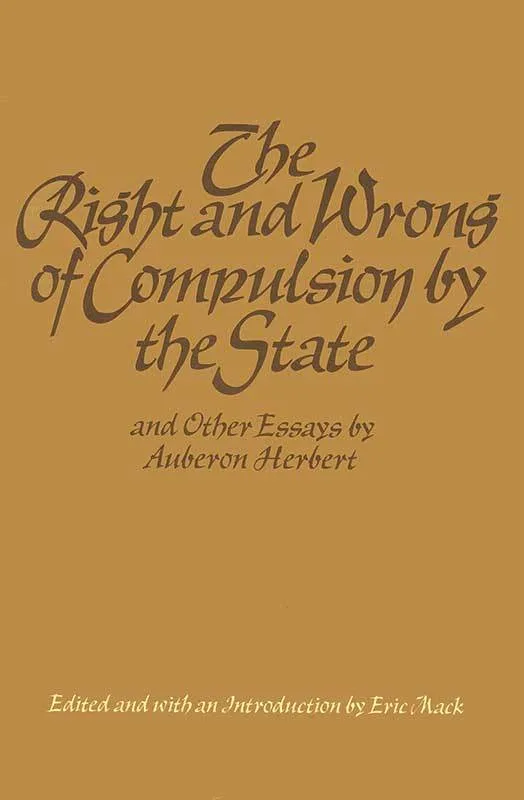
Auberon Herbert · 1885
The Right and Wrong of Compulsion by the State and Other Essays (1978 ed.)
A collection of essays by a leading late-19th century radical individualist and follower of the ideas of Herbert Spencer. Herbert discusses the moral problems of state coercion, especially when applied to state…
Thomas Mackay · 1891
A Plea for Liberty: An Argument against Socialism and Socialistic Legislation (LF ed.)
This collection of essays was originally published in 1891 in response to a collection of Fabian Essays on Socialism which advocated policies which would eventually lead to the modern welfare state. The theoretical and…
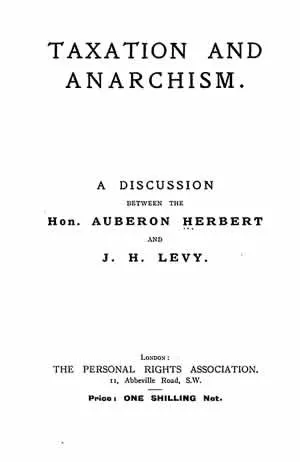
Joseph Hiam Levy · 1912
Taxation and Anarchism: A Discussion between the Hon. Auberon Herbert and J.H. Levy
A discussion between two radical individualists under the auspices of the Personal Rights Association. The exchange took place over many years and this booklet appeared after the death of one (Herbert in 1906) and one…
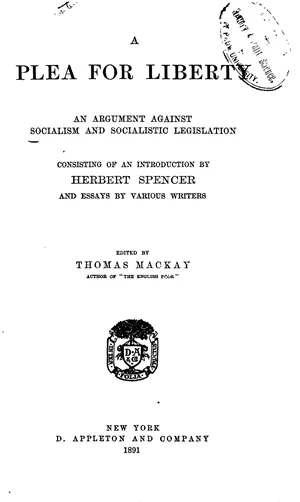
Auberon Herbert · 1891
A Plea for Liberty: An Argument against Socialism and Socialistic Legislation (1891 ed.)
This collection of essays was originally published in 1891 in response to a collection of Fabian Essays on Socialism which advocated policies which would eventually lead to the modern welfare state. The theoretical and…
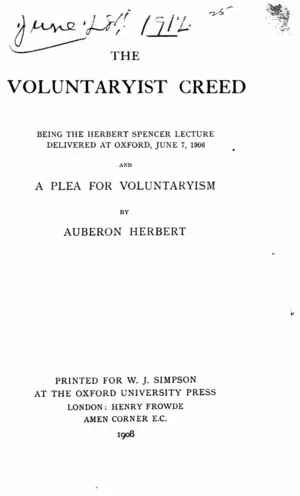
Auberon Herbert · 1906
The Voluntaryist Creed and A Plea for Voluntaryism
This volume consists of a lecture Herbert gave at Oxford University in 1906 in honour of Herbert Spencer and an essay he wrote just before his death outlining the principles of his philosophy of Voluntaryism.
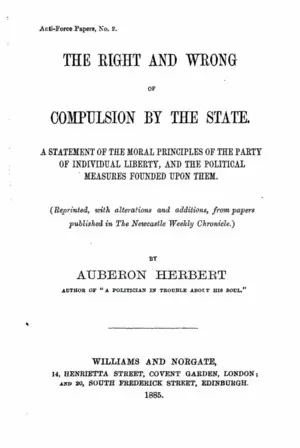
Auberon Herbert · 1885
The Right and Wrong of Compulsion by the State (1885)
A radical individualist appeals to the workmen of Tyneside in 1885 to give up demands for government intervention in the name of both morality and economic efficiency. The Liberty Fund edition includes this and other…
Quotes from Auberon Herbert
5 quotes from the library