Sociology1851
Social Statics
- Herbert Spencer(author)
Spencer’s first major work of political philosophy in which he attempts to lay the basis for a limited state on a rigorous development of a doctrine of natural rights. He begins with a defense of his “first principle” ’that every man, may claim the fullest liberty to exercise his faculties compatible with the possession of like liberty by every other man.” From that, he argues, follows all other rights.
Key Quotes
Passages from this text chosen by OLL editors.
- Natural Rights“
As a corollary to the proposition that all institutions must be subordinated to the law of equal freedom, we cannot choose but admit the right of the citizen to adopt a condition of voluntary outlawry. If every man has freedom to do all that he wills, provided he infringes not the equal freedom of any other man, then he is free to drop connection with the state—to relinquish its protection, and to refuse paying towards its support. It is self-evident that in so behaving he in no way trenches upon the liberty of others; for his position is a passive one; and whilst passive he cannot become an aggressor. It is equally selfevident that he cannot be compelled to continue one of a political corporation, without a breach of the moral law, seeing that citizenship involves payment of taxes; and the taking away of a man’s property against his will, is an infringement of his rights.
- Property Rights“
An argument fatal to the communist theory, is suggested by the fact, that a desire for property is one of the elements of our nature. ... And if a propensity to personal acquisition be really a component of man’s constitution, then that cannot be a right form of society which affords it no scope. ... it is also true that no change in the state of society will alter its nature and its office. To whatever extent moderated, it must still be a desire for personal acquisition. Whence it follows that a system affording opportunity for its exercise must ever be retained; which means, that the system of private property must be retained; and this presupposes a right of private property, for by right we mean that which harmonizes with the human constitution as divinely ordained.
About This Edition
Citation
Spencer, Herbert. Social Statics: or, The Conditions essential to Happiness specified, and the First of them Developed, (London: John Chapman, 1851).
Spencer, Herbert. Social Statics (1851). John Chapman, 1851. Online Library of Liberty, https://oll.libertyfund.org/titles/spencer-social-statics-1851.
Spencer, H. (1851). Social Statics (1851). John Chapman. https://oll.libertyfund.org/titles/spencer-social-statics-1851
@book{spencer18511851,
  author = {Herbert Spencer},
  title = {Social Statics (1851)},
  publisher = {John Chapman},
  address = {London},
  year = {1851},
  url = {https://oll.libertyfund.org/titles/spencer-social-statics-1851},
  note = {Online Library of Liberty}
}TY - BOOK AU - Spencer, Herbert TI - Social Statics (1851) PY - 1851 CY - London PB - John Chapman UR - https://oll.libertyfund.org/titles/spencer-social-statics-1851 DB - Online Library of Liberty ER -
Copyright
The text is in the public domain.

About the author
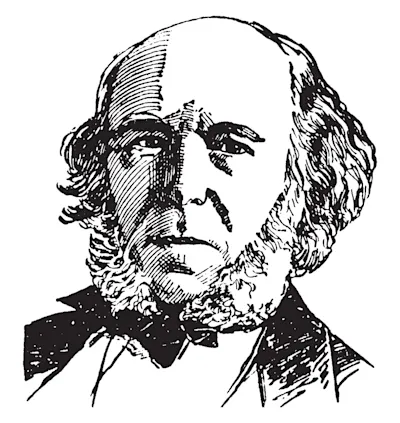
Herbert Spencer 1820–1903
Herbert Spencer (1820-1903) was one of the leading 19th century English radical individualists. He began working as a journalist for the laissez-faire magazine The Economist in the 1850s. Much of the rest of his life was spent working on an all-encompassing theory of human development based upon the ideas of individualism, utilitarian moral theory, social and biological evolution, limited government, and laissez-faire economics.
More in Sociology
See all >The Principles of Sociology, 3 vols. (1898)
Herbert SpencerPolitical Institutions, being Part V of the Principles of Sociology
Herbert SpencerThe Principles of Sociology, vol. 2 (1898)
Herbert SpencerThe Principles of Sociology, vol. 1 (1898)
Herbert SpencerThe Principles of Sociology, vol. 3 (1898)
Herbert SpencerThe Study of Sociology (1873)
Herbert Spencer