
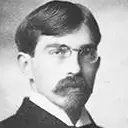
William Abbott Oldfather
1880–1945
William Abbott Oldfather was Professor of Classics at the University of Illinois at Urbana-Champaign.


Political Science
25 items in this collection
The natural law and natural rights tradition emerged in the 17th and 18th centuries and argues that the world is governed by natural laws which are discoverable by human reason. A key aspect of this intellectual tradition is the notion that natural rights are not created by governments. Governments are instead created to secure these rights.
In this collection
17 titles, earliest first.
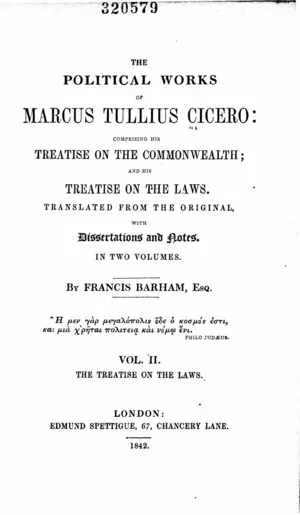
Marcus Tullius Cicero · 51 BC
The Treatise on the laws is Cicero’s imitation of Plato’s dialogue The Laws where he develops a Stoic theory of natural law as right reason. This book became very influential during the middle ages.
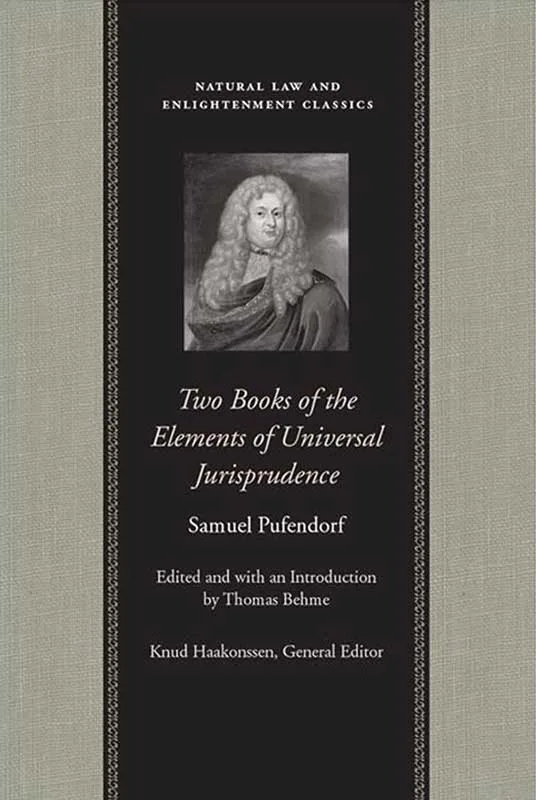
Samuel von Pufendorf · 1660
This was Pufendorf’s first work, published in 1660. Its appearance inaugurated the modern natural-law movement in the German-speaking world. The work also established Pufendorf as a key figure and laid the foundations…
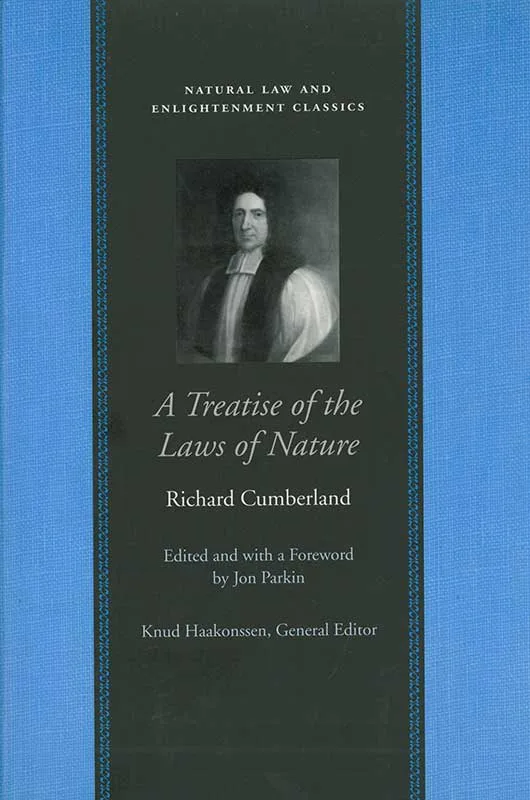
Richard Cumberland · 1672
A Treatise of the Laws of Nature, first appeared in 1672 as a theoretical response to a range of issues that came together during the late 1660s. It argued that science might offer an effective means of demonstrating…
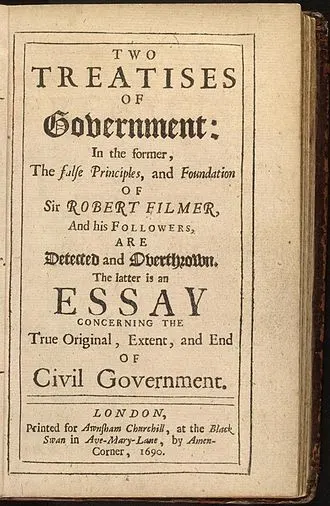
John Locke · 1689
Locke’s most famous work of political philosophy began as a reply to Filmer’s defense of the idea of the divine right of kings and ended up becoming a defense of natural rights, especially property rights, and of…
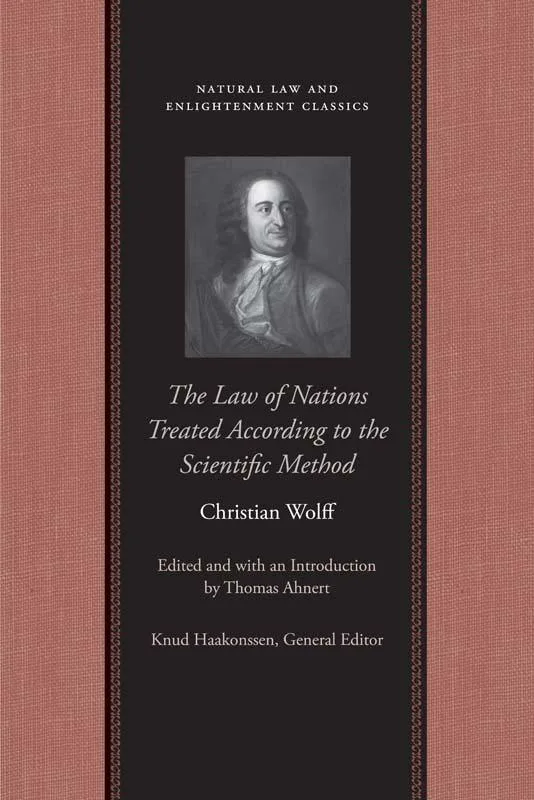
Christian Wolff · 1729
Christian Wolff’s The Law of Nations is a cornerstone of eighteenth-century thought. A treatise on the philosophy of human action, on the foundations of political communities, and on international law, it influenced…
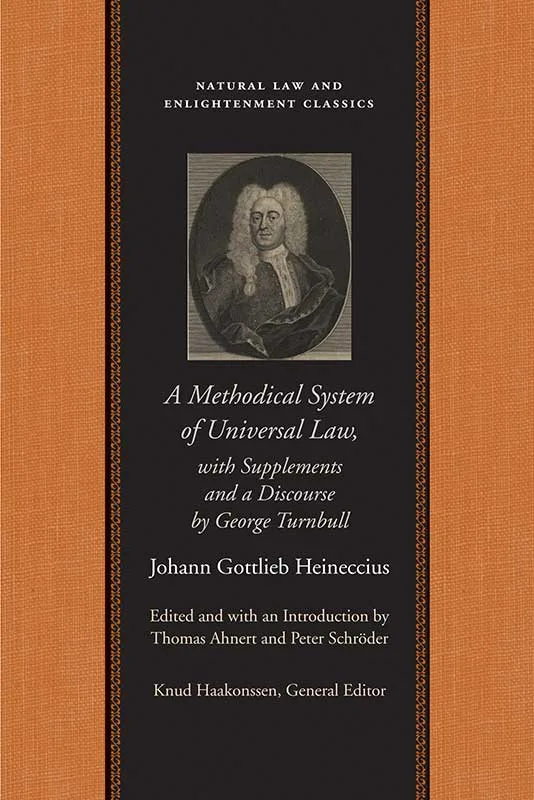
Johann Gottlieb Heineccius · 1738
The natural law theory of Johann Gottlieb Heineccius was one of the most influential to emerge from the early German Enlightenment. Heineccius continued and, in important respects, modified the ideas of his…
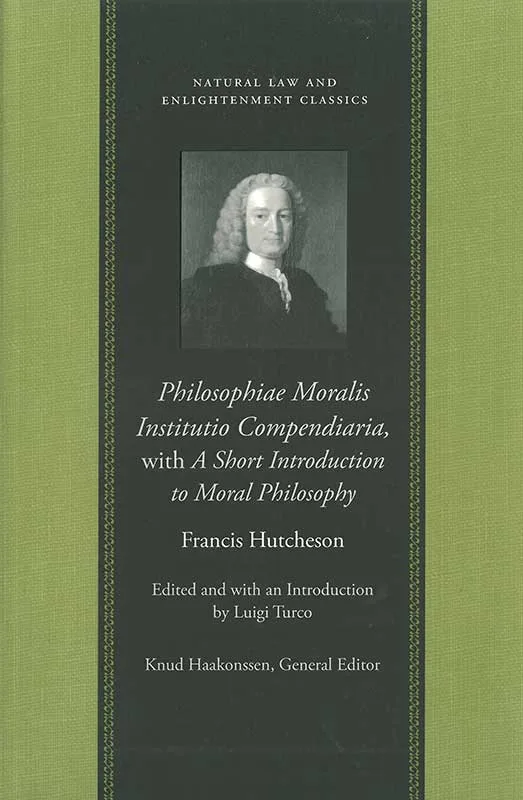
Francis Hutcheson · 1747
This Liberty Fund publication of Philosophiae Moralis Institutio Compendiaria is a parallel edition of the English and Latin versions of a book designed by Hutcheson for use in the classroom.
Thomas Paine · 1779
Vol. 2 of a 4 vol. collection of the works of Thomas Paine. Vol. 2 (1779-1792) contains the Letter to Abbey Raynal, Dissertations on Government, The Rights of Man (1 and 2) and various articles.
Thomas Hodgskin · 1832
In this series of letters to Lord Braugham, Hodgskin distinguishes between the natural right of property (based upon Lockean principles of natural law) and the artificial right of property (which is decreed by…
Herbert Spencer · 1851
Spencer’s first major work of political philosophy in which he attempts to lay the basis for a limited state on a rigorous development of a doctrine of natural rights. He begins with a defense of his “first principle”…
Sir James Mackintosh · 1871
This collections contains his philosophical writings on Locke, natural law, Thomas More, and Machiavelli; his historical writings on the Glorious Revolution, his defence of the French Revolution Vindiciae Gallicae; and…
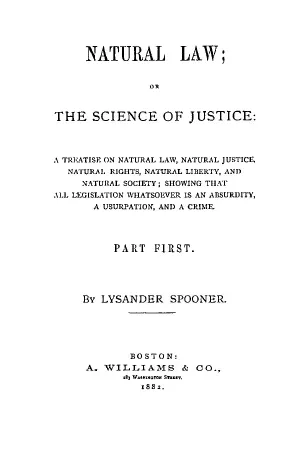
Lysander Spooner · 1882
Even this is entitled “The First” it is the only part Spooner published. It was meant to be the opening section of a much larger treatise on natural law. It is interesting because Spooner outlines the basic principles…
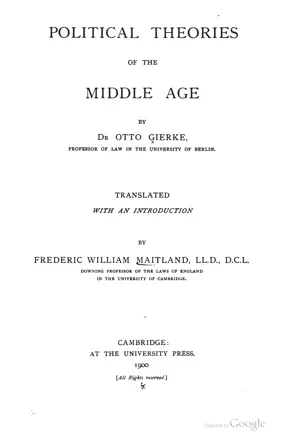
Otto von Gierke · 1900
A translation by F.W. Maitland of part of vol. 3 of Das deutsche Genossenschaftsrecht (1881) entitled “Die publicistischen Lehren des Mittelalters.” It is a short history of the evolution of modern political thought…
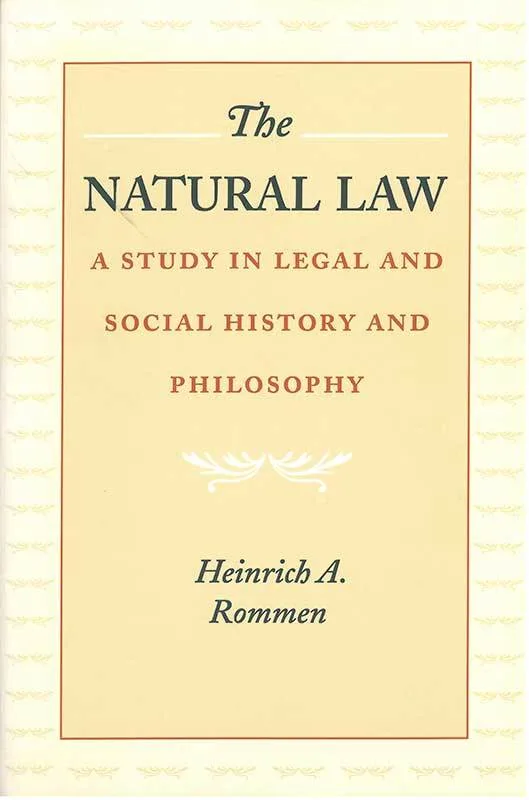
Heinrich Rommen · 1936
Originally published in German in 1936, The Natural Law is the first work to clarify the differences between traditional natural law as represented in the writings of Cicero, Aquinas, and Hooker and the revolutionary…
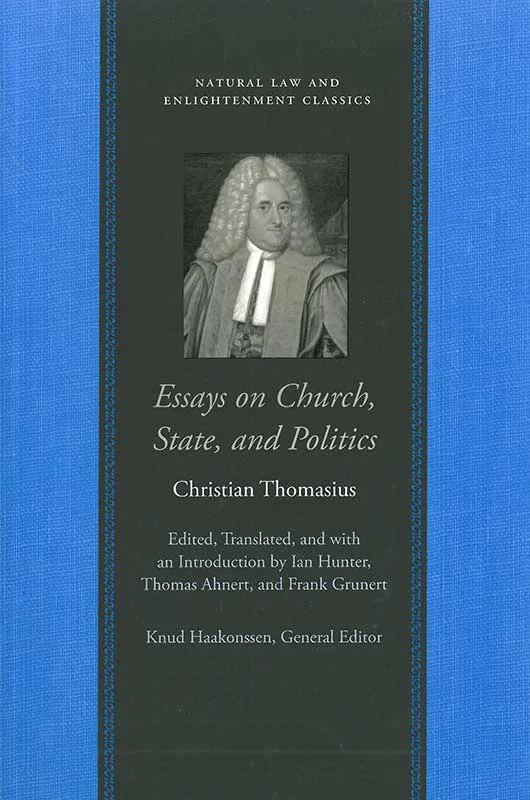
Christian Thomasius · 2007
The essays selected here for translation derive largely from Thomasius’s work on Staatskirchenrecht, or the political jurisprudence of church law. These works, originating as disputations, theses, and pamphlets, were…
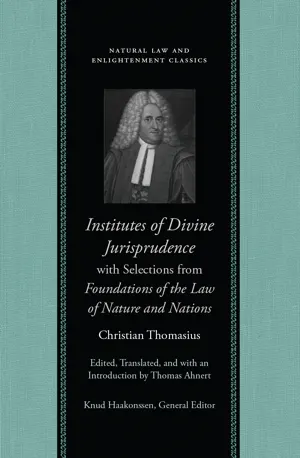
Christian Thomasius · 2011
First published in 1688, Thomasius’s Institutes attempted to draw a clear distinction between natural and revealed law and to emphasize that human reason was able to know the precepts of natural law without the aid of…
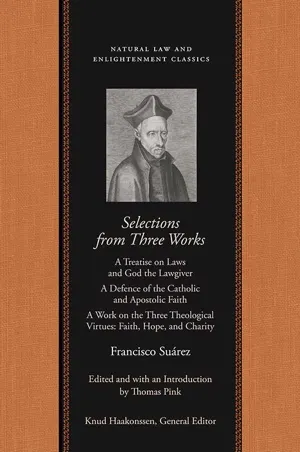
Francisco Suárez · 2015
The bulk of the selections in this volume are from A Treatise on Laws and God the Lawgiver (1612). In the Treatise Suárez presented a systematic account of human moral activity in all its dimensions, synthesizing the…
In this collection
3 people central to Natural Law and Natural Rights.
1880–1945
William Abbott Oldfather was Professor of Classics at the University of Illinois at Urbana-Champaign.

1714–1767
Emer de Vattel (1714-1767) was one of the foremost theorists of natural law in the 18th century. His writings were widely read in the…

1660–1724
William Wollaston (1660-1724) was an English philosopher whose most popular work was The Religion of Nature Delineated (1722) which went…
In this collection
From The Reading Room, Liberty Matters and the library’s other publications.
Sarah Skwire · Nov 25, 2022
Passages on this subject, chosen by OLL editors.
I here close my examination into those natural rights, which, in my humble opinion, it is the business of civil government to protect, and not to subvert, and the exercise of which it is the duty of civil government to enlarge, and not to restrain. I go farther; and now proceed to show, that in peculiar instances, in which those rights can receive neither protection nor reparation from civil government, they are, notwithstanding its institution, entitled still to that defence, and to those methods of recovery, which are justified and demanded in a state of nature.
Rights are, then, the fruits of the law, and of the law alone. There are no rights without law—no rights contrary to the law—no rights anterior to the law. Before the existence of laws there may be reasons for wishing that there were laws—and doubtless such reasons cannot be wanting, and those of the strongest kind;—but a reason for wishing that we possessed a right, does not constitute a right. To confound the existence of a reason for wishing that we possessed a right, with the existence of the right itself, is to confound the existence of a want with the means of relieving it. It is the same as if one should say, everybody is subject to hunger, therefore everybody has something to eat.
“’Tis not the same with Goodness as with other Qualitys, which we may understand very well, and yet not possess. We may have an excellent Ear in Musick, without being able to perform in any kind. We may judg well of Poetry, without being Poets, or possessing the least of a Poetick Vein: But we can have no tolerable Notion of Goodness, without being tolerably good. So that if the Praise of a Divine Being be so great a part of his Worship, we shou’d, methinks, learn Goodness, were it for nothing else than that we might learn, in some tolerable manner, how to praise. For the praise of Goodness from an unsound hollow Heart, must certainly make the greatest Dissonance in the world. (FROM: SECTION V)
If a body of soldiers, seeing another body approach, should fire upon them, would not this action declare that they were enemies; and if they were not enemies, would not this military language declare what was false? No, perhaps it may be said; this can only be called a mistake... Suppose then, instead of this firing, some officer to have said they were enemies, when indeed they were friends: would not that sentence affirming them to be enemies be false, notwithstanding he who spoke it was mistaken?... I lay this down then as a fundamental maxim, That whoever acts as if things were so, or not so, doth by his acts declare, that they are so, or not so; as plainly as he could by words, and with more reality. And if the things are otherwise, his acts contradict those propositions, which assert them to be as they are.
Liberty Fund is publishing an extensive collection of works about natural law in its Natural Law and Enlightenment Series including works by Hugo Grotius, Samuel von Pufendorf, and Francis Hutcheson.
See also the following schools of thought which supported the natural law and natural rights tradition:
And the 19th Century Utilitarians which did not.
For further reading on this topic see the works listed below:
Law
49 titles · 1 publication · 69 people

Political Science
618 titles · 60 publications · 383 people

Law
140 titles · 14 publications · 134 people
Law
41 titles · 25 publications · 75 people
Political Science
32 titles · 23 people

Philosophy, Psychology, and Religion
209 titles · 81 publications · 198 people