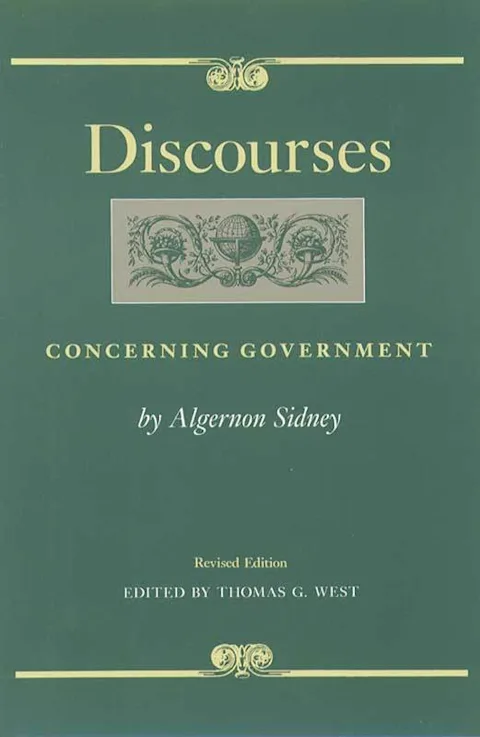
Discourses Concerning Government (LF ed.)
- Algernon Sidney(author)
- Thomas G. West(editor)
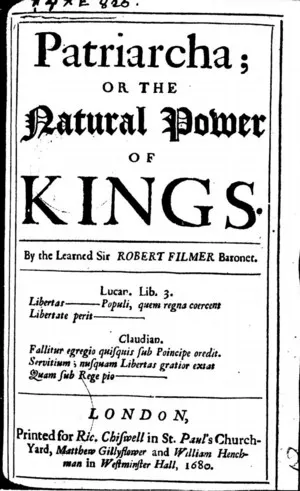
Written in response to Sir Robert Filmer’s Patriarcha (1680), the Discourses Concerning Government is a classic defense of republicanism and popular government. Sidney rejected Filmer’s theories of royal absolutism and divine right of kings, insisting that title to rule should be based on merit rather than birth; and republics, he thought, were more likely to honor merit than were monarchies.
Key Quotes
Passages from this text chosen by OLL editors.
- Presidents, Kings, Tyrants, & Despots“
Manus haec inimica tyrannis
Einse petit placidam cum libertate quietem.
(This hand, enemy to tyrants,
By the sword seeks calm peacefulness with liberty.) - Law“
SECTION 11: That which is not just, is not Law; and that which is not Law, ought not to be obeyed.
… the directive power of the law, which is certain, and grounded upon the inherent good and rectitude that is in it, is that alone which has a power over the conscience, whereas the coercive is merely contingent; and the most just powers commanding the most just things, have so often fallen under the violence of the most unjust men, commanding the most execrable villainies, that if they were therefore to be obeyed, the consciences of men must be regulated by the success of a battle or conspiracy, than which nothing can be affirmed more impious and absurd….
If this were so, the governments of the world might be justly called magna latrocinia; and men laying aside all considerations of reason or justice, ought only to follow those who can inflict the greatest punishments, or give the greatest rewards. But since the reception of such opinions would be the extirpation of all that can be called good, we must look for another rule of our obedience, and shall find that to be the law, which being, as I said before, sanctio recta, must be founded upon that eternal principle of reason and truth, from whence the rule of justice which is sacred and pure ought to be deduced, and not from the depraved will of man, which fluctuating according to the different interests, humors and passions that at several times reign in several nations, one day abrogates what had been enacted the other. The sanction therefore that deserves the name of a law, which derives not its excellency from antiquity, or from the dignity of the legislators, but from an intrinsick equity and justice, ought to be made in pursuance of that universal reason to which all nations at all times owe an equal veneration and obedience.
- Class“
They (Princes) consider nations, as grazers do their herds and flocks, according to the profit that can be made of them: and if this be so, a people has no more security under a prince, than a herd or flock under their master. Tho he desire to be a good husband, yet they must be delivered up to the slaughter when he finds a good market, or a better way of improving his land. ... they look upon us not as children, but as beasts, nor do us any good for our own sakes, or because it is their duty, but only that we may be useful to them, as oxen are put into plentiful pastures that they may be strong for labour, or fit for slaughter. This is the divine model of government that he offers to the world.
About This Edition
Citation
Sidney, Algernon. Discourses Concerning Government, ed. Thomas G. West (Indianapolis: Liberty Fund 1996).
Sidney, Algernon. Discourses Concerning Government. Edited by Thomas G. West, Liberty Fund, 1996. Online Library of Liberty, https://oll.libertyfund.org/titles/sidney-discourses-concerning-government.
Sidney, A. (1996). Discourses Concerning Government. Liberty Fund. https://oll.libertyfund.org/titles/sidney-discourses-concerning-government
@book{sidney1996government,
  author = {Algernon Sidney},
  editor = {Thomas G. West},
  title = {Discourses Concerning Government},
  publisher = {Liberty Fund},
  address = {Indianapolis},
  year = {1996},
  url = {https://oll.libertyfund.org/titles/sidney-discourses-concerning-government},
  note = {Online Library of Liberty}
}TY - BOOK AU - Sidney, Algernon A2 - West, Thomas G. TI - Discourses Concerning Government PY - 1996 CY - Indianapolis PB - Liberty Fund UR - https://oll.libertyfund.org/titles/sidney-discourses-concerning-government DB - Online Library of Liberty ER -
Copyright
The copyright to this edition, in both print and electronic forms, is held by Liberty Fund, Inc.

About the author
Algernon Sidney 1622–1683
Algernon Sidney (1622-1683) was a radical English republican political theorist who challenged Filmer’s theory of the divine right of kings. He was executed for treason in 1683.
More in Political Theory
See all >The Political Writings of Jean Jacques Rousseau vol. 1
Jean-Jacques RousseauThe Writings of Thomas Paine, Vol. I (1774-1779)
Thomas PaineDissertations on Early Law and Custom
Sir Henry Sumner MaineAncient Law
Sir Henry Sumner MaineThe Political Writings of Jean Jacques Rousseau, 2 vols.
Jean-Jacques RousseauLeviathan (1909 ed)
Thomas HobbesPatriarcha, or the Natural Power of Kings
Sir Robert FilmerThe Man versus the State (1885 ed.)
Herbert SpencerThe Man versus the State, with Six Essays on Government, Society and Freedom (LF ed.)
Herbert Spencer