John Stuart Mill · 1812
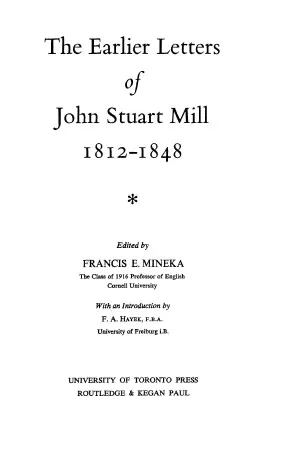
The Collected Works of John Stuart Mill, Volume XII - The Earlier Letters 1812-1848 Part I
Vol. 12 of the 33 vol. Collected Works contains Mill’s letters written between 1812-1837.

Political Science
32 titles · 23 people · Nineteenth century · Britain
The Collected Works of John Stuart Mill, ed. J.M. Robson (Toronto: University of Toronto Press, London: Routledge and Kegan Paul, 1963-1991), 33 vols. Editorial committee: J.M. Robinson, General Editor, Harold Bohme, J.C. Cairns, J.B. Conacher, D.P. Dryer, Marion Filipiuk, Frances Halpenny, Samuel Hollander, R.F. McRae, Ian Montagnes, Ann P. Robson, F.E. Sparshott.
All 33 vols. are available online at the Online Library of Liberty. Volumes I, II, III, IV, V, VII, VIII, and X have been republished in book form by Liberty Fund.
In this collection
32 titles, earliest first.
John Stuart Mill · 1812
Vol. 12 of the 33 vol. Collected Works contains Mill’s letters written between 1812-1837.
John Stuart Mill · 1820
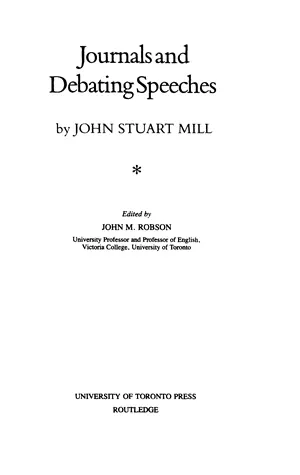
Vol. 26 of the 33 vol. Collected Works contains Mill’s juvenile writings from the 1820s such as journals, notebooks, and debating speeches.
John Stuart Mill · 1822
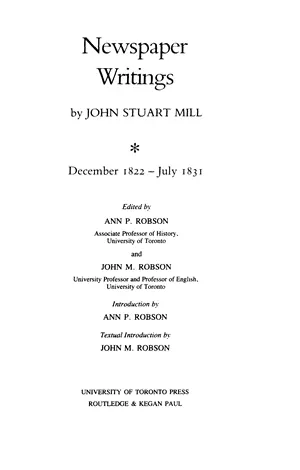
Vol. 22 of the 33 vol. Collected Works contains Mill’s newspaper articles from 1822-1831, including many on the French Revolution of 1830 and the series called The Spirit of the Age.
John Stuart Mill · 1824
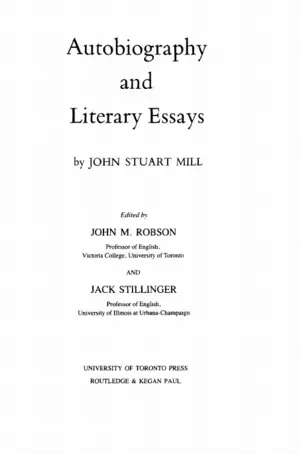
Vol. 1 of the 33 vol. Collected Works contains Mill’s autobiography and some literary essays mostly from the 1830s.
John Stuart Mill · 1824
Vol. 4 of the 33 vol. Collected Works contains a number of Mill’s essays on economic topics, including the collection Essays on Some Unsettled Questions of Political Economy.
John Stuart Mill · 1824
Vol. 6 of the 33 vol. Collected Works contains a number of Mill’s essays on contemporary political issues, including his essay Reorganization of the Reform Party.
John Stuart Mill · 1824
Vol. 32 of the 33 vol. Collected Works contains letters by Mill which were left out of earlier volumes and a full list of correspondents, and of persons and works cited in the letters.
John Stuart Mill · 1825
Vol. 21 of the 33 vol. Collected Works contains a number of Mill’s essays on the law, women and children, the American Civil War, and his book on The Subjection of Women. It also contains in the Appendix Harriet…
John Stuart Mill · 1826
Vol. 20 of the 33 vol. Collected Works contains a number of Mill’s essays and book reviews about French history.
John Stuart Mill · 1827
Vol. 27 of the 33 vol. Collected Works contains Mill’s diaries of his walking tours 1827-32, a diary from 1854 and other material from the early 1820s.
John Stuart Mill · 1827
Vol. 31 of the 33 vol. Collected Works contains Mill’s writings on botany and reviews of medical books. It also contains his edition of Bentham’s Rationale of Judicial Evidence and his father’s Analysis of the Phenomena…
John Stuart Mill · 1828
Vol. 11 of the 33 vol. Collected Works contains a number of Mill’s essays on philosophy, Plato, Aristotle, and the history of Greece.
John Stuart Mill · 1828
Vol. 30 of the 33 vol. Collected Works contains Mill’s longer writings on India. Some parliamentary speeches and newspaper articles can be found in other volumes.
John Stuart Mill · 1831
Vol. 23 of the 33 vol. Collected Works contains Mill’s newspaper articles from 1831-1834, including many on the French Revolution of 1830 and a number on the Poor Law Report.
John Stuart Mill · 1833
Vol. 10 of the 33 vol. Collected Works contains a number of Mill’s essays on religion and moral philosophy as well as his works on Utilitarianism and Auguste Comte.
John Stuart Mill · 1835
Vol. 24 of the 33 vol. Collected Works contains Mill’s newspaper articles from 1835-1847, including many on the Bank Charter and the Condition of Ireland.
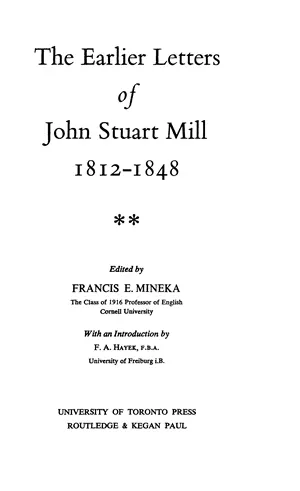
John Stuart Mill · 1838
Vol. 13 of the 33 vol. Collected Works contains Mill’s letters written between 1838-1848 with an Introdcution by F.A. Hayek.
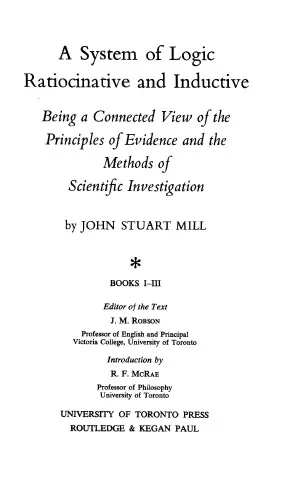
John Stuart Mill · 1843
Vol. 7 of the 33 vol. Collected Works contains Part 1 of Mill’s System of Logic. It contains chapters on reasoning, induction, the laws of nature, causation, and disbelief.
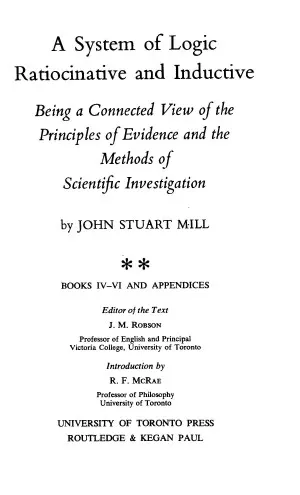
John Stuart Mill · 1843
Vol. 8 of the 33 vol. Collected Works contains Part 2 of Mill’s System of Logic. It contains chapters on fallacies, methodology of the social sciences, and the science of history.
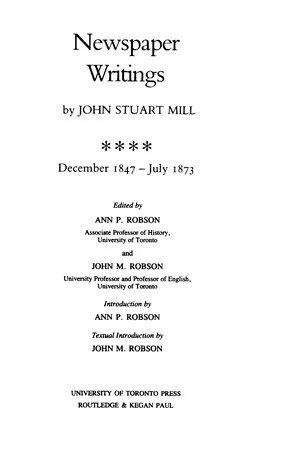
John Stuart Mill · 1847
Vol. 25 of the 33 vol. Collected Works contains Mill’s newspaper articles from 1847-1873, including a number of electoral reform and the revolution in Hungary.
John Stuart Mill · 1848
Vol. 2 of the 33 vol. Collected Works contains Part 1 of Mill’s Principles of Political Economy.
John Stuart Mill · 1848
Vol. 3 of the 33 vol. Collected Works contains Part 2 of Mill’s Principles of Political Economy.
John Stuart Mill · 1849
Vol. 14 of the 33 vol. Collected Works contains Mill’s letters written between 1849-1855.
John Stuart Mill · 1850
Vol. 5 of the 33 vol. Collected Works contains a number of Mill’s essays on economic topics, including the Chapters on Socialism.
John Stuart Mill · 1850
Vol. 28 of the 33 vol. Collected Works contains Mill’s electoral and parliamentary speeches from 1865-1868, including those on the right of women to vote, the Reform Bill, the riots in Jamaica, India, and smoking in…
John Stuart Mill · 1856
Vol. 15 of the 33 vol. Collected Works contains Mill’s letters written between 1856-1864.
John Stuart Mill · 1865
Vol. 9 of the 33 vol. Collected Works contains Mill’s book on William Hamilton’s philosophy.
John Stuart Mill · 1865
Vol. 16 of the 33 vol. Collected Works contains Mill’s letters written between 1865-1868.
John Stuart Mill · 1869
Vol. 17 of the 33 vol. Collected Works contains Mill’s letters written between 1869-1873.
John Stuart Mill · 1869
Vol. 29 of the 33 vol. Collected Works contains Mill’s electoral and parliamentary speeches from 1869-1873, including women’s suffrage education, and land reform. It also includes an essay by Helen Taylor on War and…
John Stuart Mill · 1977
Vol. 19 of the 33 vol. Collected Works contains a number of Mill’s essays on politics and his book Considerations on Representative Government.
John Stuart Mill · 1977
Vol. 18 of the 33 vol. Collected Works contains a number of Mill’s essays on politics, including his reviews of Tocqueville’s Democracy in America and his book On Liberty.
Passages from titles in this collection, chosen by OLL editors.
The object of this Essay is to assert one very simple principle, as entitled to govern absolutely the dealings of society with the individual in the way of compulsion and control, whether the means used be physical force in the form of legal penalties, or the moral coercion of public opinion. That principle is, that the sole end for which mankind are warranted, individually or collectively, in interfering with the liberty of action of any of their number, is self-protection. That the only purpose for which power can be rightfully exercised over any member of a civilized community, against his will, is to prevent harm to others. ... In the part which merely concerns himself, his independence is, of right, absolute. Over himself, over his own body and mind, the individual is sovereign.
To prevent the weaker members of the community from being preyed upon by innumerable vultures, it was needful that there should be an animal of prey stronger than the rest, commissioned to keep them down. But as the king of the vultures would be no less bent upon preying on the flock than any of the minor harpies, it was indispensable to be in a perpetual attitude of defence against his beak and claws. The aim, therefore, of patriots was to set limits to the power which the ruler should be suffered to exercise over the community; and this limitation was what they meant by liberty. It was attempted in two ways. First, by obtaining a recognition of certain immunities, called political liberties or rights, which it was to be regarded as a breach of duty in the ruler to infringe, and which, if he did infringe, specific resistance, or general rebellion, was held to be justifiable. A second, and generally a later expedient, was the establishment of constitutional checks, by which the consent of the community, or of a body of some sort, supposed to represent its interests, was made a necessary condition to some of the more important acts of the governing power.
A government cannot have too much of the kind of activity which does not impede, but aids and stimulates, individual exertion and development. The mischief begins when, instead of calling forth the activity and powers of individuals and bodies, it substitutes its own activity for theirs; when, instead of informing, advising, and, upon occasion, denouncing, it makes them work in fetters, or bids them stand aside and does their work instead of them. The worth of a State, in the long run, is the worth of the individuals composing it; and a State which postpones the interests of their mental expansion and elevation, to a little more of administrative skill, or of that semblance of it which practice gives, in the details of business; a State which dwarfs its men, in order that they may be more docile instruments in its hands even for beneficial purposes—will find that with small men no great thing can really be accomplished; and that the perfection of machinery to which it has sacrificed everything, will in the end avail it nothing, for want of the vital power which, in order that the machine might work more smoothly, it has preferred to banish.
The occasion was one for deep grief, not for irritation. He agreed with the honourable Member for Birmingham (Mr. Bright) that this Bill was a cause for shame and humiliation to this country. We were present at the collapsing of a great delusion. England had for a considerable number of years been flattering itself that the Irish people had come to their senses; that they were now sensible that they had got Catholic Emancipation and the Incumbered Estates Bill, which were the only things they could possibly want; and had become aware that a nation could not have anything to complain of when it was under such beneficent rulers as us, who, if we do but little for them, would so gladly do much if we only knew how... But we had fallen into the mistake of thinking that good intentions were enough... He hardly knew to what to compare the position of England towards Ireland, but some illustration of his meaning might be drawn from the practice of flogging. Flogging in some few cases was probably a necessary abomination, because there were some men and boys whom long persistence in evil had so brutalized and perverted that no other punishment had any chance of doing them good. But when any man in authority-- whether he was the captain of a ship or the commander of a regiment, or the master of a school, needed the instrument of flogging to maintain his authority--that man deserved flogging as much as any of those who were flogged by his orders.
Political Science
63 titles · 58 people

Political Science
6 titles · 8 people
Political Science
3 titles · 5 people
Political Science
2 titles · 1 person
Political Science
3 titles · 16 people
Political Science
3 titles · 3 people