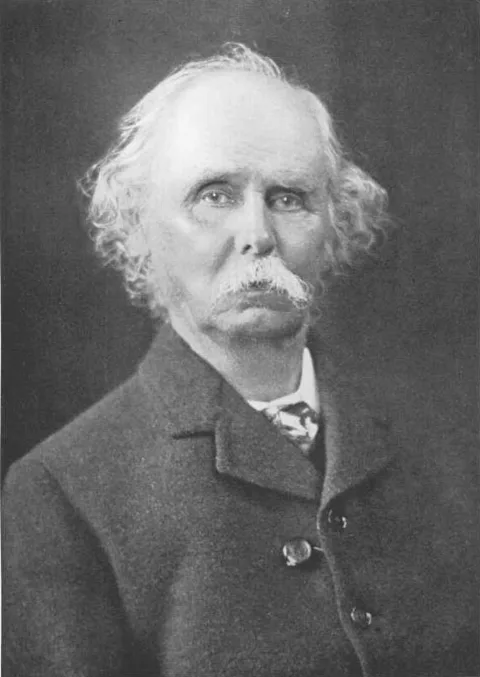
Principles of Economics (8th ed.)
- Alfred Marshall(author)
This is the 8th edition of what is regarded to be the first “modern” economics textbook, leading in various editions from the 19th into the 20th century. The final 8th edition was Marshall’s most-used and most-cited.
About This Edition
Citation
Marshall, Alfred. Principles of Economics (London: Macmillan and Co. 8th ed. 1920).
Marshall, Alfred. Principles of Economics (8th ed.). Macmillan, 1920. Online Library of Liberty, https://oll.libertyfund.org/titles/marshall-principles-of-economics-8th-ed.
Marshall, A. (1920). Principles of Economics (8th ed.). Macmillan. https://oll.libertyfund.org/titles/marshall-principles-of-economics-8th-ed
@book{marshall1920ed,
  author = {Alfred Marshall},
  title = {Principles of Economics (8th ed.)},
  publisher = {Macmillan},
  address = {London},
  year = {1920},
  url = {https://oll.libertyfund.org/titles/marshall-principles-of-economics-8th-ed},
  note = {Online Library of Liberty}
}TY - BOOK AU - Marshall, Alfred TI - Principles of Economics (8th ed.) PY - 1920 CY - London PB - Macmillan UR - https://oll.libertyfund.org/titles/marshall-principles-of-economics-8th-ed DB - Online Library of Liberty ER -
Copyright
The text is in the public domain.

About the author
Alfred Marshall 1842–1924
Alfred Marshall, English economist at the University of Cambridge, reconciled many neoclassical economic concepts and introduced many of the modern terms and diagrams used today by economists. His teaching covered marginal utility, elasticity of demand, production costs, and consumer surplus.
Related People
William Stanley Jevons
Author
One of the founders of marginal utility theory, which shaped Marshall’s ideas on demand.
Carl Menger
Author
Founder of the Austrian School, focusing on subjective value and marginal analysis.
Léon Walras
Author
Introduced general equilibrium theory, contrasting with Marshall’s partial equilibrium approach.
Adam Smith
Author
The cornerstone of economic thought, introducing the invisible hand, division of labor, and market efficiency.
David Ricardo
Author
Developed comparative advantage and rent theory, influencing Marshall’s views on cost structures.


Critical Responses
Works that answer or challenge this text.
 Book
Foundations of Economic Analaysis
Paul SamuelsonVisit site ↗Samuelson's classic text brings mathematical rigor to economic theory, formalizing concepts Marshall introduced.
 Essay
Free Trade's Origin Myth
Oren CassVisit site ↗American elites-and perhaps Alfred Marshall- accepted the economic theory of "comparative advantage" mainly because it justified their geopolitical agenda.
Connected Readings
What to read next.

Neoclassical Economics
E. Roy WeintraubThe Concise Encyclopedia of Economics
Visit site ↗In the 19th century, the classical “substance” theories of value, which took value to be a property inherent in an object, gradually gave way to a perspective in which value was associated with the relationship between the object and the person obtaining the object. Several economists in different places at about the same time (the 1870s and 1880s) began to base value on the relationship between costs of production and “subjective elements,” later called “supply” and “demand.” This came to be known as the Marginal Revolution in economics, and the overarching theory that developed from these ideas came to be called neoclassical economics.
- Liberty Matters
On the Origin of the Supply-and-Demand Graph
Donald J. BoudreauxView title >Donald Boudreaux digs into the graph that Marshall made famous in his "Principles."
More in Economic theory. Demography
See all >The Collected Works of Frédéric Bastiat. Vol. 2: The Law, The State, and Other Political Writings, 1843-1850
Frédéric BastiatCost and Choice: An Inquiry in Economic Theory, Vol. 6 of the Collected Works
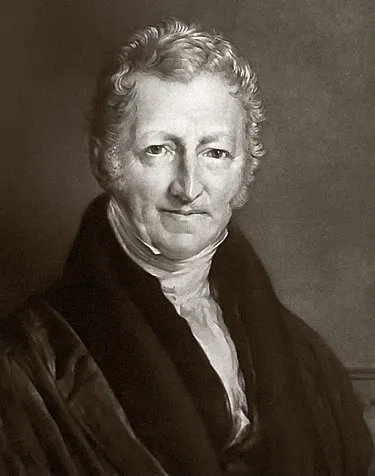
James M. BuchananAn Essay on the Principle of Population, vol. 1 [1826, 6th ed.]
Thomas Robert MalthusUniversal Economics
Armen A. AlchianCan Capitalism Survive?
Benjamin A. RoggeAn Essay on the Principle of Population [1798, 1st ed.]
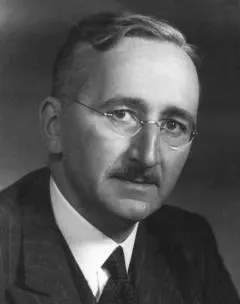
Thomas Robert Malthus“The Use of Knowledge in Society” (1945)
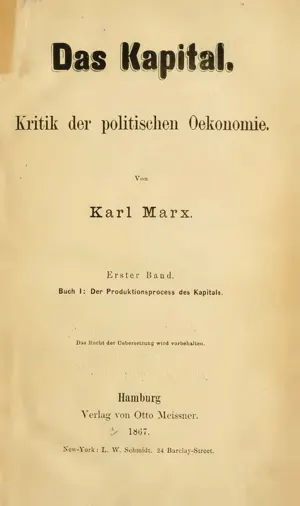
Friedrich August von HayekDas Kapital. Kritik der politischen Oekonomie. Buch 1 (1867)
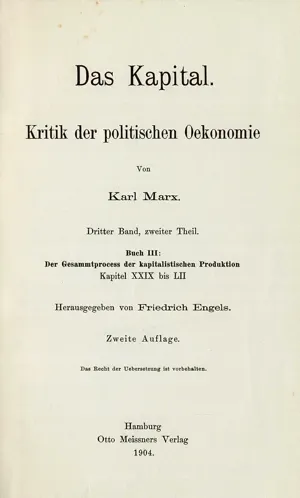
Karl MarxDas Kapital. Kritik der politischen Ökonomie. Buch III, zweiter Theil (1894)
Karl Marx