The Free Sea (Hakluyt trans.)
- Hugo Grotius(author)
- William Welwod(author)
- David Armitage(editor)
- Richard Hakluyt(translator)
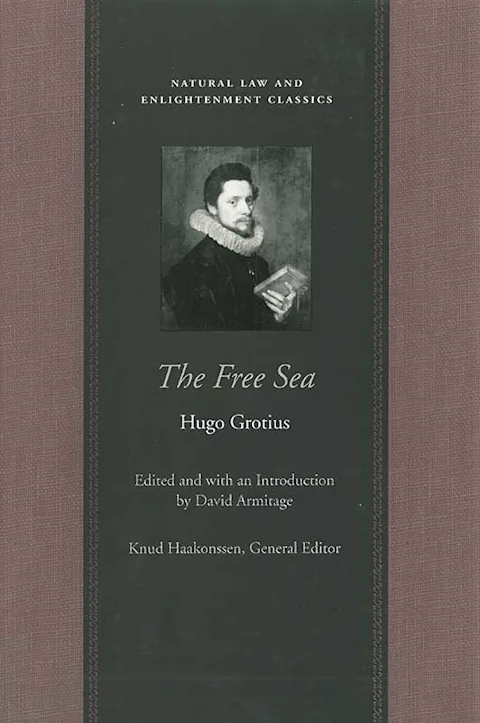
Grotius’s influential argument in favor of freedom of navigation, trade, and fishing in Richard Hakluyt’s translation. The book also contains William Welwod’s critque and Grotius’s reply to Welwod.
About This Edition
Citation
The Free Sea, trans. Richard Hakluyt, with William Welwod’s Critiuqe and Grotius’s Reply, ed. David Armitage (Indianapolis: Liberty Fund, 2004).
Grotius, Hugo and William Welwod. The Free Sea (Hakluyt trans.). Edited by David Armitage, translated by Richard Hakluyt, Liberty Fund, 2004. Online Library of Liberty, https://oll.libertyfund.org/titles/hakluyt-the-free-sea-hakluyt-trans.
Grotius, H. & Welwod, W. (2004). The Free Sea (Hakluyt trans.). Liberty Fund. https://oll.libertyfund.org/titles/hakluyt-the-free-sea-hakluyt-trans
@book{grotius2004trans,
  author = {Hugo Grotius and William Welwod},
  editor = {David Armitage},
  title = {The Free Sea (Hakluyt trans.)},
  publisher = {Liberty Fund},
  address = {Indianapolis},
  year = {2004},
  url = {https://oll.libertyfund.org/titles/hakluyt-the-free-sea-hakluyt-trans},
  note = {Online Library of Liberty}
}TY - BOOK AU - Grotius, Hugo AU - Welwod, William A2 - Armitage, David A3 - Hakluyt, Richard TI - The Free Sea (Hakluyt trans.) PY - 2004 CY - Indianapolis PB - Liberty Fund UR - https://oll.libertyfund.org/titles/hakluyt-the-free-sea-hakluyt-trans DB - Online Library of Liberty ER -
Copyright
The copyright to this edition, in both print and electronic forms, is held by Liberty Fund, Inc.

About the author
Hugo Grotius 1583–1645
Hugo Grotius (1583-1645) was a Dutch scholar and jurist whose legal masterpiece, De Jure Belli ac Pacis (On the law of war and peace) (1625), contributed significantly to the formation of international law as a distinct discipline. In addition to that work, Grotius wrote a number of literary pieces of lasting merit, including Sacra (a collection of Latin poems) and the drama Christus Patiens. Like Erasmus, Grotius sought to end the religious schism and urged the papacy to reconcile with the Protestant faiths.
Related People
Francisco de Vitoria
Author
The Spanish theologian greatly influenced Grotius’ work, especially with regard to international law and the rules of commerce, especially those in The Free Sea.
John Locke
Author
Grotius was one of Locke’s key influences, and both philosophers inspired the political and cultural ideas of the Glorious Revolution and the American Revolution.
Samuel von Pufendorf
Author
The German philosopher and jurist was influenced by Grotius, though they disagreed on the source and applications of natural law.
St. Thomas Aquinas
Author
Aquinas’ work on natural law, human rights, and morality was instrumental in Grotius’ ethical philosophy.
Thomas Jefferson
Author
Grotius’ work on natural rights, the social contract, and the rule of law inspired many of the American Founding Fathers, including Jefferson.


Critical Responses
Works that answer or challenge this text.
 Book
Solution 295-304: Mare Amoris
Ingo NiermannVisit site ↗Niermann outlines his belief that the ideal of free maritime trade has caused rampant exploitation of the ocean, and his proposition of a new way to engage with the ocean economically and politically.
 Podcast
Anne Applebaum on the Twilight of Democracy
Anne Applebaum and Russ RobertsEconTalk
Visit site ↗The Free Sea deals with complex issues of national sovereignty, issues nations in the European Union's need to balance contemporarily, a line that Roberts and Applebaum fall on opposing sides of.
- Journal Article
The Imperialism of Free Trade
John Gallagher and Ronald RobinsonVisit site ↗The 1953 journal article ties the expansion of colonialism and imperialism in the 19th century, especially that of the British Empire, to free trade. Gallagher and Robsinson’s arguments indict Grotius’ free trade and exploration as colonialist apologia.
Connected Readings
What to read next.
- Econlib Article
Free Trade
Alan S. BlinderVisit site ↗Alan Blinder explains why economists are nearly universally in agreement about the benefits of free trade.
 Book
A Splendid Exchange: How Trade Shaped the World
William J. BernsteinVisit site ↗The Free Sea would become an instrumental work in the advocation of free trade, Bernstein shows the effect the expansion of global trade has had on human progress, values, and the environment.
- Podcast
William Bernstein on the History of Trade
William Bernstein and Russ RobertsVisit site ↗In this conversation with Russ Roberts, Bernstein talks about the magic of spices, how trade in sugar explains why Jews ended up in Manhattan, the real political economy of the Boston Tea Party and the demise of the Corn Laws in England.
- Website
The Rise And Fall Of The Largest Corporation In History
Bryan TaylorVisit site ↗Grotius wrote The Free Sea to defend the Dutch East India Company's right to operate freely in the waters of Southeast Asia, assisting in the company becoming a global trade superpower.
- Econlib Article
Free Trade and TPP
Pierre LemieuxVisit site ↗The Free Sea was a foundational work in international law, especially in trade agreement and disputes. Lemieux examines a recent large proposed trade deal, the Trans-Pacific Partnership.
More in Law of nations
See all >The Rights of War and Peace (2005 ed.) vol. 2 (Book II)
Hugo GrotiusThe Rights of War and Peace (2005 ed.) vol. 3 (Book III)
Hugo GrotiusThe Rights of War and Peace (2005 ed.) vol. 1 (Book I)
Hugo GrotiusThe Law of Nations Treated According to the Scientific Method
Christian WolffA Methodical System of Universal Law: Or, the Laws of Nature and Nations
Johann Gottlieb HeinecciusThe Law of Nations (LF ed.)
Emer de VattelLe droit des gens, ou Principes de la loi naturelle, 2 vols.
Emer de VattelThe Rights of War and Peace (1901 ed.)
Hugo GrotiusLe droit des gens, ou Principes de la loi naturelle, vol. 1
Emer de Vattel