The Tempest
Part of The Complete Works of William Shakespeare (The Oxford Shakespeare)
- William Shakespeare(author)
- William James Craig(editor)
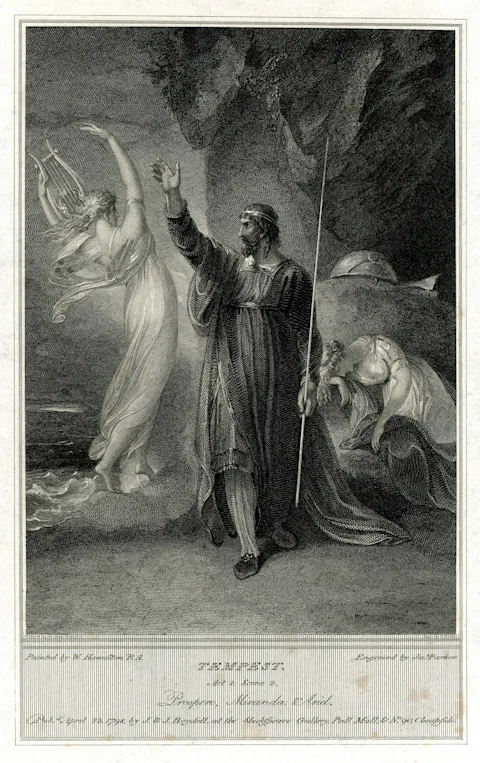
Thought to be one of Shakespeare’s latest plays, The Tempest is haunted by magic and by images of humans at their best and their worst. Many critics read Prospero’s farewell to his books at the play’s end as conveying, in some way, the thoughts of the play’s aging author about his own theatrical career. This edition comes from the 1916 Oxford University Press edition of all of Shakespeare’s plays and poems.
Key Quotes
Passages from this text chosen by OLL editors.
- Literature & Music“
I must eat my dinner.
This island's mine, by Sycorax my mother,
Which thou tak'st from me. When thou camest first,
Thou strok'dst me, and mad'st much of me; wouldst give me
Water with berries in't; and teach me how
To name the bigger light, and how the less,
That burn by day and night: and then I lov'd thee
And show'd thee all the qualities o' th' isle,
The fresh springs, brine-pits, barren place, and fertile.
Cursed be I that did so!–All the charms
Of Sycorax, toads, beetles, bats, light on you!
For I am all the subjects that you have,
Which first was mine own king; and here you sty me
In this hard rock, whiles you do keep from me
The rest o' th' island.
About This Edition
Citation
The Complete Works of William Shakespeare (The Oxford Shakespeare), ed. with a glossary by W.J. Craig M.A. (Oxford University Press, 1916).
Shakespeare, William. The Tempest. Edited by William James Craig, Oxford University Press, 1916. Online Library of Liberty, https://oll.libertyfund.org/titles/shakespeare-the-tempest.
Shakespeare, W. (1916). The Tempest. Oxford University Press. https://oll.libertyfund.org/titles/shakespeare-the-tempest
@book{shakespeare1916tempest,
  author = {William Shakespeare},
  editor = {William James Craig},
  title = {The Tempest},
  publisher = {Oxford University Press},
  address = {Oxford},
  year = {1916},
  url = {https://oll.libertyfund.org/titles/shakespeare-the-tempest},
  note = {Online Library of Liberty}
}TY - BOOK AU - Shakespeare, William A2 - Craig, William James TI - The Tempest PY - 1916 CY - Oxford PB - Oxford University Press UR - https://oll.libertyfund.org/titles/shakespeare-the-tempest DB - Online Library of Liberty ER -
Copyright
The text is in the public domain.

About the author
William Shakespeare 1564–1616
William Shakespeare (1564-1616) is probably the best known poet and playwright of the English language. He is considered by many to be the greatest poet and dramatist of all time. The plays he wrote nearly four hundred years ago for a small theater in London are now performed in more countries and more often than those of any other playwright.
Related People
Geoffrey Chaucer
Author
The greatest English writer before Shakespeare, Chaucer pioneered the use of English, rather than French or Latin, for serious literary works. He also brought all classes of society onto the page together, particularly in his masterwork, The Canterbury Tales.

Critical Responses
Works that answer or challenge this text.
 Film
Prospero's Books
Visit site ↗Peter Greenaway’s Prospero’s Books is an avant-garde revisioning of the story of The Tempest.
Miranda
W. H. AudenVisit site ↗W. H. Auden’s “The Sea and the Mirror” follows a performance of The Tempest, with Auden’s poems serving as speeches or thoughts from the characters. The best known of these is his villanelle “Miranda” with its plaintive refrain, “My Dear One is mine as mirrors are lonely.”
Connected Readings
What to read next.
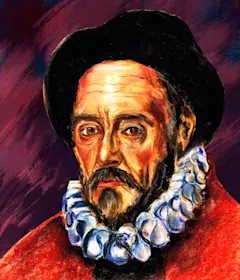
Essays of Montaigne, Vol. 2
Michel de MontaigneView title >Montaigne’s essay “Of Cannibals” explores cultural difference and what it means to be “civilized” or “savage.”
In Praise of Folly
Desiderius ErasmusView title >Shakespeare’s comedies are known for their use of the “fool.” His fools are sometimes truly foolish, and sometimes foolish in a way that reveals a deep and important wisdom. Inspiration for the wise fool can be traced to Erasmus’s Praise of Folly.
More in English literature
See all >The First Part of King Henry the Sixth
William ShakespeareThe Tragedy of King Richard the Second
William ShakespeareHamlet Prince of Denmark
William ShakespeareThe First Part of King Henry the Fourth
William ShakespeareThe Merchant of Venice
William ShakespeareThe Third Part of King Henry the Sixth
William ShakespeareTwelfth-Night: or, What You Will
William ShakespeareThe Second Part of King Henry the Fourth
William ShakespeareThe Winter’s Tale
William Shakespeare