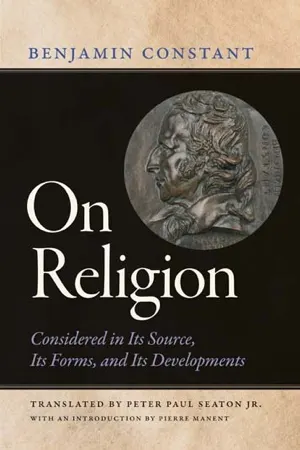
On Religion Considered in Its Source, Its Forms, and Its Developments
- Benjamin Constant(author)
- Peter Paul Seaton Jr.(translator)
Constant worked on this study of humanity’s religious forms and development throughout his life, publishing five volumes between 1824 and 1831. He sought to relate religious forms to historical contexts and civilizational developments, to show partisans of the post-revolutionary order that the religious impulse was natural to the human heart, and to show religious reactionaries that the natural state of religious sentiment was an unfettered spirituality left free to find new forms of expression.
About This Edition
Citation
Constant, Benjamin. On Religion Considered in Its Source, Its Forms, and Its Developments. Translated by Peter Paul Seaton Jr. Introduction by Pierre Manent (Indianapolis: Liberty Fund, 2017).
Constant, Benjamin. On Religion Considered in Its Source, Its Forms, and Its Developments. translated by Peter Paul Seaton Jr., Liberty Fund, 2017. Online Library of Liberty, https://oll.libertyfund.org/titles/on-religion-considered-in-its-source-its-forms-and-its-developments.
Constant, B. (2017). On Religion Considered in Its Source, Its Forms, and Its Developments. Liberty Fund. https://oll.libertyfund.org/titles/on-religion-considered-in-its-source-its-forms-and-its-developments
@book{constant2017developments,
  author = {Benjamin Constant},
  title = {On Religion Considered in Its Source, Its Forms, and Its Developments},
  publisher = {Liberty Fund},
  address = {Indianapolis},
  year = {2017},
  url = {https://oll.libertyfund.org/titles/on-religion-considered-in-its-source-its-forms-and-its-developments},
  note = {Online Library of Liberty}
}TY - BOOK AU - Constant, Benjamin A3 - Jr., Peter Paul Seaton TI - On Religion Considered in Its Source, Its Forms, and Its Developments PY - 2017 CY - Indianapolis PB - Liberty Fund UR - https://oll.libertyfund.org/titles/on-religion-considered-in-its-source-its-forms-and-its-developments DB - Online Library of Liberty ER -
Copyright
The copyright to this edition, in both print and electronic forms, is held by Liberty Fund, Inc.

About the author
Benjamin Constant 1767–1830
Benjamin Constant (1767–1830) was born in Switzerland and became one of France’s leading writers, as well as a journalist, philosopher, and politician. His colorful life included a formative stay at the University of Edinburgh; service at the court of Brunswick, Germany; election to the French Tribunate; and initial opposition and subsequent support for Napoleon, even the drafting of a constitution for the Hundred Days.
Related People
Like Constant, Montesquieu analyzed the role of religion in different political systems. In "The Spirit of the Laws," he argued that religious pluralism can support liberty and that imposing a single state religion often leads to despotism.
Jean-Jacques Rousseau
Author
Though they had key differences, Rousseau’s "The Social Contract" influenced Constant’s ideas about religion’s social function. Rousseau promoted the idea of a "civil religion" to unify society, while Constant argued that religious liberty is better preserved when separated from state control.
Voltaire
Author
Voltaire was a fierce critic of religious intolerance and clerical power, themes that Constant also explored. However, while Voltaire was often critical of religion itself, Constant saw religion as a necessary social and moral force that should remain independent of the state.


Critical Responses
Works that answer or challenge this text.
 Book
On the Genealogy of Morals
Friedrich NietzscheVisit site ↗Nietzsche opposed the idea that religion, even in its modern, individualized form, was a beneficial force.He saw Constant’s belief in th e moral and social importance of religion as a form of weak “slave morality” that hindered human greatness.
 Book
The Elementary Forms of Religious Life
Emile DurkheimVisit site ↗Durkheim took a sociological approach, agreeing with Constant that religion evolves but arguing that its primary function is to reinforce social cohesion, not individual liberty. Unlike Constant, Durkheim thought religious belief was an expression of collective identity, not merely personal conviction.
 Book
Charles Taylor
A Scular AgeTaylor revisits Constant’s idea that religion shifts from external coercion to personal belief, but he challenges whether this transition is truly liberating. Taylor argues that modern secularism doesn’t eliminate religion but transforms it into a more diffuse and often conflicted set of personal commitments.
 Book
The Stillborn God
Mark LillaVisit site ↗Lilla questions whether Constant’s vision of a modern, non-coercive religion is sustainable in a world where religious and political authority are often deeply intertwined. He suggests that the separation of faith from political life is more fragile than Constant assumed.

After Virtue
Alasdair MacIntyreVisit site ↗MacIntyre criticizes liberal individualism, which Constant sees as essential to religious liberty. He argues that modern society, in breaking away from religious traditions, has lost a shared moral foundation, leading to moral fragmentation.
Connected Readings
What to read next.
 OLL Essay
The Liberty of Ancients Compared with that of Moderns (1819)
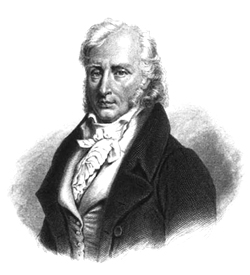
Benjamin ConstantView title >Constant’s classic work in which he contrasts unfavorably the purely political liberties of the ancients with the far more expansive notion of liberty among the moderns.
 Book
The History of Freedom and Other Essays
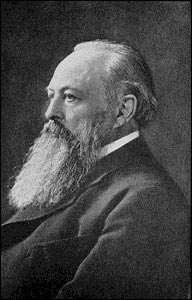
John Emerich Edward Dalberg, Lord ActonView title >Acton's essays explore the history of religious liberty and its role in shaping Western political thought.
 Book
Four Essays on Liberty
Isaiah BerlinVisit site ↗In these essays, Berlin discusses the balance between positive and negative liberty, which relates to Constant’s distinction between ancient and modern liberty.
More in Religions. Mythology. Rationalism
See all >History of the Rise and Influence of the Spirit of Rationalism in Europe, vol. 1
William Edward Hartpole LeckyThe Bhagvat-Geeta, or Dialogues of Kreeshna and Arjoon
Charles WilkinsThe Ramayana and the Mahabharata
MahabharataAn Elegant and Learned Discourse of the Light of Nature
Nathaniel CulverwellThe Thirteen Principal Upanishads
Misc (Upanishads)The Alchemy of Happiness
Al GhazaliThe Natural History of Religion
David HumeThe Sacred Books of China. The Texts of Confucianism, Part IV. The Li Ki, XI-XLVI
ConfuciusHistory of the Rise and Influence of the Spirit of Rationalism in Europe, 2 vols.
William Edward Hartpole Lecky