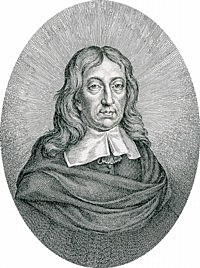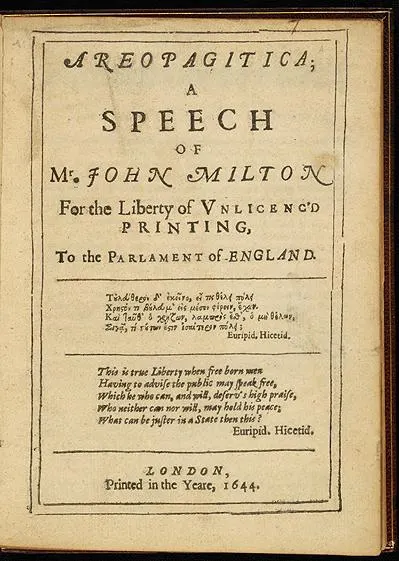
Areopagitica (1644) (Jebb ed.)
- John Milton(author)
- Sir Richard C. Jebb(editor)
This is Milton's famous defense of freedom of speech and the press, in an edition based upon Sir Richard Jebb’s lectures at Cambridge in 1872, with extensive notes and commentaries. Mlton's work was a protest against Parliament’s ordinance to further restrict the freedom of print. Milton issued his oration in an unlicensed form and courageously put his own name, but not that of his printer, on the cover.
Key Quotes
Passages from this text chosen by OLL editors.
- Freedom of Speech“
What should ye do then, should ye suppress all this flowery crop of knowledge and new light sprung up and yet springing daily in this city? Should ye set an oligarchy of twenty engrossers over it, to bring a famine upon our minds again, when we shall know nothing but what is measured to us by their bushel? ... Give me the liberty to know, to utter, and to argue freely according to conscience, above all liberties.
- Freedom of Speech“
...books are not absolutely dead things, but do contain a potency of life in them to be as active as that soul was whose progeny they are; nay, they do preserve as in a vial the purest efficacy and extraction of that living intellect that bred them. I know they are as lively, and as vigorously productive, as those fabulous dragon’s teeth: and being sown up and down, may chance to spring up armed men. And yet, on the other hand, unless wariness be used, as good almost kill a man as kill a good book: who kills a man kills a reasonable creature, God’s image; but he who destroys a good book, kills reason itself, kills the image of God, as it were, in the eye.
- Freedom of Speech“
Truth and understanding are not such wares as to be monopolized and traded in by tickets, and statutes, and standards. We must not think to make a staple commodity of all the knowledge in the land, to mark and license it like our broad-cloth and our woolpacks. What is it but a servitude like that imposed by the Philistines, not to be allowed the sharpening of our own axes and coulters, but we must repair from all quarters to twenty licensing forges?
About This Edition
Citation
Milton, John. Areopagitica, with a Commentary by Sir Richard C. Jebb and with Supplementary Material (Cambridge at the University Press, 1918). The text is in the public domain.
Milton, John. Areopagitica (1644) (Jebb ed.). Edited by Sir Richard C. Jebb, Cambridge University Press, 1918. Online Library of Liberty, https://oll.libertyfund.org/titles/jebb-areopagitica-1644-jebb-ed.
Milton, J. (1918). Areopagitica (1644) (Jebb ed.). Cambridge University Press. https://oll.libertyfund.org/titles/jebb-areopagitica-1644-jebb-ed
@book{milton1918ed,
  author = {John Milton},
  editor = {Sir Richard C. Jebb},
  title = {Areopagitica (1644) (Jebb ed.)},
  publisher = {Cambridge University Press},
  address = {Cambridge},
  year = {1918},
  url = {https://oll.libertyfund.org/titles/jebb-areopagitica-1644-jebb-ed},
  note = {Online Library of Liberty}
}TY - BOOK AU - Milton, John A2 - Jebb, Sir Richard C. TI - Areopagitica (1644) (Jebb ed.) PY - 1918 CY - Cambridge PB - Cambridge University Press UR - https://oll.libertyfund.org/titles/jebb-areopagitica-1644-jebb-ed DB - Online Library of Liberty ER -
Copyright
The text is in the public domain.

About the author
John Milton 1608–1674
John Milton (1608-1674) ranks among the greatest poets of the English language. He is best known for the epic poem Paradise Lost (1667), but he also wrote prose works on history, religion, and contemporary politics.
Related People
Isocrates
Author
Isocrates was a famous fourth century Athenian rhetorician. The name of Milton’s Areopagitica pays homage to Isocrates’s speech before Athens’s Areopagus.
King Charles I
Other
Milton wrote Areopagitica during the English Civil War, a conflict between Charles I and the English Parliament over monarchical authority.
John Stuart Mill
Author
Mill is one of the prominent defenders of freedom of thought, discussion, and expression. His essay On Liberty argues that these freedoms are essential to the discovery of truth and fraud.


Critical Responses
Works that answer or challenge this text.
- Article
Repressive Tolerance
Herbert MarcuseVisit site ↗Marcuse discusses the pros and cons of tolerance in an open society. It was originally published in the larger work A Critique of Pure Tolerance co-authored with B. Moore and R.P. Wolff.
Connected Readings
What to read next.
 Book
Treatise On Education
John MiltonVisit site ↗This brief discourse relates Milton’s ideas on education’s purpose and curriculum.
 Book
A Letter concerning Toleration and Other Writings
John LockeView title >In this letter, Locke discusses the importance and virtue of religious tolerance.
- Video
English Civil War
Crash Course European HistoryVisit site ↗This video explains the context, causes, and consequences of the English Civil War.
 Book
On Liberty and The Subjection of Women (1879 ed.)
John Stuart MillView title >Mill’s essay On Liberty defends individual freedom of opinion, discussion, and expression.
 Econlib Article
Liberty, Not Licensing: John Milton's Areopagitica
Sarah SkwireVisit site ↗Skwire discusses Milton’s Areopagitica in relation to book bannings and modern day censorship.
 The Reading Room
Discussing John Milton
Sarah Skwire, Garth Bond, and Steve PincusView title >Sarah Skwire, Garth Bond, and Steve Pincus discuss Nicholas McDowell’s book, Poet of Revolution: The Making of John Milton, which considers the question of how Milton’s early life could have produced the great radical revolutionary.