Julius Cæsar
Part of The Complete Works of William Shakespeare (The Oxford Shakespeare)
- William Shakespeare(author)
- William James Craig(editor)
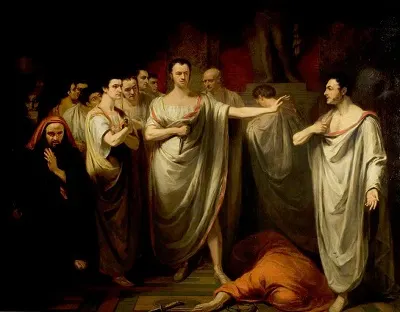
Shakespeare’s Julius Caesar is the best known and most widely read of his Roman plays. Its portraits of ambition, loyalty, and treachery remain evergreen. The funeral orations by Brutus and Mark Antony remain some of Shakespeare’s greatest poetry, and present a study in contrasting rhetoric for the reader. This edition comes from the 1916 Oxford University Press edition of all of Shakespeare’s plays and poems.
About This Edition
Citation
The Complete Works of William Shakespeare, ed. with a glossary by W.J. Craig M.A. (Oxford University Press, 1916).
Shakespeare, William. Julius Cæsar. Edited by William James Craig, Oxford University Press, 1916. Online Library of Liberty, https://oll.libertyfund.org/titles/craig-julius-caesar.
Shakespeare, W. (1916). Julius Cæsar. Oxford University Press. https://oll.libertyfund.org/titles/craig-julius-caesar
@book{shakespeare1916caesar,
  author = {William Shakespeare},
  editor = {William James Craig},
  title = {Julius Cæsar},
  publisher = {Oxford University Press},
  address = {Oxford},
  year = {1916},
  url = {https://oll.libertyfund.org/titles/craig-julius-caesar},
  note = {Online Library of Liberty}
}TY - BOOK AU - Shakespeare, William A2 - Craig, William James TI - Julius Cæsar PY - 1916 CY - Oxford PB - Oxford University Press UR - https://oll.libertyfund.org/titles/craig-julius-caesar DB - Online Library of Liberty ER -
Copyright
The text is in the public domain.

About the author
William Shakespeare 1564–1616
William Shakespeare (1564-1616) is probably the best known poet and playwright of the English language. He is considered by many to be the greatest poet and dramatist of all time. The plays he wrote nearly four hundred years ago for a small theater in London are now performed in more countries and more often than those of any other playwright.
Related People
Plutarch
Author
After Holinshed’s history of England and Boccaccio’s Decameron, one of Shakespeare’s most influential sources was Thomas North’s translation of Plutarch’s Lives of the Noble Grecians and Romans, more generally known as Plutarch’s Lives. Shakespeare drew extensively--though never without variation--from Plutarch’s Lives for his plays Julius Caesar, Coriolanus, Antony and Cleopatra, and Timon of Athens.

Critical Responses
Works that answer or challenge this text.
 In the Reading Room
Shakespeare and January 6th
Garth BondView title >Garth Bond considers Julius Caesar and other Shakespearean insurrections.
Connected Readings
What to read next.
 Book
Antony and Cleopatra
William ShakespeareView title >Shakespeare’s Antony and Cleopatra continues the story of Julius Caesar’s friend Mark Antony after Caesar’s death.
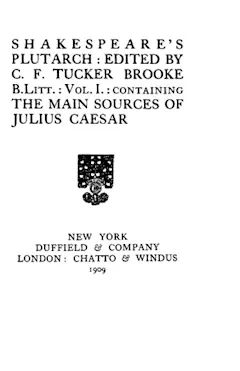
Shakespeare’s Plutarch, Vol. I (containing the main sources of Julius Caesar)
Sir Thomas NorthView title >You can find the sections of Plutarch’s Lives most directly related to Julius Caesar in this collection of extracts from the work designed for use by readers of Shakespeare.
- Book
The Lives of the Twelve Caesars
Suetonius TranquillusView title >Yet another version of the life of Julius Caesar is found in Suetonius’s The Lives of the Twelve Caesars. It might make an interesting historical study to contrast this version with Plutarch’s and with Shakespeare’s.
- Book
The Divine Comedy
DanteView title >Dante places Julius Caesar in Limbo, with other virtuous pagans, in the Divine Comedy. Cassio and Brutus, who betrayed him, are in the deepest circle of the Inferno, in the very mouth of Lucifer.
- Audio
Folger Shakespeare
Visit site ↗Listen to some selections from a performance of Julius Caesar at the Folger Library, including the great funeral orations by Brutus and Mark Antony.
More in English literature
See all >The First Part of King Henry the Sixth
William ShakespeareThe Tragedy of King Richard the Second
William ShakespeareHamlet Prince of Denmark
William ShakespeareThe First Part of King Henry the Fourth
William ShakespeareThe Merchant of Venice
William ShakespeareThe Third Part of King Henry the Sixth
William ShakespeareTwelfth-Night: or, What You Will
William ShakespeareThe Second Part of King Henry the Fourth
William ShakespeareThe Winter’s Tale
William Shakespeare