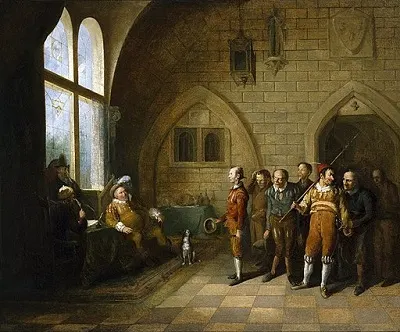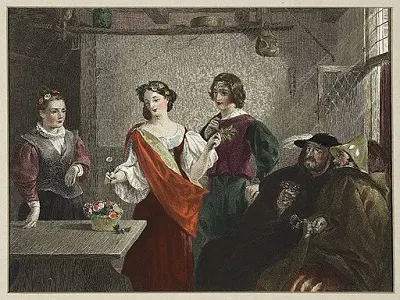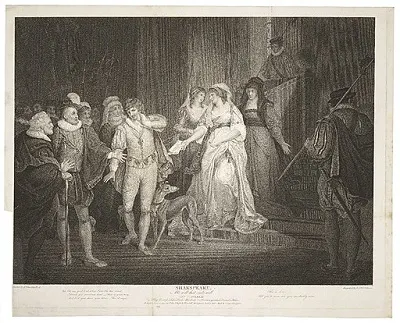
All’s Well that Ends Well
Part of The Complete Works of William Shakespeare (The Oxford Shakespeare)
- William Shakespeare(author)
- William James Craig(editor)
All’s Well that Ends Well has defied categorization for centuries. The winning of a reluctant husband by an over-eager bride, and the subsequent bed-trick that secures their continued marriage are morally complicated in ways that make the play more than a simple comedy. This edition comes from the 1916 Oxford University Press edition of all of Shakespeare’s plays and poems.
About This Edition
Citation
The Complete Works of William Shakespeare (The Oxford Shakespeare), ed. with a glossary by W.J. Craig M.A. (Oxford University Press, 1916).
Shakespeare, William. All’s Well that Ends Well. Edited by William James Craig, Oxford University Press, 1916. Online Library of Liberty, https://oll.libertyfund.org/titles/craig-all-s-well-that-ends-well.
Shakespeare, W. (1916). All’s Well that Ends Well. Oxford University Press. https://oll.libertyfund.org/titles/craig-all-s-well-that-ends-well
@book{shakespeare1916well,
  author = {William Shakespeare},
  editor = {William James Craig},
  title = {All’s Well that Ends Well},
  publisher = {Oxford University Press},
  address = {Oxford},
  year = {1916},
  url = {https://oll.libertyfund.org/titles/craig-all-s-well-that-ends-well},
  note = {Online Library of Liberty}
}TY - BOOK AU - Shakespeare, William A2 - Craig, William James TI - All’s Well that Ends Well PY - 1916 CY - Oxford PB - Oxford University Press UR - https://oll.libertyfund.org/titles/craig-all-s-well-that-ends-well DB - Online Library of Liberty ER -
Copyright
The text is in the public domain.

About the author
William Shakespeare 1564–1616
William Shakespeare (1564-1616) is probably the best known poet and playwright of the English language. He is considered by many to be the greatest poet and dramatist of all time. The plays he wrote nearly four hundred years ago for a small theater in London are now performed in more countries and more often than those of any other playwright.
Related People
John Dryden
Author
One of the great English poets and playwrights who followed Shakespeare, Dryden is similarly interested in portraying the importance of English history for English audiences. Dryden was also deeply interested in establishing the theater as a legitimate art form rather than just a popular entertainment.

Critical Responses
Works that answer or challenge this text.
Shakespeare's 'Problem' Plays
Visit site ↗Readers have never quite known what to do with All’s Well that Ends Well, which feels like it ought to be a comedy but sits uneasily with that definition. Some critics suggest it belongs to a category of plays called “problem plays” as a result.
The Bed Trick
Visit site ↗The “bed trick”, where one character sleeps with another character while pretending to be someone else, drives the action of the second half of All’s Well. The bed-trick is a mainstay of early modern comedy, and it has been adopted wholeheartedly by film, television, and other media to the point of becoming a TV Trope page of its own.
Connected Readings
What to read next.
Boccaccio's Decameron
Visit site ↗Boccaccio’s Decameron--a collection of tales told by a group of men and women escaping the Black Death--provides the source text for the tale of Helen and Bertram.
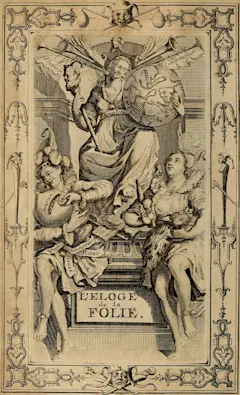 Book
In Praise of Folly
Desiderius ErasmusView title >Shakespeare’s comedies are known for their use of the “fool.” His fools are sometimes truly foolish, and sometimes foolish in a way that reveals a deep and important wisdom. Inspiration for the wise fool can be traced to Erasmus’s Praise of Folly.
More in English literature
See all >The First Part of King Henry the Sixth
William ShakespeareThe Tragedy of King Richard the Second
William ShakespeareHamlet Prince of Denmark
William ShakespeareThe First Part of King Henry the Fourth
William ShakespeareThe Merchant of Venice
William ShakespeareThe Third Part of King Henry the Sixth
William ShakespeareTwelfth-Night: or, What You Will
William ShakespeareThe Second Part of King Henry the Fourth
William ShakespeareThe Winter’s Tale
William Shakespeare