Collections1605
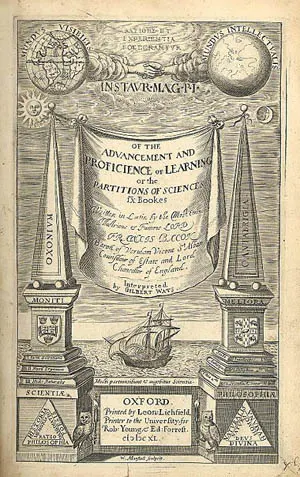
The Advancement of Learning
- Sir Francis Bacon(author)
- Joseph Devey(editor)
The first of Bacon’s writings on the nature of science and the scientific method. He also had a view of the unity of knowledge, both scientific and non-scientific.
About This Edition
Citation
The Advancement of Learning, by Lord Bacon, edited by Joseph Devey, M.A. (New York: P.F. Collier and Son, 1901). The text is in the public domain.
Bacon, Sir Francis. The Advancement of Learning. Edited by Joseph Devey, P. F. Collier, 1901. Online Library of Liberty, https://oll.libertyfund.org/titles/bacon-the-advancement-of-learning.
Bacon, S. F. (1901). The Advancement of Learning. P. F. Collier. https://oll.libertyfund.org/titles/bacon-the-advancement-of-learning
@book{bacon1901learning,
  author = {Sir Francis Bacon},
  editor = {Joseph Devey},
  title = {The Advancement of Learning},
  publisher = {P. F. Collier},
  address = {New York},
  year = {1901},
  url = {https://oll.libertyfund.org/titles/bacon-the-advancement-of-learning},
  note = {Online Library of Liberty}
}TY - BOOK AU - Bacon, Sir Francis A2 - Devey, Joseph TI - The Advancement of Learning PY - 1901 CY - New York PB - P. F. Collier UR - https://oll.libertyfund.org/titles/bacon-the-advancement-of-learning DB - Online Library of Liberty ER -
Copyright
The text is in the public domain.

About the author
Sir Francis Bacon 1561–1626
Sir Francis Bacon (1561-1626) was trained as a lawyer but made a name for himself as one of the clearest exponents of the scientific method at the dawn of the scientific revolution in the 16th and early 17th centuries. He argued that knowledge about the natural world could be best acquired through direct observation, experiment, and the testing of an hypothesis.
Related People
René Descartes
Author
Descartes, another thinker from The Early Modern Period, appealed to rationalism in evaluating entities.
Galileo Galilei
Author
Galilei is a founder of the experimental method and utilized mathematical appeal in support of Copernicus’ theory that the planets revolve around the sun.
Sir Isaac Newton
Author
One of the greatest scientific minds ever, Newton came after Bacon and reached groundbreaking discoveries regarding motion utilizing the scientific method.


Critical Responses
Works that answer or challenge this text.
- Book
The “Summa Theologica” of St. Thomas Aquinas. Part I. 10 vols.
St. Thomas AquinasView title >Bacon would disagree with Aquinas in the starting point for creation. Aquinas proceeds from a belief that God brought about creation, while Bacon would base his natural theory on scientific evidence and methodology.
Connected Readings
What to read next.
 Book
Principia mathematica (Latin ed.)
Sir Isaac NewtonView title >Newton’s work provides scientific explanations for the physical mechanics of earth.
 Book
Dialogues Concerning Two New Sciences
Galileo GalileiView title >Galilei explores great questions in physics and what can explain physical phenomena.
 Book
Novum Organum
Sir Francis BaconView title >Bacon’s piece highlights the use of the scientific method in exploring the natural world. Heat and energy are topics of interest.
 Book
On the Nature of Things
Titus Lucretius CarusView title >Lucretius theorizes the nature of life and the order of worldly experiences in his belief that people should not fear death or the gods.
More in Collections
See all >A Collection of Tracts, 2 vols. (1751)
Thomas GordonA Collection of Tracts, vol. I
Thomas GordonA Collection of Tracts, vol. 2
Thomas GordonEssays on Education and Kindred Subjects (1861, 1911)
Herbert SpencerAutobiography
Edward Gibbon