

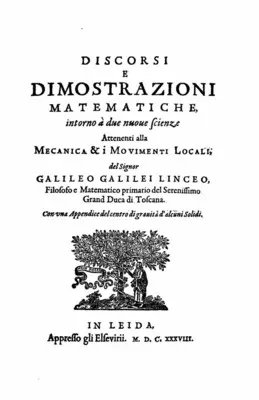
Dialogues Concerning Two New Sciences
- Galileo Galilei(author)
- Alfonso de Salvio(translator)
- Antonio Favaro(introduction)
A treatise on physics in the form of a dialogue. It deals with how solid bodies resist fracturing, the behavior of bodies in motion, the nature of acceleration, and projectile motion.
About This Edition
Citation
Dialogues Concerning Two New Sciences by Galileo Galilei. Translated from the Italian and Latin into English by Henry Crew and Alfonso de Salvio. With an Introduction by Antonio Favaro (New York: Macmillan, 1914).
Galilei, Galileo. Dialogues Concerning Two New Sciences. translated by Alfonso de Salvio, Macmillan, 1914. Online Library of Liberty, https://oll.libertyfund.org/titles/galilei-dialogues-concerning-two-new-sciences.
Galilei, G. (1914). Dialogues Concerning Two New Sciences. Macmillan. https://oll.libertyfund.org/titles/galilei-dialogues-concerning-two-new-sciences
@book{galilei1914sciences,
  author = {Galileo Galilei},
  title = {Dialogues Concerning Two New Sciences},
  publisher = {Macmillan},
  address = {New York},
  year = {1914},
  url = {https://oll.libertyfund.org/titles/galilei-dialogues-concerning-two-new-sciences},
  note = {Online Library of Liberty}
}TY - BOOK AU - Galilei, Galileo A3 - Salvio, Alfonso de TI - Dialogues Concerning Two New Sciences PY - 1914 CY - New York PB - Macmillan UR - https://oll.libertyfund.org/titles/galilei-dialogues-concerning-two-new-sciences DB - Online Library of Liberty ER -
Copyright
The text is in the public domain.

About the author
Galileo Galilei 1564–1642
Galileo Galilei, an Italian mathematician, astronomer, and physicist, is considered a founder of the experimental method. His conflict with the Catholic church arose over his support of Copernicus’s theory that the planets revolve around the sun. He was the first to apply a mathematical analysis to the mechanics of this theory.
