Lectures on the French Revolution (LF ed.)
- John Emerich Edward Dalberg, Lord Acton(author)
- John Neville Figgis(editor)
- Reginald Vere Laurence(editor)
- Stephen J. Tonsor(foreword)
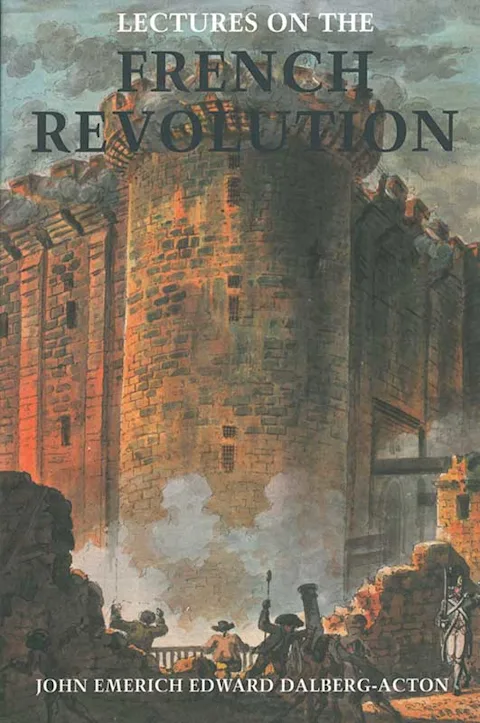
Delivered at Cambridge University between 1895 and 1899, Lectures on the French Revolution is a distinguished account of the entire epochal chapter in French experience by one of the most remarkable English historians of the nineteenth century.
Key Quotes
Passages from this text chosen by OLL editors.
- Politics & Liberty“
During the agony of his party, Condorcet found shelter in a lodging-house at Paris. There, under the Reign of Terror, he wrote the little book on Human Progress, which contains his legacy to mankind. He derived the leading idea from his friend Turgot, and transmitted it to Comte. There may be, perhaps, a score or two dozen decisive and characteristic views that govern the world, and that every man should master in order to understand his age, and this is one of them. When the book was finished, the author’s part was played, and he had nothing more to live for. As his retreat was known to one, at least, of the Montagnards, he feared to compromise those who had taken him in at the risk of their life. Condorcet assumed a disguise, and crept out of the house with a Horace in one pocket and a dose of poison in the other. When it was dark, he came to a friend’s door in the country. What passed there has never been known, but the fugitive philosopher did not remain. A few miles outside Paris he was arrested on suspicion and lodged in the gaol. In the morning they found him lying dead.
- Revolution“
The Bastille not only overshadowed the capital, but it darkened the hearts of men, for it had been notorious for centuries as the instrument and the emblem of tyranny. The captives behind its bars were few and uninteresting; but the wide world knew the horror of its history, the blighted lives, the ruined families, the three thousand dishonoured graves within the precincts, and the common voice called for its destruction as the sign of deliverance. At the elections both nobles and commons demanded that it should be levelled with the ground.
About This Edition
Citation
Acton, John Emerich Edward Dalberg, Lord. [Lectures on the French Revolution](https://www.libertyfund.org/books/lectures-on-the-french-revolution), ed. John Neville Figgis and Reginald Vere Laurence, with a foreword by Steven J. Tonsor (Indianapolis: Liberty Fund, 2000).
Acton, John Emerich Edward Dalberg, Lord. Lectures on the French Revolution (LF ed.). Edited by John Neville Figgis and Reginald Vere Laurence, Liberty Fund, 2000. Online Library of Liberty, https://oll.libertyfund.org/titles/acton-lectures-on-the-french-revolution-lf-ed.
Acton, J. E. E. D. L. (2000). Lectures on the French Revolution (LF ed.). Liberty Fund. https://oll.libertyfund.org/titles/acton-lectures-on-the-french-revolution-lf-ed
@book{acton2000ed,
  author = {John Emerich Edward Dalberg, Lord Acton},
  editor = {John Neville Figgis and Reginald Vere Laurence},
  title = {Lectures on the French Revolution (LF ed.)},
  publisher = {Liberty Fund},
  address = {Indianapolis},
  year = {2000},
  url = {https://oll.libertyfund.org/titles/acton-lectures-on-the-french-revolution-lf-ed},
  note = {Online Library of Liberty}
}TY - BOOK AU - Acton, John Emerich Edward Dalberg, Lord A2 - Figgis, John Neville A2 - Laurence, Reginald Vere TI - Lectures on the French Revolution (LF ed.) PY - 2000 CY - Indianapolis PB - Liberty Fund UR - https://oll.libertyfund.org/titles/acton-lectures-on-the-french-revolution-lf-ed DB - Online Library of Liberty ER -
Copyright
The copyright to this edition, in both print and electronic forms, is held by Liberty Fund, Inc.

About the author
John Emerich Edward Dalberg, Lord Acton 1834–1902
Lord Acton (1834-1902) was one of the great historians of the Victorian period and one of the greatest classical liberal historians of all time. His theme was “the history of liberty” and even though he was never able to complete his magnum opus of that name he did write numerous essays, book reviews, and lectures. He also was the inspiration behind the multi-volume Cambridge Modern History.
More in France - Andorra - Monaco
See all >The Origins of Contemporary France: The Ancient Regime
Hippolyte TaineThe French Revolution, vol. 3
Hippolyte TaineThe French Revolution, vol. 2
Hippolyte TaineThe French Revolution, vol. 1
Hippolyte TaineTocqueville’s Voyages: The Evolution of His Ideas and Their Journey Beyond His Time
Christine Dunn HendersonThe Old Regime and the Revolution (1856)
Alexis de TocquevilleConsiderations on the Principal Events of the French Revolution (LF ed.)
Germaine de StaëlVindiciae Gallicae and Other Writings on the French Revolution
Sir James MackintoshAn Historical and Moral View of the Origin and Progress of the French Revolution
Mary Wollstonecraft