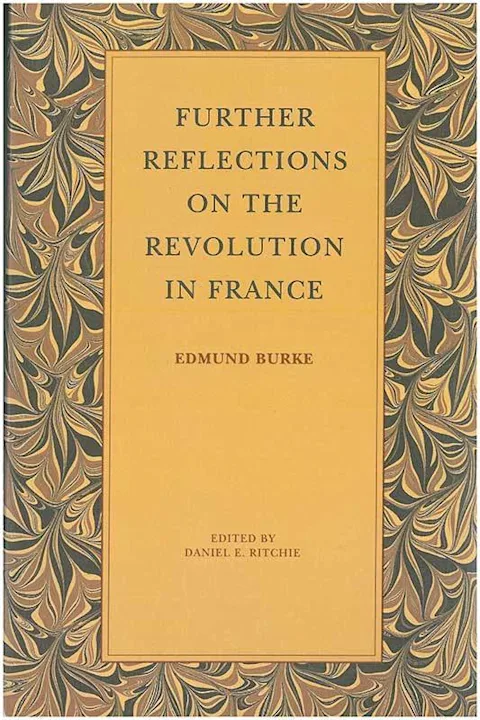
Further Reflections on the French Revolution
- Edmund Burke(author)
- Daniel E. Ritchie(editor)
Burke continued arguing about the French Revolution throughout the 1790s in a series of letters and pamphlets, the most significant being “An Appeal from the New to the Old Whigs”.
Key Quotes
Passages from this text chosen by OLL editors.
- Liberty“
Permit me then to continue our conversation, and to tell you what the freedom is that I love, and that to which I think all men entitled. This is the more necessary, because, of all the loose terms in the world, liberty is the most indefinite. It is not solitary, unconnected, individual, selfish liberty, as if every man was to regulate the whole of his conduct by his own will. The liberty I mean is social freedom. It is that state of things in which liberty is secured by the equality of restraint. A constitution of things in which the liberty of no one man, and no body of men, and no number of men, can find means to trespass on the liberty of any person, or any description of persons, in the society. This kind of liberty is, indeed, but another name for justice; ascertained by wise laws, and secured by well-constructed institutions.
About This Edition
Citation
Burke, Edmund. Further Reflections on the Revolution in France, ed. Daniel E. Ritchie (Indianapolis: Liberty Fund 1992).
Burke, Edmund. Further Reflections on the French Revolution. Edited by Daniel E. Ritchie, Liberty Fund, 1992. Online Library of Liberty, https://oll.libertyfund.org/titles/ritchie-further-reflections-on-the-french-revolution.
Burke, E. (1992). Further Reflections on the French Revolution. Liberty Fund. https://oll.libertyfund.org/titles/ritchie-further-reflections-on-the-french-revolution
@book{burke1992revolution,
  author = {Edmund Burke},
  editor = {Daniel E. Ritchie},
  title = {Further Reflections on the French Revolution},
  publisher = {Liberty Fund},
  address = {Indianapolis},
  year = {1992},
  url = {https://oll.libertyfund.org/titles/ritchie-further-reflections-on-the-french-revolution},
  note = {Online Library of Liberty}
}TY - BOOK AU - Burke, Edmund A2 - Ritchie, Daniel E. TI - Further Reflections on the French Revolution PY - 1992 CY - Indianapolis PB - Liberty Fund UR - https://oll.libertyfund.org/titles/ritchie-further-reflections-on-the-french-revolution DB - Online Library of Liberty ER -
Copyright
The copyright to this edition, in both print and electronic forms, is held by Liberty Fund, Inc.

About the author
Edmund Burke 1729–1797
Edmund Burke (1729-1797) was an English political philosopher who is often seen as laying the foundations of modern conservatism. Although he supported the American colonies in the revolution against the claims of Parliament, he strongly opposed the French Revolution, the rise of unbridled democracy, and the growing corruption of government.
Related People
Adam Smith
Author
Burke and Smith were contemporaries and had an occasional correspondence. Burke called Adam Smith’s Theory of Moral Sentiments “one of the most beautiful fabrics of moral theory, that has perhaps ever appeared.” Of Smith’s Wealth of Nations, he declared that “I am convinced of its solidity and Truth.” Smith’s influence on Burke is particularly clear in Burke’s “Thoughts and Details on Scarcity” and his brief writings on the corn laws.
David Hume
Author
Hume was an acquaintance of Burke and their intellectual relationship has long been the source of lively debate. The two shared a broadly skeptical view of politics that has marked them both as proto-conservatives, but Hume’s more thoroughgoing skepticism on matters of religion and philosophy contrast with Burke’s relative orthodoxy.
Samuel Johnson
Author
Though Burke was a Whig and Johnson a Tory, the two were on good terms personally, and both were original members of the famous “Club” at Turk’s Head Inn. Johnson was sometimes critical of Burke’s politics, but today they are both seen as pivotal figures in the development of a self-consciously conservative political sensibility.


Critical Responses
Works that answer or challenge this text.
 Book
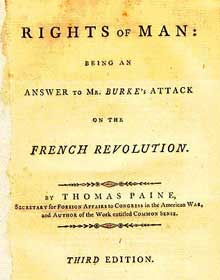
The Rights of Man
Thomas PaineView title >The Rights of Man was written as a direct response to Burke’s Reflections on the Revolution in France, but the ideas contained in it are also in debate with Burke’s other revolutionary writings contained here. Paine defended the early phases of the Revolution as a movement for liberty against illegitimate and unrestrained power.
Connected Readings
What to read next.
 Book
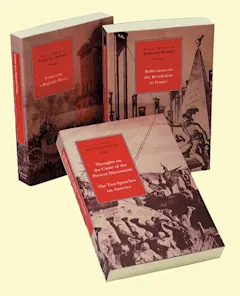
Select Works of Edmund Burke, 4 vols.
Francis CanavanView title >This Liberty Fund collection contains many of Burke’s most famous writings, including Reflections on the Revolution in France, his two most well-known speeches on the American colonies and Revolution, and his searing Letters on a Regicide Peace, written as Britain considered making peace with Revolutionary France.
 Book
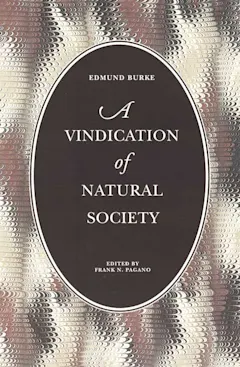
A Vindication of Natural Society
Edmund BurkeView title >One of Burke’s earliest works, the Vindication is a satirical essay in the manner of Bolingbroke putting the latter’s religious opinions to work undermining the foundations of social order. Though it was meant primarily to undermine the arguments of natural religion, the satirical political arguments came to have a more direct relevance once Burke turned his pen to revolutionary ideas several decades later.
- Podcast
The Delusions of the Ideologue and the Wisdom of the Statesman
Greg WeinerVisit site ↗Greg Weiner discusses his book Old Whigs with Richard Reinsch on Liberty Law Talk. The title of Weiner’s book is a reference to Burke’s “Appeal from the New to the Old Whigs,” contained in this volume, and uses Burke as an example of a statesman guided by a particular understanding of prudence.
- Law & Liberty Essay
Edmund Burke: Natural Lawyer
Samuel GreggVisit site ↗It remains an open question as to how much Burke was animated by instinctive political skepticism and by natural law. Gregg makes the case for Burke as a natural law thinker.
More in France - Andorra - Monaco
See all >The French Revolution, vol. 3
Hippolyte TaineThe French Revolution, vol. 2
Hippolyte TaineThe French Revolution, vol. 1
Hippolyte TaineTocqueville’s Voyages: The Evolution of His Ideas and Their Journey Beyond His Time
Christine Dunn HendersonThe Old Regime and the Revolution (1856)
Alexis de TocquevilleConsiderations on the Principal Events of the French Revolution (LF ed.)
Germaine de StaëlVindiciae Gallicae and Other Writings on the French Revolution
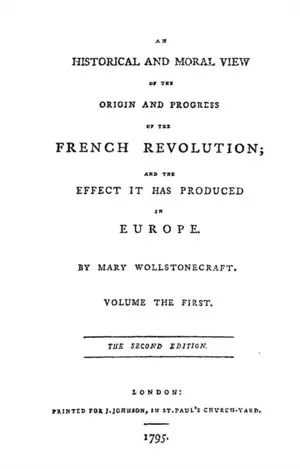
Sir James MackintoshAn Historical and Moral View of the Origin and Progress of the French Revolution
Mary WollstonecraftThe Origins of Contemporary France
Hippolyte Taine