

Matt Zwolinski
Lead essay · Jul 03, 2017
The real misery of mankind is the struggle for existence; why not "declare" that there ought not to be any struggle for existence, and that there shall not be any more? Let it be decreed that existence is a natural right, and let it be secured in that way. If we attempt to execute this plan, it is plain that we shall not abolish the struggle for existence; we shall only bring it about that some men must fight that struggle for others.[6] ("Some Natural Rights")
A talks it over with B, and A and B then propose to get a law passed to remedy the evil and help X. Their law always proposes to determine what C shall do for X or, in the better case, what A, B and C shall do for X.[14]
I call him the Forgotten Man. Perhaps the appellation is not strictly correct. He is the man who never is thought of. He is the victim of the reformer, social speculator and philanthropist, and I hope to show you before I get through that he deserves your notice both for his character and for the many burdens which are laid upon him.[15]
If we let nature alone, she cures vice by the most frightful penalties. It may shock you to hear me say it, but when you get over the shock, it will do you good to think of it: a drunkard in the gutter is just where he ought to be. Nature is working away at him to get him out of the way, just as she sets up her processes of dissolution to remove whatever is a failure in its line. Gambling and less mentionable vices all cure themselves by the ruin and dissolution of their victims. Nine-tenths of our measures for preventing vice are really protective towards it, because they ward off the penalty.[19]
We may philosophize as coolly and correctly as we choose about our duties and about the laws of right living; no one of us lives up to what he knows. The man struck by the falling tree has, perhaps, been careless. We are all careless. Environed as we are by risks and perils, which befall us as misfortunes, no man of us is in a position to say, "I know all the laws, and am sure to obey them all; therefore I shall never need aid and sympathy." At the very best, one of us fails in one way and another in another, if we do not fail altogether. Therefore the man under the tree is the one of us who for the moment is smitten. It may be you tomorrow, and I next day. It is the common frailty in the midst of a common peril which gives us a kind of solidarity of interest to rescue the one for whom the chances of life have turned out badly just now. Probably the victim is to blame. He almost always is so. A lecture to that effect in the crisis of his peril would be out of place, because it would not fit the need of the moment; but it would be very much in place at another time, when the need was to avert the repetition of such an accident to somebody else. Men, therefore, owe to men, in the chances and perils of this life, aid and sympathy, on account of the common participation in human frailty and folly.[21]
represent the bitterest and basest social injustice. Every honest citizen of a free state owes it to himself, to the community, and especially to those who are at once weak and wronged, to go to their assistance and to help redress their wrongs. Whenever a law or social arrangement acts so as to injure any one, and that one the humblest, then there is a duty on those who are stronger, or who know better, to demand and fight for redress and correction. When generalized this means that it is the duty of All-of-us (that is, the State) to establish justice for all, from the least to the greatest, and in all matters.[23]
Fabio Rojas
Response · Jul 05, 2017 · Own page
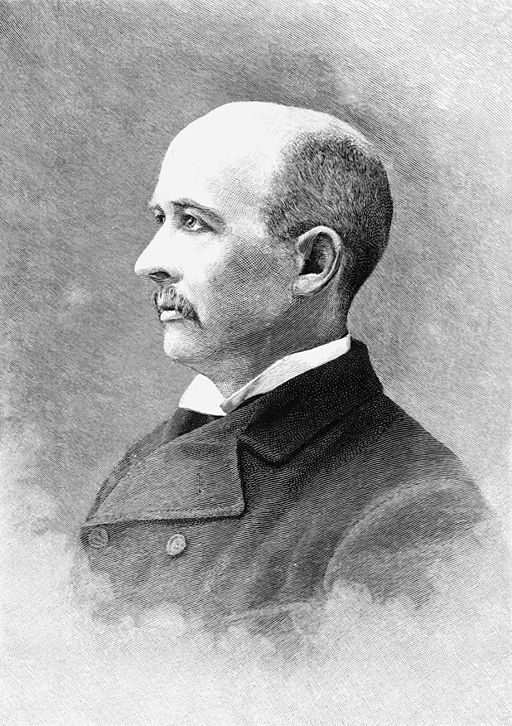
Like many intellectuals of his era, William Graham Sumner was a classical liberal who favored laissez faire and limited government. Still, these intellectuals faced opposition, and classical liberalism was a controversial position. For example, Sumner's biography at the website of the American Sociological Association (ASA) notes that the president of Yale College objected to Sumner's use of Herbert Spencer's text in a class and Sumner was forced to drop the book.[24] Later, Sumner came out strongly against the Spanish-American war, which was a popular war at the time.[25]
Phillip W. Magness
Response · Jul 06, 2017 · Own page
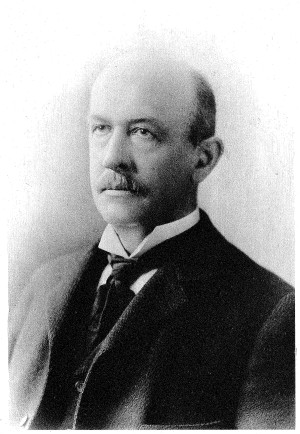
When discussed at all by historians, William Graham Sumner's name is usually attached to the concept of social Darwinism. As Matt Zwolinski notes in his opening essay, this phrase is actually a poor descriptor of Sumner's beliefs and directly chafes with his highly developed criticisms of injustices that come about through unscrupulous state actors. It has nonetheless proven a difficult designation for Sumner, along with his English counterpart Herbert Spencer, to shake. We owe this situation in large part to the lasting influence of the progressive historian Richard Hofstadter, and particularly his pairing of the concept with another cause that Sumner actually did champion – laissez-faire economics. In this sense, Sumner's aversion to progressive meddling in the freedom of exchange, and particularly his arguments against state redistribution of resources, are said to foster a social rule of the "survival of the fittest."
I would not want to deny them their meed of praise, but our new economic thought disturbed them and they considered us a menace to the welfare of the country. Generally speaking, they had taken over the English classical economics in a rather extreme form and this placed them with those English economists called by the Germans, the Epigones.
[I]t must be admitted that there remains what has been termed the human rubbish heap of the competitive system. There are those who are not able to live in its strenuous atmosphere. The sad fact, however, is not that of competition, but the existence of these feeble persons. The sadness consists in the hard facts of life of which competition takes cognizance. If the weakest are favored and their reproduction encouraged, we must have social degeneration. The recognition of these hard facts, with suitable action taken with reference to them, reduces the amount of human pain for the present and the future by public and private charity. The socially rejected must be cared for and given as happy an existence as possible, provided only that we do not encourage the increase of those who belong to this sad human rubbish-heap.
David M. Hart
Response · Jul 17, 2017 · Own page
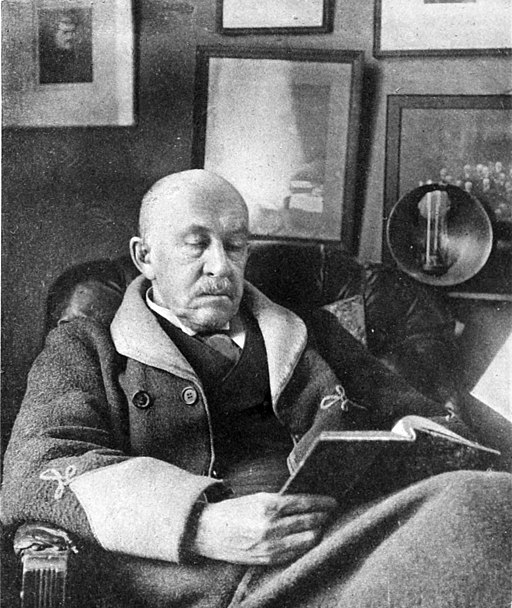
Matt Zwolinski is both witty and correct to call William Graham Sumner "Liberty's Forgotten Man." Both Sumner's own considerable professional work as a sociologist, economist, and historian, and as an activist for free trade and the anti-imperialist movement, as well as the ideas which lie behind one of his greatest essays, "The Forgotten Man" (and interestly for the historical period, Sumner includes "Woman" as well), with its deep insights into the nature of class in America in the late 19th century, have fallen into a seemingly inextricable Orwellian memory hole. Thus, in a way, both the man and a number of very important classical-liberal ideas have been not only "forgotten" but also tabooed. It has been Zwolinki's task in this essay and others to rectify this situation and for that he should be congratulated.[51]
Robert Leroux
Response · Jul 17, 2017 · Own page
Sumner is a stranger to us today. With the exception of a few scholars of the history of ideas, no one reads him anymore. But many of them think he was a social Darwinist.
We have noticed that the relations involved in the struggle for existence are twofold. There is first the struggle of individuals to win the means of subsistence from nature, and secondly there is the competition of man with man in the effort to win a limited supply. The radical error of the socialists and sentimentalists is that they never distinguish these two relations from each other. They bring forward complaints which are really to be made, if at all, against the author of the universe for the hardships which man has to endure in his struggle with nature. The complaints are addressed, however, to society; that is, to other men under the same hardships. The only social element, however, is the competition of life, and when society is blamed for the ills which belong to the human lot, it is only burdening those who have successfully contended with those ills with the further task of conquering the same ills over again for somebody else. Hence liberty perishes in all socialistic schemes, and the tendency of such schemes is to the deterioration of society by burdening the good members and relieving the bad ones.[59]
The modern industrial system is a great social co-operation. It is automatic and instinctive in its operation. The adjustments of the organs take place naturally. The parties are held together by impersonal force—supply and demand. They may never see each other; they may be separated by half the circumference of the globe. Their co-operation in the social effort is combined and distributed again by financial machinery, and the rights and interests are measured and satisfied without any special treaty or convention at all. All this goes on so smoothly and naturally that we forget to notice it. We think that it costs nothing—does itself, as it were. The truth is, that this great co-operative effort is one of the great products of civilization—one of its costliest products and highest refinements, because here, more than anywhere else, intelligence comes in, but intelligence so clear and correct that it does not need expression.[61]
The need for a science of life in society is urgent, and it is increasing every year. It is a fact which is generally overlooked that the great advance in the sciences and the arts which has taken place during the last century is producing social consequences and giving rise to social problems.[62]
Matt Zwolinski
Evolutionary Arguments and Laissez Faire · Jul 17, 2017
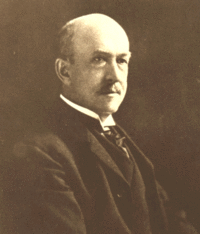
As Fabio Rojas and Phil Magness both note in their excellent essays, Sumner grounded his laissez-faire theory of government on an evolutionary theory of society. Our discussion so far has already highlighted the way in which this form of argument gave rise to the misleading charge of "social Darwinism." In this essay, I want to raise a more substantive question about Sumner's argument: to what extent does an evolutionary approach like Sumner's actually support a policy of laissez faire?The gist of Sumner's argument is nicely illustrated in the gardening metaphor that Phil Magness quotes in his essay. Just as it would be foolish for a gardener to try to impose an abstractly conceived ideal upon a garden without first acquiring a thorough understanding of the nature of the plants, soil, and other elements with which he was working, and the constraints that those natural phenomena impose upon his possibilities, so too it would be foolish for a statesman to impose a rigid set of rules upon society without understanding the ways in which the natural order of social processes constrain his ability to realize his vision. Social order, like natural order, is an evolved phenomenon exhibiting a high degree of interconnectedness and complexity. And attempts to meddle with that order on the assumption that one knows more than one really does about how it works are doomed to fail.Arguments such as this are familiar within the classical-liberal tradition. The most obvious parallel, of course, is to be found in the work of Friedrich Hayek, whose writings on complexity and spontaneous order[41] develop the line of reasoning in perhaps its most sophisticated form. But arguments of this form were also common in the writings of Herbert Spencer, who often employed them to warn would-be reformers of the likely unintended consequences of their well-meaning meddling. For Spencer, each social phenomenon "is a link in an infinite series -- is the result of myriads of preceding phenomena, and will have a share in producing myriads of succeeding ones." Because phenomena are complexly interrelated, it is always the case that "in disturbing any natural chain of sequences, [legislators] are not only modifying the result next in succession, but all the future results into which this will enter as a part-cause."[42] Social legislation is like trying to straighten out a wrought-iron plate with a hammer – attempts to flatten it here will only cause it to bend somewhere else. "What, then, shall we say about a society? 'Do you think I am easier to be played on than a pipe?' asks Hamlet.[43] Is humanity more readily straightened than an iron plate?"[44]Indeed, arguments of this form are often found outside of the classical-liberal tradition as well. James C. Scott's wonderful book, Seeing Like a State, opens with an account of the failures of scientific forestry in late 18th-century Prussia and Saxony. In order to achieve maximum yield with minimum oversight, forest managers imposed a rigid, easily legible order on their trees.The forest trees were drawn up into serried, uniform ranks, as it were, to be measured, counted off, felled, and replaced by a new rank and file of lookalike conscripts. As an army, it was designed hierarchically from above to fulfill a unique purpose and to be at the disposition of a single commander. At the limit, the forest itself would not even have to be seen; it could be "read" accurately from the tables and maps in the forester's office.[45]
But the schematic vision of the foresters was too limited to understand the complexity of the forest ecosystem. Vast forests of monoculture trees died off entirely as they failed to receive adequate nutrients from the soil and fell victim to pests and disease. "An exceptionally complex process involving soil building, nutrient uptake, and symbiotic relations among fungi, insects, mammals, and flora -- which were, and still are, not entirely understood -- was apparently disrupted, with serious consequences."[46]Scott's book is much adored by classical liberals, despite the fact the he explicitly denies that it is "a case for unfettered market coordination as urged by Friedrich Hayek and Milton Friedman."[47] But the fact that a relatively progressive liberal like Scott can employ arguments of the same form as those employed by Spencer, Sumner, and Hayek should give us pause. Is Scott simply failing to think through the logical implications of his position? Or do evolutionary arguments simply not do much to make the case for laissez faire?Hayek himself seems to have been somewhat ambivalent on this point. In The Road to Serfdom, he famously (or infamously, depending on whom you ask) wrote that "nothing has done so much harm to the liberal cause as the wooden insistence of some liberals on certain rules of thumb, above all the principle of laissez-faire capitalism."[48] Elsewhere, however, he seemed to take a kinder attitude toward a certain woodenness, writing that "a successful defense of freedom must therefore be dogmatic and make no concessions to expediency…."[49]For Sumner, laissez faire seems to have been a kind of rule of thumb, but nothing more. "Laissez-faire," he wrote, "is so far from meaning the unrestrained action of nature without any intelligent interference by man, that it really means the only rational application of human intelligence to the assistance of natural development."[50] The principle is a maxim, a rule of art, that is useful as a corrective against mankind's natural tendency to over-legislate. But as a maxim, it is not absolute. It does not rule out state interference altogether. Rather, it counsels us to be cautious in interfering -- to approach social problems with a sense of humility, rather than hubris.Arguments of this sort certainly seem to tell against proposals to centrally manage the entire economy, à la state socialism. But how much more weight can contemporary classical liberals really place on them? Do they counsel against state welfare programs? Against clean-air regulations? Socialized medicine?The proponent of such legal interventions can grant that the economy is a complex system and that prudence is warranted. But the mere fact that there are problems associated with intervention hardly seems sufficient to demonstrate that the expected costs of intervention will always exceed the expected benefits. (This is a problem with consequentialist arguments for laissez fairein general.) We can be cautious; we can experiment on a small scale; and we can learn. Scott's own story proves the point. Eighteenth-century Prussian attempts at scientific forest management may have been a bungle, but we've gotten much, much better. Is there some reason to think that the same sort of process isn't possible in the realm of state intervention in the economy?Endnotes[41.] F.A. Hayek, Chapter 2 "The Theory of Complex Phenomena" in Studies in Philosophy, Politics and Economics (London: Routledge & Kegan Paul, 1967), pp. 22-42. Online at <https://emergentpublications.com/ECO/ECO_papers/Issue_9_1-2_14_CP.pdf?AspxAutoDetectCookieSupport=1>. OLL Topic: Spontaneous Order </collections/104>.[42.] Herbert Spencer, "Over-Legislation" [First published in The Westminster Review for July 1853.] in Herbert Spencer, Essays: Scientific, Political, and Speculative. Library Edition, containing Seven Essays not before republished, and various other Additions (London: Williams and Norgate, 1891). Vol. 3. </titles/337#Spencer_0620-03_320>.[43.] Hamlet says to Guildenstern: "Why, look you now, how unworthy a thing you make of me. You would play upon me; you would seem to know my stops; you would pluck out the heart of my mystery; you would sound me from my lowest note to the top of my compass; and there is much music, excellent voice, in this little organ, yet cannot you make it speak. 'Sblood, do you think I am easier to be played on than a pipe? Call me what instrument you will, though you can fret me, you cannot play upon me." "Hamlet", Act III, Sc. II, The Complete Works of William Shakespeare (The Oxford Shakespeare), ed. with a glossary by W.J. Craig M.A. (Oxford University Press, 1916). </titles/1639#Shakespeare_0612zf_Hamlet_1973>.[44.] Herbert Spencer, The Study of Sociology (London: Henry S. King, 1873). </titles/1335#Spencer_0623_503>.[45.] James C. Scott, Seeing Like a State, (New Haven, CT: Yale University Press, 1999), p. 15.[46.] Ibid., p. 20.[47.] Ibid., p. 8.[48.] Hayek, The Road to Serfdom (Chicago: University of Chicago Press, 2007), p. 71[49.] Hayek, Law, Legislation, and Liberty, vol. 1 (New York: Routledge, 1973), p. 61.[50.] William Graham Sumner, "Laissez-Faire" (1886), in Sumner, On Liberty, Society, and Politics, ed. Robert C. Bannister (1992), p. 228.; also online at <https://www.panarchy.org/sumner/laissezfaire.html>.Fabio Rojas
The Rivals of Classical-Liberal Social Science · Jul 19, 2017
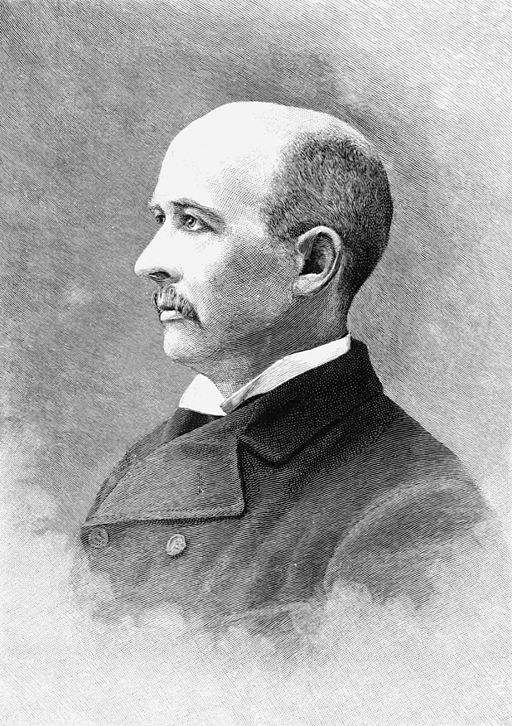
The social science of William Graham Sumner has generated a spirited discussion of the meaning of laissez faire at the turn of the 20th century. Sumner, and other classical-liberal intellectuals, viewed their science as a science of an organic and decentralized system. This has led others to categorize theories of spontaneous order as a rationalization of social domination dressed up in scholarly language. In my initial response to Zwolinski's essay on Sumner, which critiqued this point, I focused on why people often made this charge. I argued that association with pro-market arguments and a lack of an activist vision doomed Sumner and the cohort of classical-liberal intellectuals.Phil Magness's essay takes on a related point. He investigates the social policies of the progressives who emerged in the wake of the demise of classical-liberal social theory. What he finds is that progressive social science of the early 1900s was often pitched as a direct reaction to laissez-faire thinkers like Sumner and Spencer. He finds that they viewed social science as a tool to tame the chaotic fluctuations of markets and that social science was associated, in some authors, with eugenic ideas.In this response, I will briefly touch on how the demise of classical-liberal social science facilitated the rise of two rival traditions. One is liberatory social science, as exemplified by such scholars as W.E.B. DuBois, who used new social-science tools to help low-status groups, such as American blacks. The features of liberatory social science were mentioned in my last response: the use of social-science methods to study marginal groups and an attempt to give them agency in Western historical narratives and to improve their material conditions and well-being.The other tradition, discussed by Magness, was embodied by the eugenics movement. They too saw that social science could be a tool for taming markets. But instead of trying to mitigate social inequality, they wanted to reinforce social inequality. There is difficulty in labeling this movement "regressive" because its practitioners are labeled "progressive." Perhaps a satisfactory label would be "retrenchment social science." The hallmark of retrenchment social science is that it rejects theories of spontaneous order so that interventions against undesirable groups may be pursued. For the early 20th-century progressives, that meant minorities and others undesirable populations. As Magness notes, the intervention against specific groups tends to be found alongside attempts to bolster national greatness.To summarize, the demise of classical-liberal social science did not result in the emergence of a single alternative. It resulted in at least two -- liberatory activist intellectuals like DuBois and retrenching social scientists like Richard T. Ely and John R. Commons. Any student of classical liberalism should understand these two streams as important competitors to classical liberalism in the marketplace of ideas.David M. Hart
Remembering Sumner the Political Economist. Part 1: The Poison of Paper Money · Jul 19, 2017
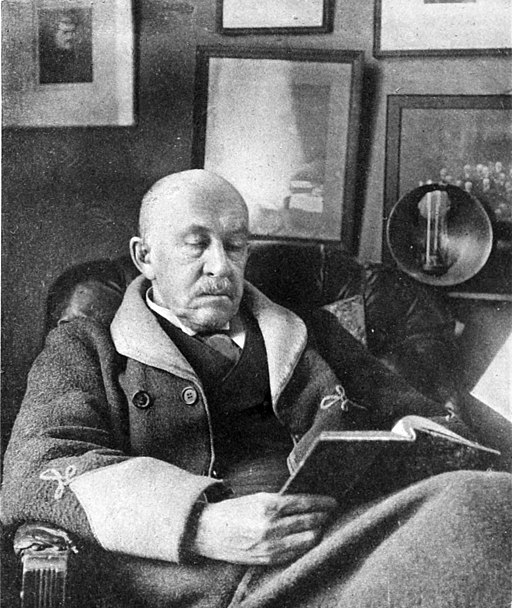
Before Sumner became a “sociologist” he was a biblical scholar and linguist, and then an economist. Unfortunately, the full history of Sumner’s work as an economist, economic historian, and free trade activist has yet to be written. The importance political economy played in Sumner’s thought was understood by the early 20th century editor of his works, Albert Galloway Keller, who realised that Sumner had a “dominant interest in political economy (which was) revealed in his teaching and writing, (his) doughty advocacy of “free trade and hard money,” and … the relentless exposure of protectionism and of schemes of currency-debasement.”[63] In this and the next post I will attempt to give a brief account of these two economic interests.After graduating from Yale in 1863, Sumner studied languages, theology, and biblical history at the Universities of Geneva, Göttingen, and Oxford. He then returned to Yale in September 1867 to teach Greek before taking a position as Rector of the Church of the Redeemer in Morristown, NJ. where he worked from September 1870 to September 1872. He returned to Yale again but this time to teach in an entirely different field, that of “Political and Social Sciences” of which he was a professor for the next 37 years (between 1872 and his retirement in 1909). What is interesting is that he thought political economy played a very important role in what he called “political science in its widest sense” and that given “the degraded state of American politics and public life” into which the country had fallen since the Civil War, economic topics “now more especially demands our attention.”[64] And this is what would occupy much of his time for the next 20 years. He summarized what would be almost his life’s work in countering the “moral and social deterioration” of the nation which was caused by the “economical mistakes” of protective tariffs and paper money, mistakes which were only made worse by policies adopted during the Civil War. Sumner believed it was the task of the economist, in whose ranks he believed he stood, to point out these mistakes and the enormous economic waste they caused for ordinary people:[65]I affirm that the questions on which our national future to-day depends are questions of political economy, questions of labor and capital, of finance and taxation. The fruits of the Civil War did not cease when the armies disbanded. It left us with financial and industrial legacies whose fruits, as every student of political economy and social science knows, are slow in ripening; and they contain seeds of future and still more disastrous crops. No man can estimate these long following results. No man can tell what social, moral, and political transformations they may produce. There is no field of activity which now calls so urgently for the activity of honest and conscientious men as the enlightenment of the American public on the nature and inevitable results of the financial and industrial errors to which they are committed. …The patriotism with which the American people submitted to the burdens of taxation and paper money, believing them to be necessary parts of the evil of the War, is deserving of the most enthusiastic admiration. It serves only to deepen the sadness with which the economist must declare the conviction that the paper money never was a necessity, never could in the nature of things be a necessity any more than it could be necessary for a physician to poison a patient in order to cure him of fever or for a man to become bankrupt to escape insolvency; and also this other conviction, not a matter of science but of history, that the necessity for taxation has been abused by the creation of a protective tariff which increases the burden which it pretends to carry. These two subjects, money and tariff, will be the subjects of my lectures during the present term.
Sumner began his new academic career with a spurt of activity on the topic of paper money, writing a 109 page “History of Paper Money” in 1873 (unpublished), a 400 page “History of American Currency” (published in 1874),[66] along with several shorter pieces on money and currency issues in 1875–76. Many of the pieces he wrote during this period are detailed historical and technical discussions of particular government financial policies which were not written for popular audiences so a pithy statement of his views are hard to find. He does however quote a passage by Webster very approvingly in A History of American Currency which I believes sums up his own opinion of the harm caused by paper money:A disordered currency is one of the greatest political evils. It undermines the virtues necessary for the support of the social system, and encourages propensities destructive to its happiness. It wars against industry, frugality, and economy, and it fosters the evil spirits of extravagance and speculation. Of all the contrivances for cheating the laboring classes of mankind, none has been more effectual than that which deludes them with paper money. This is the most effectual of inventions to fertilize the rich man’s field by the sweat of the poor man’s brow. Ordinary tyranny, oppression, excessive taxation, these bear lightly on the happiness of the mass of the community, compared with fraudulent currencies and the robberies committed by depreciated paper. Our own history has recorded for our instruction enough, and more than enough, of the demoralizing tendency, the injustice, and the intolerable oppression on the virtuous and well disposed, of a degraded paper currency, authorized by law, or any way countenanced by government.[67]
Something similar can be found in the slightly later essay on “The Forgotten Man” (1883) where Sumner argues that it is essential to protect his “earnings and savings” from the ravages of inflation and the depreciation of the currency:Hence, if you care for the Forgotten Man, you will be sure to be charged with not caring for the poor. Whatever you do for any of the petted classes wastes capital. If you do anything for the Forgotten Man, you must secure him his earnings and savings, that is, you legislate for the security of capital and for its free employment; you must oppose paper money, wildcat banking and usury laws and you must maintain the inviolability of contracts. Hence you must be prepared to be told that you favor the capitalist class, the enemy of the poor man.[68]
The years from 1872 to 1876 was the first period of Sumner’s career as a political economist during which he focussed mainly on money and currency issues. In the spring of 1876 he would begin a second period which lasted 10 years during which he would turn his attention to the matter of tariff protection and free trade on which he would write many more accessible articles, books, and essays. This will be the topic of my next post.Endnotes[63.] Preface to William Graham Sumner, The Forgotten Man and Other Essays, ed. Albert Galloway Keller (New Haven: Yale University Press, 1918). </titles/2396#Sumner_1225_5>.[64.] See his program for his courses in the “Introductory Lecture to Courses in Political and Social Science” (1873) in William Graham Sumner, The Challenge of Facts and other Essays, ed. Albert Galloway Keller (New Haven: Yale University Press, 1914). . Keller notes in the Bibliographical Note to The Forgotten Man and Other Essays </titles/2396#lf1225_head_128> that he found in Sumner’s papers at Yale 300–400 pages of “lecture notes for classroom use” which he used in his course on Political Economy.[65.] “Introductory Lecture to Courses in Political and Social Science” >and </titles/1656#Sumner_0962_482>.[66.] William Graham Sumner, A History of American Currency, with Chapters on the English Bank Restriction and Austrian Paper Money, to which is appended “The Bullion Report” (New York: Henry Holt and Company, 1884). </titles/1653>.[67.] Sumner, A History of American Currency </titles/1653#Sumner_1231_167>.Phillip W. Magness
William Graham Sumner as Historian · Jul 24, 2017
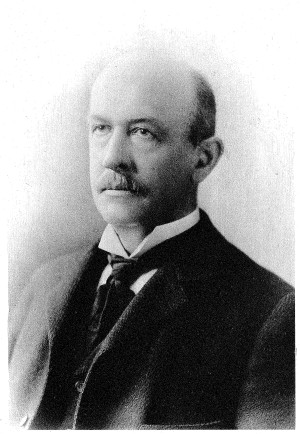
One interesting and salient feature of the discussion so far is the vast amount of evidence presented that his reputation has suffered unjustly in historical estimation. This is true of both the social Darwinism slur that Matt Zwolinski noted in his opening essay, and in the larger pattern of neglect we have seen around Sumner's distinctive humane dimensions: his harsh opposition to imperialism and war, his crusade against corruption and cronyism, and his contributions to a classical-liberal theory of class that sought to root out the beneficiaries of undue and unjust government privileges. A remarkable feature of Sumner's poor reputation today is that some of its main culprits are historians, and particularly intellectual historians.While Hofstadter's mischaracterizations of Sumner's intellectual history have been pinpointed as a primary source of this problem, I wanted to raise a related dimension in noting that one of the many intellectual hats that Sumner himself wore was that of intellectual historian. Some of his least-known works in the present day fell in this genre, although they once ranked among his most familiar contributions. As David Hart's response above notes, Sumner's writings on economic history served as an important vehicle for conveying economic logic as well. To this end he wrote substantial historical works on banking, on currency, and on the financial dimensions of the American revolution. He also took a historical approach to his favorite topic of free trade, publishing a collection of five Lectures on the History of Protection in the United States.[69] These lessons used the historical progression of the tariff system from the founding era through his own time to essentially teach the economics of trade and taxation.In several instances, profound economic insights may be found lurking amidst what is ostensibly a historical account. The 1883 text, for example, reveals one such lesson in its discussion of tariff history. Calling upon Adam Smith's maxims of taxation and adding his own eye for analytical observation, Sumner actually developed an early precursor to the Laffer Curve within the tariff system. "Protective tariffs are hostile to revenue," he noted, on account of their purpose of preventing importations. "The moment, however, that a tax begins to have this effect it prevents revenue. Hence where protection begins, there revenue ends."[70] Building on this principle, he proceeded to dissect the historical progression and purposes of American tariff statutes. His discussion of the tensions between tariff's two objectives – revenue and protective rents – both anticipates modern public-choice theory and contains a more sophisticated understanding of the tariff's operations than many modern historical works on the same subject.Another closely related foray into historical scholarship may be found in Sumner's critical biography of Alexander Hamilton, published in 1890.[71] It was written at a time that Hamilton scholarship was mired in a mixture of founding father hagiography and political appropriation to bolster the issues of the day. One of the leading Hamilton "scholars" at the turn of the century was the arch-protectionist Senator Henry Cabot Lodge of Massachusetts. Lodge made a frequent habit of enlisting his subject matter's authority to his own legislative agenda, presenting it as a uniquely American contribution to political economy and borrowing heavily upon Hamilton's legacy to differentiate his protectionist project from both the poor repute of the mercantilists of old and the imperial designs of European protectionist contemporaries – primarily in the emerging Bismarckian state of Germany.Sumner subjected Hamilton's record to thoroughgoing scrutiny. He easily dispelled the claimed novelty and originality of the Hamiltonian system, finding traces of low-grade protectionist reasoning on trade in the earliest stages of Hamilton's political career. Sumner specifically rebutted the notion that Hamilton's famous Report on Manufactures was a work of deep theory and original economic insight. As he showed using first Treasury secretary's own earlier statements, Hamilton "was completely befogged in the mists of mercantilism," his works consisting of the recycled "doctrines of the first quarter of the eighteenth century." Despite this proclivity, Hamilton's own tariffs were not quite the system that Lodge and other turn-of-the-century Hamiltonians claimed.[72] Since they were rooted in a larger comprehensive revenue system, Hamilton's tariffs were "hostile to any extravagant rates" achieved at the neglect of excises and other mechanisms. In this sense, they stood at odds with the aggressively protectionist schedules of the McKinley Tariff in Sumner's own time – a veritable rent-seeking extravaganza of preferential rates to any and every American industry that was willing to pay for the privilege from the government.In each case, Sumner tapped a detailed and often meticulous recounting of historical events to interpret the contemporary lay of the political land. His work on Hamilton, for example, also probes into the problems of empire and military expansionism – both of which found their roots in Hamilton's own proclivities for military buildup as happened during the Quasi-War and, at times, Hamilton's own fantastical visions of an American empire stretching southward to the Caribbean and Latin America. History thus became a prominent vehicle for Sumner to develop and reinforce his own arguments on militarism, trade and currency policies, and the financial habits of the U.S. government in his own time.Endnotes[69.] Lectures on the History of Protection in the United States: delivered before the International Free-Trade Alliance (New York: G. P. Putnam's Sons, 1883).[70.] Ibid., 4.[71.] Alexander Hamilton (New York: Dodd Mead, 1890).Fabio Rojas
The Path Away from Evolutionism · Jul 24, 2017
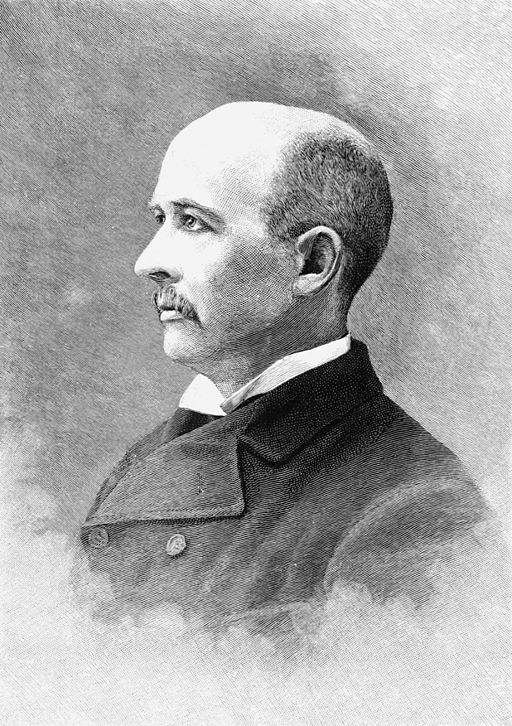
In this final response to the essays by Zwolinski and Magness, I want to focus on an intellectual trend that should be of concern to any reader who values personal autonomy. After the eclipse of classical-liberal social science, the academy oriented itself toward some very illiberal frameworks such as eugenics. These ideas, which I termed retrenchment social science in my previous response, combined nationalist impulses, interventionist social science, and a desire to correct or control undesirable populations.This discussion originated in the discussion of William Graham Sumner, who was one of the leading classical liberals of his day, but helps illuminate the path to the present. The discussion of how Sumner was critiqued and what replaced his ideas points to the need to excavate the intellectual landscape that emerged in the early 1900s. Much intellectual history, especially that written by classical liberals, focuses on the rise of socialist thinking. There is also an understandable focus on the history of economic thought, especially that of Keynes and his contemporaries.Perhaps what is more important in the American context is the history of retrenchment social science. If one takes the writings of classical liberals like Sumner and Spencer as a starting point, then the question is less about socialist thought and its descendants and more about retrenchment social science broadly understood not just as economic theory but also social and cultural theory.Taking this perspective, one is led to a series of questions. For example, what legacies, if any, did intellectuals of the late 20th century inherit from the retrenchment social science of the early 20th century? How do encroachments of freedom such as mass incarceration rely on these earlier intellectuals?Another important question for classical liberals is how the insights of Sumner should be returned to modern thinking. One argument is that later generations of scholars have already built on these ideas. In modern sociology, neo-institutional scholars already recognize Sumner as a forebear but have developed his ideas in new ways. Similarly, his critiques of welfare states have been presented in a much more modern way by public-choice theorists. But aside from the followers of Hayek, few other social scientists so consistently focus on the spontaneous order of society. Whatever route classical-liberal social science takes in the future, it would be enriched by further consideration of its evolutionist heritage.David M. Hart
Not just Forgotten but Unknown: Sumner's Unpublished Manuscripts · Jul 24, 2017

Looking through Albert Galloway Keller bibliography of the works of Sumner which he included as an appendix to The Forgotten Man and Other Essays (1918) and which I have added to our bibliography below, I was struck by how many substantial pieces of work by Sumner were never published. By not publishing them Sumner did not help his own career. The longest onew were:- History of Paper Money. Paper money in China, England, Austria, Russia, and the American Colonies (1873). Unpublished manuscript, 109 pp.;
- followed by The Currency Question (1875). An address delivered about this time opposing the issue of irredeemable paper money. Unpublished manuscript, 96 pp.;
- Free Trade (c. 1899). About 64 typewritten pages (it was however published in French - see below for details); and what looks might have been his treatise on Political Economy if he could have got it into a publishable form, Political Economy. From 300 to 400 pp. of lecture notes for classroom use.
Having read his essay on "Liberté des Échanges" (Free Trade) I can say that it is an excellent piece of both economic history and history of ideas which shows an impressive depth of knoweldge of the literature covering several centuries and countries.Here is a fuller list of some of Sumner's longer unpublished pieces:1873.The Solidarity of the Human Race. Unpublished manuscript of an address on the influence of ideas and events in one country on conditions in other countries, delivered at the Sheffield Scientific School, January 11. 40 pp. (Sumner Estate.)Relation of Physical to Moral Good. An address. Unpublished manuscript probably of this date, 35 pp. (Sumner Estate.)History of Paper Money. Paper money in China, England, Austria, Russia, and the American Colonies. Unpublished manuscript, 109 pp. (Sumner Estate.)1874.The Lesson of the Panic (of 1873). Unpublished manuscript advocating a return to a sound currency, 20 pp. (Sumner Estate.)Have we had Enough? Unpublished manuscript on the evils of paper money, written soon after the panic of 1873, 15 pp. (Sumner Estate.)Political Economy. From 300 to 400 pp. of lecture notes for classroom use. (Sumner Estate.)Taxation. What it is, what its relation to other departments of political economy is, and what are the general principles by which it must be controlled. Unpublished manuscript probably of this date, 24 pp. (Sumner Estate.)1875.The Currency Question. An address delivered about this time opposing the issue of irredeemable paper money. Unpublished manuscript, 96 pp. (Sumner Estate.)1878.Relation of Legislation to Currency. Unpublished manuscript written about this time dealing with the nature of money, coining, paper money, legal tender acts, the monetary experience of England and France, etc., and opposing the abuses of legislation in regard to currency. 45 pp. (Sumner Estate.)1879.Amortization of Public Debts. Unpublished manuscript, chiefly historical, written about this time. 35 pp. (Sumner Estate.)1889.Peasants and Land Tenure in Scandinavia. Unpublished manuscript, 20 typewritten pages, written in 1889 or later, covering the period from the earliest times to the eighteenth century. (Sumner Estate.)Free Trade. Unpublished manuscript of about this date. I. Definitions of Protection and Protectionism. II. The Medieval Doctrine of Commerce. III. The Sixteenth Century. IV. The Dynastic States. V. Mercantilism and the Colonial System. VI. The New Doctrine. VII. Smithianismus. VIII. Protection in the United States. IX. Nineteenth-century Protectionism. X. The Present Situation. About 64 typewritten pages. (Sumner Estate.) Published in French as "Liberté des Échanges" in Nouveau Dictionnaire d'Économie Politique, vol. 2, pp. 138–166, Guillaumin et Cie., Paris.The Strikes. Unpublished manuscript written sometime in the eighties, 21 typewritten pages. A general survey of the "labor question." (Sumner Estate.)The Sphere of Academical Instruction. Address delivered at the celebration of a school anniversary. To judge "what an academy is, what it ought to do, and how it ought to do it; and to judge of its achievements by true standards." Unpublished manuscript of the eighties, 27 pages. (Sumner Estate.)1896.The Currency Crisis. A course of six lectures given at the house of Mr. John E. Parsons, 30 East 36th St., New York City, February 13 and 27 and March 5, 12, 19, and 26. What the lecturer said, as well as the questions and answers at the end of his lectures, was taken down in shorthand and typewritten. Mr. Herbert Parsons has the transcript in bound form, and the Yale University Library also has a copy. (Sumner Estate.)1897.Money And Currency. A course of four lectures delivered in Boston. I. The Anxiety Lest there be not Money Enough. II. How We Resumed Specie Payments in 1879. What We Did Not Do. III. The Single Gold Standard - A Beneficent and Accomplished Fact. IV. Where we now Stand and what we have to Do. Syllabus.Sociology. A course of six lectures given in Albany, February 27, March 6, 13, 20, 27, and April 3. Introduction. Individuality and Sociality. Property. Industrialism and Militarism. Population. Mental Reaction on Experience. Suggested Books for a Course of Reading. Syllabus.1898.Syllabus of six lectures given during January and February in Plainfield, N. J. I. What is a Free Man and a Free State? II. What is Democracy? III. Aggregations of Wealth and Plutocracy. IV. The Rich and the Poor. V. Woman. VI. Immigration.David M. Hart
Hayek on the Role of History in teaching Political and Economic Ideas · Jul 24, 2017
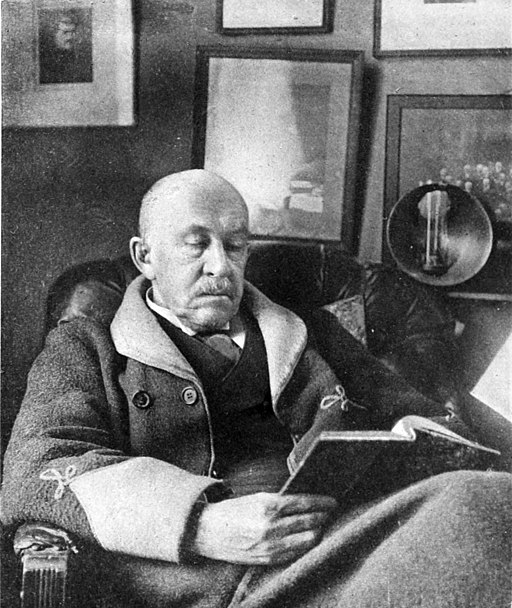
Phil Magness's post reminds me of something Fridrich Hayek wrote about the importance history (and I would add novels, films, and TV) plays in influencing people's political and economic ideas. I'm not sure if this was Sumner's intention in writing his histories of money, tariffs, and biographies of figures like Hamilton, that is to indirectly impart sound economic ideas to his students and readers. It would be interesting to know how many people read his more popular works like the biography of Alexander Hamilton (1890) or his Protectionism, the -ism which teaches that waste makes wealth (1885) and how they were reviewed in the press.Given the popularity of sociology as a subject at universities and colleges since the 1960s I wonder what role this discipline has played in spreading ideas about economics and politics?Here are two passages from Hayek's Introduction to Capitalism and the Historians (1954) which caught my attention:[73]"The influence which the writers of history thus exercise on public opinion is probably more immediate and extensive than that of the political theorists who launch new ideas. It seems as though even such new ideas reach wider circles usually not in their abstract form but as the interpretations of particular events. The historian is in this respect at least one step nearer to direct power over public opinion than is the theorist." (p. 4 )"Most people, when being told that their political convictions have been affected by particular views on economic history, will answer that they never have been interested in it and never have read a book on the subject. This, however, does not mean that they do not, with the rest, regard as established facts many of the legends which at one time or another, have been given currency by writers on economic history. Although in the indirect and circuitous process by which new political ideas reach the general public the historian holds a key position, even he operates chiefly through many further relays. It is only at several removes that the picture which he provides becomes general property; it is via the novel and the news- paper, the cinema and political speeches, and ultimately the school and common talk that the ordinary person acquires his conceptions of history. But in the end even those who never read a book and probably have never heard the names of the historians whose views have influenced them come to see the past through their spectacles." (p. 8)
Endnotes[73.] F. A. Hayek, "Introduction" to Capitalism and the Historians: Essays by T.S. Ashton, L.M. Hacker, W.H. Hutt, B. de Jouvenal. Edited and with an Introduction by F.A. Hayek (University of Chicago Press, 1974, 1st ed. 1954), pp. 3-29.Robert Leroux
William Graham as a Social Historian · Jul 25, 2017
Philip Magness and David Hart remind us the importance of historical knowledge in Friedrich Hayek's works. By the same token, we should not forget the pioneering role of the Austrian economists at large on this topic, especially Ludwig von Mises.[74]The enthusiasm for history that emerged at the beginning of the 19th century had a great influence on the social sciences. Born of the crisis of Western societies – caught up in what seemed a sudden acceleration of history – it is natural enough that these sciences should attempt to define the laws governing human destiny. The social sciences were historical by necessity: William Graham Sumner could not conceive of them in any other manner. With the coming of age of sociology, the idea that there could be a "science" of history was the subject of much and varied debate.[75]And yet the science of history would draw some valuable lessons from the methodology of sociology which was emerging at the time. It was in large part under the impetus of the issues and problems raised by Sumner, increasingly aware of the limits of narrative history, turned so enthusiastically to social and economic history. He then consulted history in order to avoid the twin pitfalls of the philosophy of history and of introspective psychology. For Sumner, singular facts are very important as he noted in a passage in his work Folkways (1906): "The modern historians turn with some disdain away from the wars, intrigues, and royal marriages which the old-fashioned historians considered their chief interest, and many of them have undertaken to write the history of the people."[76]In this context, some historians came to see written documentation as the key factor in the definition of "scientific" history. The document supported the historian's argument, and it served to demarcate history from the philosophy of history. With the aid of the document, history could at last claim to be an objective science.But for many social scientists, like Sumner and many others, history was not completely free of philosophy, nor did it renounce systematization. History should then show how people try to meet their psychological and biological needs through institutions. On this, Sumner seems to mix Bastiat and Spencer theoretical standpoints.To conclude, I would attempt to answer David Hart's question. That is, does sociology have a particular role in spreading ideology and politics ideas. It is well known that Marx and the Marxists played a decisive role. But it is not obvious with other founding fathers of sociology like Émie Durkheim, Max Weber, Gabriel Tarde, and Georg Simmel. Concerning Sumner, it is tough to detect a direct influence. Maybe because he had a very small network. He had no link for example with the Chicago school of sociology and he never published a paper in the American Journal of Sociology, the most important academic journal of his time.Endnotes[74.] See Ludwig von Mises, History and Theory, Yale University Press, New Haven, 1957.[75.] See James Harvey Robinson, The New History, Essays Illustrating the Modern Historical Outlook, New York, The MacMillan Company, 1912. In the Human Comedy (1937), he writes : "It is true that biologists have, many of them, given up what they call 'Darwinism'; they have surrendered Spencer's notion of the hereditary transmission of acquired characters, and they even use the word 'evolution' timidly and with many reservations. But this does not mean that they have any doubts that mankind is a species of animal, sprung in some mysterious and as yet unexplained manner from extinct wild creatures of the forests and plains."David M. Hart
Remembering Sumner the Political Economist. Part 2: The Economic Waste caused by Tariff Protection · Jul 25, 2017
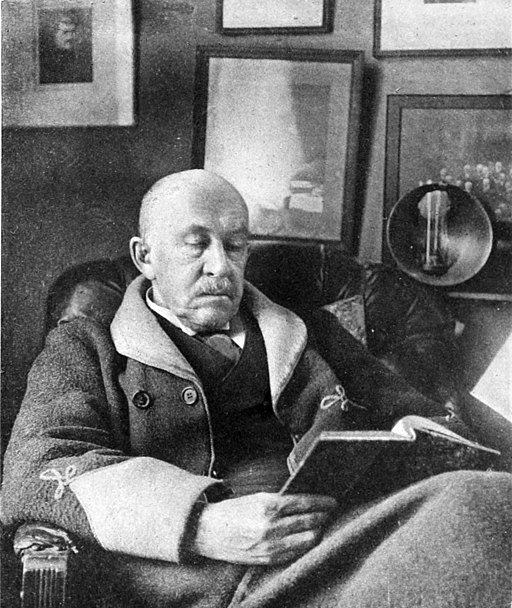
After four years of academic work on paper money and currency matters Sumner turned his attention to tariffs with a series of lectures on “The History of Protection in the United States” which he gave to the International Free-trade Alliance in New York city in the spring of 1876.[77] This began a ten year period during which he wrote a great deal about tariffs and the need for free trade. He gave lectures to the New York Free-Trade Club, wrote letters to the editors of newspapers on free trade, and wrote position papers for bodies such as the Philadelphia Tariff Commission. After 1886 his attention turned to other topics.This is where I take issue with Fabio Rojas's claim in "The Rivals of Classical-Liberal Social Science" that what "doomed Sumner" to obscurity was the "lack of an activist vision." In both areas of his economic interests, paper money and tariff protection, but especially the latter, Sumner had both an activist vision and was indeed very active in trying to promote free trade ideas to both government bodies as well as the general public, especially after 1883. He would do much the same thing after 1898 when the U.S. fought Spain and began its acquisition of colonies when he became active in the Anti-Imperialist League. Unfortuantely, what "doomed" him and the other laissez-faire classical liberals was not a lack of "activism" but the fact that both protectionism and colonial or imperial expansion were popular among government officials, some powerful business leaders, and the general public.What got Sumner first engaged in "activism" was the debate which erupted because of an off-the-cuff remark in his essay “The Forgotten Man” (1883) in which he criticised the tariff protection given to the thread manufacturers of Willimantic, Connecticut (known as “Thread City”). He noted that the tariffs benefitted the “Willimantic linen company” at the expence of the forgotten men and women of America:When you go to Willimantic, they will show you with great pride the splendid thread mills there. I am told that there are sewing-women who can earn only fifty cents in twelve hours, and provide the thread. In the cost of every spool of thread more than one cent is tax. It is paid, not to get the thread, for you could get the thread without it. It is paid to get the Willimantic linen company which is not worth having and which is, in fact, a nuisance, because it makes thread harder to get than it would be if there were no such concern. If a woman earns fifty cents in twelve hours, she earns a spool of thread as nearly as may be in an hour, and if she uses a spool of thread per day, she works a quarter of an hour per day to support the Willimantic linen company, which in 1882 paid 95 per cent dividend to its stockholders. If you go and look at the mill, it will captivate your imagination until you remember all the women in all the garrets, and all the artisans’ and laborers’ wives and children who are spending their hours of labor, not to get goods which they need, but to pay for the industrial system which only stands in their way and makes it harder for them to get the goods.[78]
This caused an uproar in the New England press which lasted for a couple of years into which Sumner threw himself with some gusto writing many letters to the editor defending his views. This period of intense free trade activity came to an end with the book Protectionism. The -Ism which Teaches that Waste makes Wealth (1885),[79] the very title of which returns us to one of the key aims of his teaching and research which Sumner had outlined in his 1873 “Introductory Lecture to Courses in Political and Social Science,” namely the duty of the political economist to identify sources of waste and the exploitation of ordinary people. In the Preface Sumner explains with some anger, moral indignation, and even religious fervour, why he took time away from “the scientific pursuits which form my real occupation, and forces me to take part in a popular agitation” against the policy of protectionism:I have written this book as a contribution to a popular agitation. I have not troubled myself to keep or to throw off scientific or professional dignity. I have tried to make my point as directly and effectively as I could for the readers whom I address, viz., the intelligent voters of all degrees of general culture, who need to have it explained to them what protectionism is and how it works. I have therefore pushed the controversy just as hard as I could, and have used plain language, just as I have always done before in what I have written on this subject. I must therefore forego the hope that I have given any more pleasure now than formerly to the advocates of protectionism.Protectionism seems to me to deserve only contempt and scorn, satire and ridicule. It is such an arrant piece of economic quackery, and it masquerades under such an affectation of learning and philosophy, that it ought to be treated as other quackeries are treated. Still, out of deference to its strength in the traditions and lack of information of many people, I have here undertaken a patient and serious exposition of it. Satire and derision remain reserved for the dogmatic protectionists and the sentimental protectionists; the Philistine protectionists and those who hold the key of all knowledge; the protectionists of stupid good faith and those who know their dogma is a humbug and are therefore irritated at the exposure of it; the protectionists by birth and those by adoption; the protectionists for hire and those by election; the protectionists by party platform and those by pet newspaper; the protectionists by “invincible ignorance” and those by vows and ordination; the protectionists who run colleges and those who want to burn colleges down; the protectionists by investment and those who sin against light; the hopeless ones who really believe in British gold and dread the Cobden Club, and the dishonest ones who storm about those things without believing in them; those who may not be answered when they come into debate, because they are “great” men, or because they are “old” men, or because they have stock in certain newspapers, or are trustees of certain colleges. All these have honored me personally, in this controversy, with more or less of their particular attention. I confess that it has cost me something to leave their cases out of account, but to deal with them would have been a work of entertainment, not of utility.Protectionism arouses my moral indignation. It is a subtle, cruel, and unjust invasion of one man’s rights by another. It is done by force of law. It is at the same time a social abuse, an economic blunder, and a political evil. The moral indignation which it causes is the motive which draws me away from the scientific pursuits which form my real occupation, and forces me to take part in a popular agitation. The doctrine of a “call” applies in such a case, and every man is bound to take just so great a share as falls in his way. That is why I have given more time than I could afford to popular lectures on this subject, and it is why I have now put the substance of those lectures into this book.[80]
I will close with this image of the Toasts given at the annual dinner of the New York Free-Trade Club which was held at Delmonico’s restaurant in New York City in February 1885.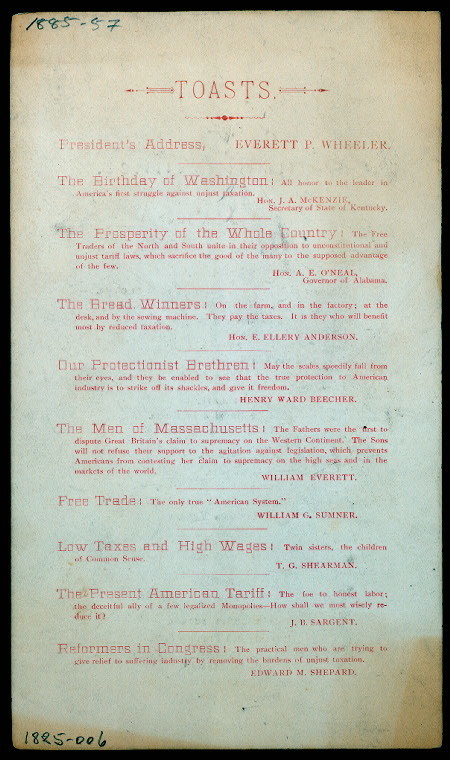
The New York Free-Trade Club: Dinner Toasts at Delmonico’s (1885) Two of the toasts are especially interesting. Note “The Birthday of Washington” given by McKenzie, the Secretary of the State of Kentucky (“All honor to the leader of America’s first struggle against unjust taxation”) and that by William Graham Sumner “Free Trade: The only true ”American System"".[81]Twenty years later at another dinner in New York City, this time hosted by the Committee on Tariff Reform of the Reform Club (2 June 1906), Sumner reminisced about why he had become active in the free trade movement to begin with and why he continued to support it now:Thirty-five or forty years ago I became a free trader for two great reasons, as far as I can now remember. One was because, as a student of political economy, my whole mind revolted against the notion of magic that is involved in the notion of a protective tariff. That is, there are facts that are accounted for by assertions that are either plainly untrue or are entirely irrational. The other reason was because it seemed to me that the protective tariff system nourished erroneous ideas of success in business and produced immoral results in the minds and hopes of the people.I cannot say that I have got any more light on the matter within the last twenty years, but it looks to me still as if the great objections to protectionism were these two.[82]
But what depressed Sumner and his contemporary Gustave de Molinari in France, who published his second set of "conversations" defending free trade in 1886 the year after Sumner's book on Protectionsm appeared, [83] was that they could not convince enough of their fellow citizens, those "forgotten men and women," that protectionism harmed them. What was emerging in both countries was a powerful alliance of protected industries, the workers who worked in those industries, politicians who saw protectionism as a way of advancing their careers in the emerging democracies of late 19th century Europe and the U.S. , and nationionalist intellectuals who had fully accepted the interventionist views of Alexander Hamilton and Friedrich List. The free traders in the mid-1880s were not able to build their own coalition of support to act as a counterveiling force to the protectionists. We should not be surprised at this as we are seeing the same forces at work today.Endnotes[77.] Lectures on the History of Protection in the United States. Delivered before the International Free-trade Alliance. Reprinted from “The New Century.” Published for the International Free-trade Alliance by G. P. Putnam’s Sons, New York, 64 pp. Contents: The National Idea and the American System, Broad Principles Underlying the Tariff Controversy, The Origin of Protection in this Country, The Establishment of Protection in this Country, Vacillation of the Protective Policy in this Country. He would write another history of free trade and protection in about 1889 which was never published in English: Free Trade (Unpublished manuscript.) I. Definitions of Protection and Protectionism. II. The Medieval Doctrine of Commerce. III. The Sixteenth Century. IV. The Dynastic States. V. Mercantilism and the Colonial System. VI. The New Doctrine. VII. Smithianismus. VIII. Protection in the United States. IX. Nineteenth-century Protectionism. X. The Present Situation. About 64 typewritten pages. (Sumner Estate.) This was published in French as “Liberté des échanges” (Free Trade) in Nouveau Dictionnaire d’Économie Politique, publié sur la direction de M. Léon Say et de M. Joseph Chailley (Paris: Librairie de Guillaumin et Cie, 1891–92), vol. 2, pp. 138–66.[78.] Sumner, The Forgotten Man and Other Essays ,</titles/2396#Sumner_1225_724>.[79.] Sumner, The Forgotten Man and Other Essays, </titles/2396#lf1225_head_002>.[80.] Preface to “Protectionism” in The Forgotten Man and Other Essays, </titles/2396#Sumner_1225_12>.[81.] Rare Book Division, The Buttolph Collection of Menus, The New York Public Library. “ANNUAL DINNER [held by] NEW YORK FREE TRADE CLUB [at] DELMONICO NY” The New York Public Library Digital Collections. 1885. <https://digitalcollections.nypl.org/items/510d47e4-3459-a3d9-e040-e00a18064a99>.[82.] Opening paragraph of Address of William G. Sumner, Professor of Political and Social Science in Yale University, At Dinner of the Committee on Tariff Reform of the Reform Club in the City of New York. June 2nd, 1906. (Published by the Reform Club Committee on Tariff Reform, 42 Broadway, New York, N. Y., 1906).[83.] Gustave de Molinari (1819-1912) wrote three collections of "conversations" between intellectual adversaries to defend his views about laissez-faire policies. The first one, Les Soirées de la rue Saint-Lazare; entretiens sur les lois économiques et défense de la propriété (Evenings on Saint Lazarus Street: Conversations about Economic Laws and a Defence of Private Property), appeared in 1849 and was a series of "conversations" between a Socialist, a Conservative, and an Economist in which he provided a concise survey of the classical liberal position (perhaps the first of its type) and explored how all public goods might be privatised, including the "production of security" (i.e police and national defence). Free trade was just one of many topics he covered in this book. His second collection of "conversations" appeared in 1855 and was devoted completely to free trade and protection: Conservations familières sur le commerce des grains (Familiar Conversations about the Grain Trade). It was a popular defense of free trade at a time when riots were occurring in Brusselles against food shortages and rising food prices. The conversations were between "un émeutier" (a rioter), "un prohibitionniste" (a trade prohibitionist or protectionist), and "un économiste" (an economist). After a hiatus of 30 years Molinari returned to the topic of free trade when he reissued his 1855 book, which is now entitled "Part One: A Time of Shortage", with an additional part added to it called "Part Two. Thirty Years Later: A Time of Plenty". The conversations are no longer described as "familiar" and take place between an Economist, a Protectionist, and a Collectivist: Conversations sur le commerce des grains et la protection de l'agriculture (Conversations about the grain trade and the protection of agriculture) (1886). In this later book the protectionists were complaining about the opposite of what had happened in 1855. The problem now was food surpluses, especially food coming from overseas (like the U.S. and Russia) and competing with French farmers. Molinari threw up his hands in despair, saying the protectionists wanted to have it both ways - protection when there are shortages and protection when there are surpluses.Matt Zwolinski
William Graham Sumner as Classical-Liberal Class Theorist · Jul 25, 2017
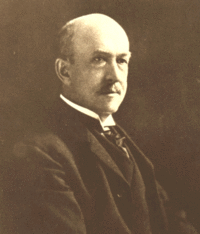
My opening essay touched on Sumner's thoughts on "plutocracy" and "jobbery." Here, I want to expand on these themes, and show how they relate to Sumner's larger classical-liberal theories of class, liberty, and exploitation.The claim that William Graham Sumner can properly be described as a "class theorist" will no doubt come as a surprise to many. Class theory in social analysis is almost always associated with Marxist thought, and most especially with Marx's claim that the bourgeoisie exploits the proletariat by means of the former's monopolistic control of the means of production.[84]But as recent scholars such as David Hart, Gary Chartier, Ross Kenyon, and Roderick Long have recently documented, there is a long and fascinating tradition of classical-liberal class analysis that precedes and rivals the Marxist one.[85] According to this alternative tradition, social classes are to be distinguished in terms of access or lack of access to state power, and it is state power (rather than access to capital as such) that gives rise to the phenomenon of exploitation.To see how Sumner fits into this tradition, we need to start with his understanding of liberty. In his essay "The Forgotten Man," Sumner defined civil liberty as the state in which each individual is guaranteed the exclusive employment of his own powers for his own welfare. According to Sumner,The institutions of civil liberty leave each man to run his career in life in his own way, only guaranteeing to him that whatever he does in the way of industry, economy, prudence, sound judgment, etc., shall redound to his own welfare and shall not be diverted to some one else's benefit. Of course it is a necessary corollary that each man shall also bear the penalty of his own vices and his own mistakes. If I want to be free from any other man's dictation, I must understand that I can have no other man under my control.[86]
For Sumner, civil liberty was a goal to be aspired to, but not a reality that most human beings were able to enjoy.All history is only one long story to this effect: men have struggled for power over their fellow-men in order that they might win the joys of earth at the expense of others and might shift the burdens of life from their own shoulders upon those of others.[87]
Like Marx, Sumner saw exploitation as a constant throughout history, with one group of individuals living off the labor of others, and only the identity of the respective groups and the particular form of exploitation varying over time.[88] Slavery, feudalism, militarism, and aristocracy were all for Sumner just different expressions of the same basic pattern: one group of people labors, and another group of people lives parasitically off the fruit of their labor.Of course, a person can only live off the fruits of others' labor in one of two ways: by consent or by force. Parents consent to support their children, and neighbors, friends, and communities will sometimes consent to support individuals who are suffering ill-fortune. But living off others' labor in that way is generally only a temporary phenomenon and is moreover dependent upon the special bonds of close relationship. To live off the labor of others as a permanent matter is generally only possible through the exercise of coercion. And the key insight of Sumner and other classical-liberal class theorists was that it was the coercive institutions of the state in particular that provided the surest and most attractive opportunity for one class to exploit another.The history of the human race is one long story of attempts by certain persons and classes to obtain control of the power of the State, so as to win earthly gratifications at the expense of others.[89]
In his own time, Sumner saw the most dangerous form of exploitation as "plutocracy," or what we might now call "corporatism," "crony capitalism," or "corporate welfare." Like many on the political left, Sumner saw a great danger in the concentration of wealth in the hands of great industrialists. But what was problematic for Sumner was not the wealth itself but rather how those industrialists chose to use it – not economically, by investing it in capital or in consumption goods, but politically.[I]nstead of employing laborers, he enlists lobbyists. Instead of applying capital to land, he operates upon the market by legislation, by artificial monopoly, by legislative privileges; he creates jobs, and erects combinations, which are half political and half industrial; he practises upon the industrial vices, makes an engine of venality, expends his ingenuity, not on processes of production, but on "knowledge of men," and on the tactics of the lobby. The modem industrial system gives him a magnificent field, one far more profitable, very often, than that of legitimate industry.[90]
A capitalist invests in capital so that he can produce goods and services that others value highly enough to enable him to earn a living from what they choose to give him voluntarily. A plutocrat invests in state power so that he can live off the produce of others' labor that is taken from them coercively by taxation. In seeking what he regards as the most effective means to the satisfaction of his self-interest, the plutocrat acts rationally – he responds to the incentives of the political system he inhabits. But in this sort of system the rational pursuit of self-interest is socially destructive. As more capitalists come to see that investing in politics is the easiest way to wealth, more and more resources are channeled away from positive-sum investment and toward a zero-sum competition over political "rents." Economic growth and democratic institutions are thereby put in peril. Even the rise of imperialism, Sumner thought, was directly related to the problem of plutocracy.[91]What could be done about the threat of plutocracy? How might humanity bring an end to the cycle of the exploitation of man by man? In one sense, the solution is simple. If exploitation is made possible by some people using political power for their own private benefit, then the solution is to minimize the scope of political power.[T]he wise policy in regard to it is to minimize to the utmost the relations of the state to industry. As long as there are such relations, every industrial interest is forced more or less to employ plutocratic methods. The corruption is greater, perhaps, on those who exercise them than on the objects of them. Laissez-faire, instead of being what it appears to be in most of the current discussions, cuts to the very bottom of the morals, the politics, and the political economy of the most important public questions of our time.[92]
Of course, even if this solution would work in theory, minimizing the relations of state to industry is easier said than done. After all, the same incentives that lead individuals to take advantage of existing state power to serve their own personal interests will also lead them to defend that power, or to re-establish it if, by some miracle, it is abolished.Sumner recognized that the task of fighting effectively against vested interests would not be easy, but would instead call for "fresh reserves of moral force and political virtue."[93] Effective political institutions were part of the story. Sumner, anticipating ideas that would later be developed in much greater detail by James Buchanan, argued that constitutional constraints were necessary to prevent legislators from using their power for private rather than public good. Day-to-day politics – electing this or that person or passing this or that bill – would not do. The rules of the political game had to be changed.Sumner saw that institutions by themselves are not enough to guarantee a state of civil liberty. A condition of freedom can only be secured by a people who are themselves morally committed to freedom. This requires the development of a certain character, at least on the part of a substantial minority of the people, and the "voluntary cooperation and combination" of those committed to liberty.In 1883, when he wrote this analysis in What Social Classes Owe to Each Other, Sumner thought there was "every ground for hope" that this movement could be successful. By the end of his life, Sumner was much less confident, having become convinced that the 19th-century era of peace and prosperity was a brief historical exception that was coming to an end, and that the 20th century would be "as full as war" as the 18th.[94] So profound was Sumner's despair that he suffered an emotional collapse in 1890 that required him to take his first academic leave. In his despair at the prospects for liberty in the 20th century, Sumner joined Herbert Spencer and Gustave de Molinari, who suffered similar personal crises over their similarly grim predictions.Endnotes[84.] Zwolinski, Matt and Wertheimer, Alan, "Exploitation", The Stanford Encyclopedia of Philosophy (Summer 2017 Edition), Edward N. Zalta (ed.), URL = <https://plato.stanford.edu/archives/sum2017/entries/exploitation/>. See the section in "1.2 Marx's Theory of Exploitation" <https://plato.stanford.edu/entries/exploitation/#MarxTheoExpl>[85.] David Hart, Gary Chartier, Ross Kenyon, and Roderick Long, eds., Social Class and State Power: Exploring an Alternative Radical Tradition (London: Palgrave, 2018).[86.] Sumner, "The Forgotten Man," in Albert Galloway Keller, ed., The Forgotten Man and Other Essays (New Haven, CT: Yale University Press, 1918). </titles/2396#Sumner_1225_701>. Sumner's thoughts on civil liberty are further developed in a series of essays written between 1887 and 1889, and later collected in his Earth-hunger and Other Essays (New Haven, CT: Yale University Press, 1913).[87.] Sumner, "The Forgotten Man."[88.] "If there are groups of people who have a certain claim to other people's labor and self-denial, and if there are other people whose labor and self-denial are liable to be claimed by the first groups, then there certainly are 'classes,' and classes of the oldest and most vicious type." Sumner, What Social Classes Owe to Each Other (New York: Harper and Brothers, 1911), I.: ON A NEW PHILOSPHY: THAT POVERTY IS THE BEST POLICY, </titles/346#Sumner_0317_14>.[89.] Sumnder, VII.: CONCERNING SOME OLD FOES UNDER NEW FACES, in What Social Classes Owe to Each Other, (New York: Harper and Brothers, 1911). </titles/346#Sumner_0317_84>.[90.] Sumner, "The Conflict of Democracy and Plutocracy," in Earth-hunger and Other Essays.[91.] "The great foe of democracy now and in the near future is plutocracy. Every year that passes brings out this antagonism more distinctly. It is to be the social war of the twentieth century. In that war militarism, expansion and imperialism will all favor plutocracy. In the first place, war and expansion will favor jobbery, both in the dependencies and at home. In the second place, they will take away the attention of the people from what the plutocrats are doing. In the third place, they will cause large expenditures of the people's money, the return for which will not go into the treasury, but into the hands of a few schemers." Sumner, "The Conquest of the United States by Spain" in William Graham Sumner, War and Other Essays, ed. Albert Galloway Keller (New Haven: Yale University Press, 1919). .[92.]Sumner, "The Conflict of Democracy and Plutocracy," in Earth-hunger and Other Essays , p. 300.[93.] VII.: CONCERNING SOME OLD FOES UNDER NEW FACES. in William Graham Sumner, What Social Classes Owe to Each Other, (1911). </titles/346#Sumner_0317_91>.[94.] Cited in Robert C. Bannister, Social Darwinism: Science and Myth in Anglo-American Social Thought (Philadelphia: Temple University Press, 1979), 102, 105. Also online: Sumner, "The Bequests of the Nineteenth Century to the Twentieth" (c. 1900) </pages/sumner-bequests>.Phillip W. Magness
Sumner and the Income Tax · Jul 28, 2017
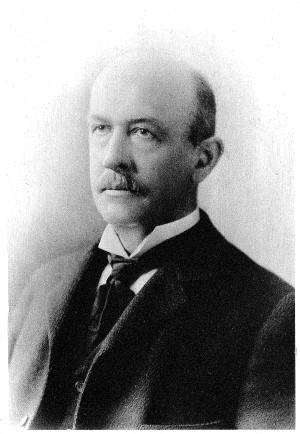
As several contributions to this discussion have noted, William Graham Sumner deserves credit for anticipating the analytical framework of public choice theory. Perhaps nowhere is this more apparent than his multi-decade crusade against protective tariffs, as highlighted in David Hart's most recent comment. Tariffs were the quintessential example of rent-seeking in Sumner's time – a government manipulation of the market in the service of politically connected protectionist industries.Not all of Sumner's work in this area carries the commendation of a favorable legacy, though, and since much of the discussion has sought to revive his reputation against unfair slanders, it seems appropriate to note the fairness of one largely unnoticed critique. Sumner, in a roundabout way, bears some of the blame for the modern federal income tax – a position he came to from the same line of reasoning as his stinging attacks upon the tariff system.The occasion happened in 1878 when a group of anti-tariff legislators invited Sumner to testify about a proposed reformulation of the federal revenue system. High protectionism had ruled the day in the United States since 1861, and electoral attempts to mount a challenge to the tariff after the Civil War ran into the recurring problem of legislative logrolling and cronyism. Sumner noticed that substantive congressional pushes to reform the tariff often faltered on the same lines – a reform would be initiated and then whittled away by legislative amendment as even nominally anti-tariff legislators carved out exceptions for industries in their home districts. Part of the problem, as Sumner noticed, came from the tariff's dual use not only as a protective measure but also as the primary revenue mechanism for funding the federal government. He recognized – and with good reason – that the revenue function of the tariff also provided a source of its political entrenchment. Congress had made a habit of adopting notoriously complex "revenue" schedules that also served as cover for thousands of protectionist favors tucked into the bill at the behest of import-competing industry groups.To get around this problem Sumner proposed an ingenious plan – switch the federal tax system over to an alternative source of revenue, and protectionism would no longer be able to piggyback on the revenue system. He outlined his plan in his testimony, stating, "I am in favor of the income tax as a matter of public finance." The purpose would be to effect a revenue swap and bypass the political problems that entrenched the tariff system and all its favoritism. "If we had an income tax and could do away with tariff taxes," Sumner continued. "The non-capitalist classes, those who depend upon their labor and who have no income or profits from capital, are the consumers and pay this consumers' tax, which is laid directly by the tariff."[95]Initially, Congress declined to act on Sumner's argument.Income taxes were a constitutionally shaky proposition due to a clause restricting the use of direct taxation, absent a census-based apportionment. A modest attempt at an income tax swap under the Wilson-Gorman Tariff faced a Supreme Court challenge in 1896 that portended greater uncertainty for the proposition. The court struck down a portion of the tax that pertained to income from property, sowing doubts as to whether a tax on wages would survive a future challenge. Sumner's tax swap strategy weighed heavily on a complex set of legislative maneuvers during the 1909 fight over the aggressively protectionist Payne-Aldrich Tariff. Seeking to force another constitutional challenge, a group of free trade Democrats advanced an income tax swap with the hopes of undermining the tariff's support. It was meant to be a flanking move. Protectionists in the Republican leadership were able to initially deflect the tax swap by offering constitutional cover to future income taxes in the 16th Amendment in exchange for withdrawing the income tax proposal. Their concession to preserve the tariff though depended on future Republican control of Congress and the White House, as the alternative revenue source had a stronger constitutional grounding.After the Democrat electoral victories of 1912, incoming president Woodrow Wilson moved aggressively to execute the long-sought swap with the tariff system. And initially it worked – when the amendment was ratified in 1913, Congress took notice of this new and alternative source of revenue. They coupled the first modern income tax with the first major tariff schedule reduction in over half a century.The tax swap strategy that Sumner had first proposed over 30 years prior involved one crucial miscalculation though. He correctly recognized that the tariff's revenue component was providing cover for protectionism. But he failed to realize that the tariff's clear constitutional sanction vis-à-vis the alternatives also effectively constrained the government's ability to extract revenue by other means. The eventual 16th Amendment opened the floodgates to a new and untested revenue device that quickly proved itself more effective at extracting revenue than any tax system the federal government had ever seen.Writing in 1954, Frank Chodorov succinctly diagnosed the problem that eventually emerged from this anti-tariff proposition. "The idea that the government would give up tariff revenue in exchange for income-tax revenue was contrary to all experience. It promised to make the swap, and perhaps its leaders believed the promise, but the nature of government is such that it cannot give up one power for another."[96] Sumner, commenting in 1878, could not have fully anticipated the course that tax policy would take in the coming decades. He almost certainly would have approved of jettisoning the tariff as a revenue device. But it is also not hard to imagine his horrors with the then-unseen fruits of the tax system that replaced it.Endnotes[95.] William Graham Sumner, Investigation of general causes of depression in labor and business. House Miscellaneous Documents, 45th Congress, 3rd Session, (1878), 206.David M. Hart
Classical Liberals and the Income Tax · Jul 28, 2017
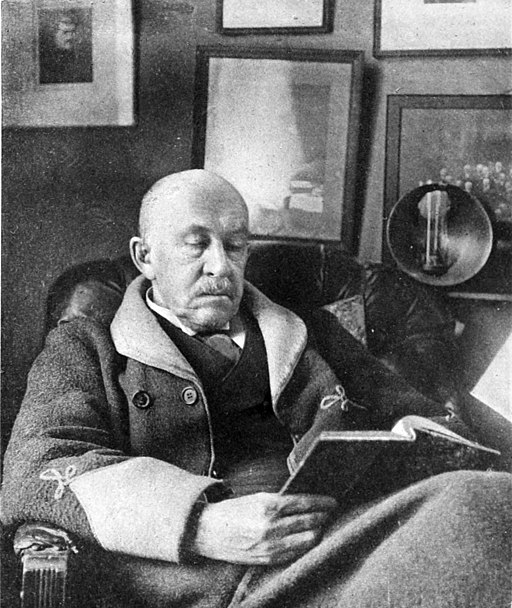
Phil Magness is correct to point out Sumner's naiveté concerning the use to which an income tax would be put by the state in the 20th century, but this was a naiveté which was shared by most classical liberals in the 19th century. Thus, I don't think he should be singled out as this blind spot concerning the voracity of the modern welfare-warfare state was I think universal as it was unimaginable to people living at that time.Take for example, the case of Frédéric Bastiat. He believed that all indirect taxes fell most heavily on the poor (such as taxes on food, salt, wine) and thus wanted them abolished. Concerning tariffs, he accepted that in the absence of an income tax they were the main source of government revenue. He distinguished between a "revenue tariff" at a maximum of 5% to raise money for essential government services, and a "protectionist tariff" at anything higher than 5% which was an unjust benefit provided to powerful vested interests by the state.However, as we will see in volume 4 of Bastiat's Collected Works, he thought there was an even fairer way to raise government revenue, namely a universal, low income tax to replace all indirect taxes and tariffs.[97] The inspiration for this was the action of Sir Robert Peel in 1842 who introduced an income tax in England in order to balance the budget and allow for a restructuring of the English tax system which did take place in 1846 with the abolition of the protectionist Corn Laws (the repeal was phased in over 4 years between 1846-49). This move, when combined with the Free Trade provisions of the Anglo-French Tariff Treaty of 1860 (signed by Richard Cobden on behalf of the British government, and Michel Chevalier on behalf of the French) introduced an unprecedented period of free trade in Europe (the U.S. as Phil Magness notes was going in the opposite direction at this time) which coincided with a rapid rise in industrial activity and increasing prosperity for western Europeans.Assessing the average rate of tariffs in different countries is very difficult given the huge variety of products, the manner in which they were taxed (by weight, volume, or price), and whether the tariff was for "fiscal" purposes (to raise revenue for the state) or protectionist purposes (to favour domestic producers at the expense of foreign producers). A useful comparative study of tariff rates in Britain, France, Germany, Italy, and Spain in the 19th century is provided by Antonio Tena Jungito who compares average tariff rates of all goods taxed as well as average tariff rates on only protected items (leaving out the usually low rates on items taxed for fiscal purposes only).[98] From his data we can conclude the following: British aggregate tariff rates (excluding fiscal goods) peaked at about 15% in 1836 and began dropping in 1840 reaching a low point of about 6% in 1847 (the abolition of the Corn Laws was announced in January 1846 and was to come into full effect in 1849), and continuing to drop steadily throughout the rest of the century reaching a plateau of less than 1% between 1880 and 1903. France had an average rate of about 12% in 1836 and it was still around 11% in 1848 before it began to drop steadily reaching 5% in 1857, then spiking briefly to 7.5% in 1858, and dropping steadily again to about 1.5% in 1870 (the Anglo-French Free Trade Treaty was signed in 1860), before again moving steadily upwards to about 8% in 1893 (the Méline tariff was introduced in January 1892). In 1849 the rates were about 6% in Britain and 10% in France.As a point of comparison, in the United States tariff rates fluctuated wildly as the protectionist North and the free trade South fought for control of the Federal government before the Civil War.[99] In 1832 the Protectionist Tariff imposed an average rate of 33%; the Compromise Tariff of 1833 intended to lower rates to a flat 20%; and the 1846 Tariff created 4 tariff schedules for goods which imposed 100%, 40%, 30%, or 20% depending upon the particular kind of good. The average rate in the U.S. in 1849 was about 23% which is definitely a "protectionist" tariff and not a "fiscal" tariff according to Bastiat's definition (5%).The opposition in France to an income tax was very strong and remained strong until the eve of WW1 when Joseph Caillaux's, the French Minister of Finance, long campaign to introduce an income tax (beginning in earnest in 1907) was finally successful on 15 July 1914. Anti-income tax groups formed a Central Committee for the Study and Defence of Fiscal Matters (Comité central d'études et de défense fiscale) which organised a campaign against the income tax, which included these striking wall posters which compared state monopolies of certain industries to a large black octopus, tax inspectors and collectors to the "Inquisition," or highway robbers who ordered taxpayers to "Raise you hands!" (Hands up!) while they rifled through their personal papers.[100]The English and French experience clearly showed that such a rebalancing of the tax burden as imagined by Bastiat and Sumner was possible and as long as public opinion favoured a system of low taxation in general the income tax remained at a low level, as in England, or, in the case of France, never introduced. However, as we well know, as soon as a Higgsian crisis appeared, most notably WW1, the ideological bedrock of upon which low taxation rested was rapidly eroded and the floodgates of steadily increasing rates of income tax were opened.Endnotes[97.] See for example, "Mr. Ewart's Proposal for a Single Tax in England" (Libre-Échange, 27 June, 1847) </pages/cw4#chapter-5-3351>.[98.] Antonio Tena Jungito, "Assessing the protectionist intensity of tariffs in nineteenth-century European trade policy," in Classical Trade Protectionism 1815-1914, ed. Jean-Pierre Dormois and Pedro Lains (London: Routledge, 2005), pp. 99-120.[99.] See, Frank Taussig, The Tariff History of the United States (New York: G.P. Putnam, 1914. 6th ed.), pp. 110-115; Douglas A. Irwin, "Tariffs and Growth in Late Nineteenth Century America," The World Economy, vol. 24(1), 2001, pp. 15-30.[100.] Propaganda posters for the ''Comité central d'études et de défense fiscale'' contre l'impôt sur le revenu" from a collection from the Université de Caen. See "Impôt sur le revenu (France)" in the French Wikipédia <https://fr.wikipedia.org/wiki/Imp%C3%B4t_sur_le_revenu_(France)>.Robert Leroux
Sumner, Darwin, and the Role of Biology in Sociological Thinking · Jul 31, 2017
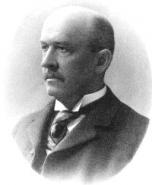
William Graham Sumner addressed the subject of biology not because he was curious to delve into its results, or eager to contribute to its improvement: he was neither an enlightened amateur nor a devoted student. Rather, his intention was to place this science within the sequencing of knowledge that he set out to trace. He then tries to define sociology and its role.In the train of Sumner's scientific thinking biology has an accessory function, but it is nonetheless important: it helps us to understand social life in its most varied manifestations and indeed in its most primitive ramifications. In his works he rarely uses the term "biology," which was still relatively recent in the second half of the 19th century, but on the other hand he frequently refers to "history" and to the "natural sciences," the sciences of life and of living beings that were at the time synonymous.Sumner was convinced that social matters can and must be studied as natural phenomena which are transformed and are progressively endowed with a power of rationalization.It is not easy to find in his writings a confirmation of Charles Darwin's ideas, but there is perhaps an anticipation of the idea of "vital force" developed by the French philosopher Henri Bergson. In fact, the publication of the Origin of Species had no direct influence on Sumner.In his essay Sociology (1881), Sumner explains his social philosophy by linking sociology with biology. He writes :We have already become familiar, in biology, with the transcendent importance of the fact that life on earth must be maintained by a struggle against nature and also by a competition with other forms of life. In the latter fact biology and sociology touch. Sociology is a science with data with one range of phenomena produced by the struggle for existence, while biology deals with another. The forces are the same, acting on different fields and under different conditions.[101]
Sumner does indeed take up the issues raised by Darwin, albeit in a fairly superficial manner. However, he expresses some serious reservations on the question of the origins of man. Behind this argument, which in the end tries to answer the question of the origins of man on the basis of the moral authority of science, we find at the same time a lively critique of the theory of natural selection.In the end, Sumner rejects Darwin's hypothesis not out of deference to any theological convictions – for he too is disinclined to invoke the supernatural element of theology in the scientific or philosophical explanation of natural facts – but rather because he considers that hypothesis to be incomplete from a scientific viewpoint.Yet Sumner does not fully dismiss Darwin's ideas. If he takes issue with certain conclusions of scientific Darwinism, he nevertheless adopts the principles of social Darwinism, which flow essentially from the demographic doctrine of Malthus, based fundamentally on the principle of the "struggle for existence." Moreover, Sumner frequently relies on those principles to counter the socialist theories of his day. But, as a liberal thinker he had no intention of making the "social" a corollary of the "biological." Maybe because, according to him:Liberty, therefore, does not by any means do away with the struggle for existence. We might as well try to do away with the need of eating, for that would, in effect, be the same thing. What civil liberty does is to turn the competition of man with man from violence and brute force into an industrial competition under which men vie with one another for the acquisition of material goods by industry, energy, skill, frugality, prudence, temperance, and other industrial virtues. Under this changed order of things the inequalities are not done away with. Nature still grants her rewards of having and enjoying, according to our being and doing, but it is now the man of the highest training and not the man of the heaviest fist who gains the highest reward.[102]
Sumner's liberalism begins with this disagreement with social Darwinism, which he opposes from his earliest writings.Endnotes[101.] "Sociology" (1881) in William Graham Sumner, War and Other Essays, ed. Albert Galloway Keller (New Haven: Yale University Press, 1919). </titles/345#Sumner_0255_196>.[102.] "The Challenge of Facts" in William Graham Sumner, The Challenge of Facts and other Essays, ed. Albert Galloway Keller (New Haven: Yale University Press, 1914). </titles/1656#Sumner_0962_52>.David M. Hart
Sumner, the Spanish-American War, and the Anti-Imperialist League · Jul 31, 2017
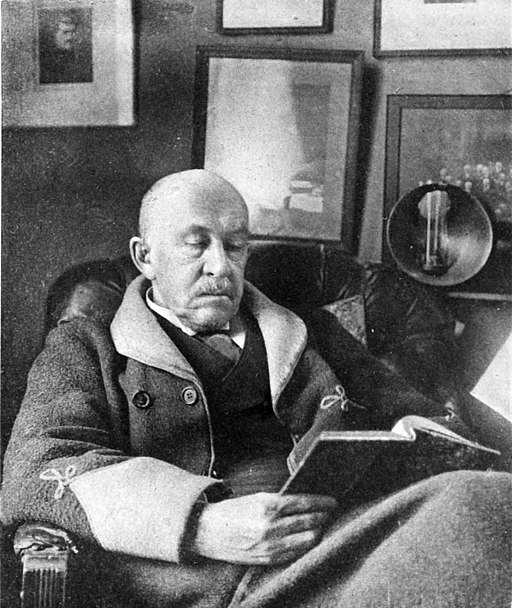
Sumner attracted the ire of the pro-imperialist forces as this cartoon from 1902 shows. The detailed explanation of what is depicted in the cartoon is provided below but the magnified section from the top left hand corner shows its intent. He is one of the 13 pieces of paper being kicked into the air in disgust by one of Teddy Rooselvelt's "Imps" - it is labelled "Sumner's Teachings" - which suggests that his ideas as espoused in his teaching and writing was considered to be a threat to their program of imperial expansion.The cartoon was entitled "Expansion: The Water-Cure method of extorting from Uncle Sam the confession that an Empire is better than a Republic" and it appeared in the January 31, 1902 edition of the Chicago magazine The Public which was edited by Louis Freeland Post (1849-1928).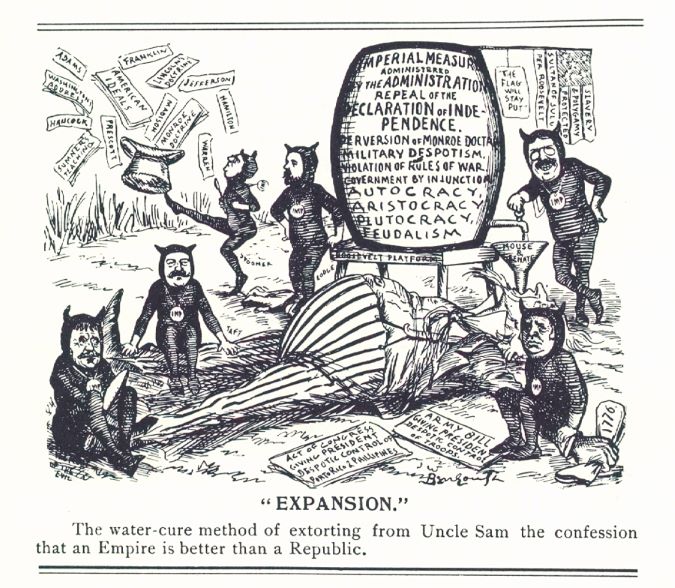
"Expansion" The Public (January 31, 1902)
In the Spanish-American War of 1898 the U.S. defeated Spain and acquired its colonies in the Philippines, Puerto Rico, and Guam. This policy was opposed by members of the Anti-Imperialist League and by liberals such as Post on the grounds that it violated the principles of Jefferson (The Declaration of Independence), Washington (his Farewell Address), and Lincoln. Post was trained as a lawyer and had become interested in the free trade and single tax ideas of Henry George which he promoted in the magazines he edited and the books he published. The Anti-Imperialist League began in June 1898 in opposition to the war against Spain and included an impressive list of establishment politicians, academics, and authors such as Charles Francis Adams, Jr., Jane Addams, Edward Atkinson, Ambrose Bierce, Andrew Carnegie, Samuel Clemens (Mark Twain), Grover Cleveland, John Dewey, Edwin Lawrence Godkin, Samuel Gompers, William Dean Howells, Henry James, William James, David Starr Jordan, Carl Schurz, William Graham Sumner, and Oswald Garrison Villard. The Platform of the Anti-Impeialism League from October 1899 is shown below.The cartoon shows the figure of Uncle Sam who has been pinned to the ground by members of Theodore Roosevelt's administration who are dressed like little devils (some are named: Taft, Spooner, Lodge) who have around their necks a medallion which says "IMP". They are using the Philippino "water torture" to force Uncle Sam (the House & the Senate) to confess that an Empire is better than a Republic. Theordore Roosevelt is the figure standing by the spigot administering the water torture to Uncle Sam. Above his head is a version of the American flag on which is written "Slavery & Polygamy Protected. Sultan of Sulu per Roosevelt" which is a refernce to the islamic Sultanate of Sulu which was a number of islands in the Sulu Sea in the southern part of the Philippines which also came under American control. Uncle Sam can be seen clutching a copy of the Declaration of Independence and one of the devils is kicking his hat which spills out papers which have the names of some of the key intellectuals who provided the League with its ideas on opposing Empire: Adams, Washington, Hancock, (William Graham) Sumner, Franklin, Lincoln, Madison, ect. The water barrel is called "Roosevelt's Platform" and has written on it "Imperial Measure administered by the Administration: Repeal of the Declaration of Independence. Perversion of Monroe Doctrine. Military Despotism. Violation of Rules of War. Government by Injunction. AUTOCRACY, ARISTOCRACY, PLUTOCRACY, FEUDALISM." In the foreground at the foot of one of the devils is a document which says "Act of Congress giving President despotic control of Puerto Rico & Philippines" and another which says "Army Bill giving President despotic control of troops." The title of the cartoon is "Expansion" which refers to both the territorial expansion of the U.S. after 1898 and the expansion of Uncle Sam's belly as large quantities of water are forced into his stomach as part of the "water cure" he is forced to endure.Sumner's critique of the war can be found in his lecture "The Conquest of the United States by Spain" in 1898 in which he stated that:[103]During the last year the public has been familiarized with descriptions of Spain and of Spanish methods of doing things until the name of Spain has become a symbol for a certain well-defined set of notions and policies. On the other hand, the name of the United States has always been, for all of us, a symbol for a state of things, a set of ideas and traditions, a group of views about social and political affairs. Spain was the first, for a long time the greatest, of the modern imperialistic states. The United States, by its historical origin, its traditions, and its principles, is the chief representative of the revolt and reaction against that kind of a state. I intend to show that, by the line of action now proposed to us, which we call expansion and imperialism, we are throwing away some of the most important elements of the American symbol and are adopting some of the most important elements of the Spanish symbol. We have beaten Spain in a military conflict, but we are submitting to be conquered by her on the field of ideas and policies. Expansionism and imperialism are nothing but the old philosophies of national prosperity which have brought Spain to where she now is. Those philosophies appeal to national vanity and national cupidity. They are seductive, especially upon the first view and the most superficial judgment, and therefore it cannot be denied that they are very strong for popular effect. They are delusions, and they will lead us to ruin unless we are hard-headed enough to resist them. In any case the year 1898 is a great landmark in the history of the United States. The consequences will not be all good or all bad, for such is not the nature of societal influences. They are always mixed of good and ill, and so it will be in this case. Fifty years from now the historian, looking back to 1898, will no doubt see, in the course which things will have taken, consequences of the proceedings of that year and of this present one which will not all be bad, but you will observe that that is not a justification for a happy-go-lucky policy; that does not affect our duty to-day in all that we do to seek wisdom and prudence and to determine our actions by the best judgment which we can form.... ... The laws of nature and of human nature are just as valid for Americans as for anybody else, and if we commit acts we shall have to take consequences, just like other people. Therefore prudence demands that we look ahead to see what we are about to do, and that we gauge the means at our disposal, if we do not want to bring calamity on ourselves and our children. We see that the peculiarities of our system of government set limitations on us. We cannot do things which a great centralized monarchy could do. The very blessings and special advantages which we enjoy, as compared with others, bring disabilities with them. That is the great fundamental cause of what I have tried to show throughout this lecture, that we cannot govern dependencies consistently with our political system, and that, if we try it, the State which our fathers founded will suffer a reaction which will transform it into another empire just after the fashion of all the old ones. That is what imperialism means. That is what it will be; and the democratic republic, which has been, will stand in history, like the colonial organization of earlier days, as a mere transition form.
Below is the Platform of the Anti-Imperialist League (October 1899) in which Sumner may well have a hand in writing:[104]Endnotes[103.] "The Spanish-American War and the Anti-Imperialism League (1902)" in William Graham Sumner, War and Other Essays, ed. Albert Galloway Keller (New Haven: Yale University Press, 1919). </titles/345#Sumner_0255_332>.[104.] "Platform of the Anti-Imperialist League" (October 1899) in Carl Schurz, The Policy of Imperialism: Address by Hon. Carl Schurz at the Anti-Imperialist Conference in Chicago, October 17, 1899 (Chicago: American Anti-Imperialist League, 1899. Liberty Tracts, Number Four).