Social Sciences1881
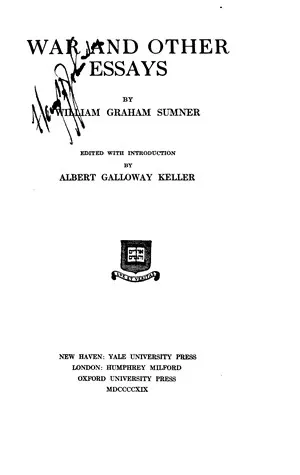
War and Other Essays
- William Graham Sumner(author)
- Albert Galloway Keller(editor)
One of several collections of Sumner’s essays which were published in the early 20th century. This volume contains his famous essay on the Spanish-American War.
Key Quotes
Passages from this text chosen by OLL editors.
- War & Peace“
Now what will hasten the day when our present advantages will wear out and when we shall come down to the conditions of the older and densely populated nations? The answer is: war, debt, taxation, diplomacy, a grand governmental system, pomp, glory, a big army and navy, lavish expenditures, political jobbery - in a word, imperialism...
The point which I have tried to make in this lecture is that expansion and imperialism are at war with the best traditions, principles, and interests of the American people, and that they will plunge us into a network of difficult problems and political perils, which we might have avoided, while they offer us no corresponding advantage in return. - Socialism & Interventionism“
... when the old-fashioned theories of State interference are applied to the new democratic State, they turn out to be simply a device for setting separate interests in a struggle against each other inside the society. It is plain on the face of all the great questions which are offered to us as political questions to-day, that they are simply struggles of interests for larger shares of the product of industry. One mode of dealing with this distribution would be to leave it to free contract under the play of natural laws. If we do not do this, and if the State interferes with the distribution, how can we stop short of the mediaæval plan of reiterated and endless interference, with constant diminution of the total product to be divided?
... Now that the governmental machine is brought within everyone's reach, the seduction of power is just as masterful over a democratic faction as ever it was over king or barons. No governing organ has yet abstained from any function because it acknowledged itself ignorant or incompetent. The new powers in the State show no disposition to do it. Nevertheless, the activity of the State, under the new democratic system, shows itself every year more at the mercy of clamorous factions, and legislators find themselves constantly under greater pressure to act, not by their deliberate judgment of what is expedient, but in such a way as to quell clamor, although against their judgment of public interests. It is rapidly becoming the chief art of the legislator to devise measures which shall sound as if they satisfied clamor while they only cheat it.
- War & Peace“
During the last year the public has been familiarized with descriptions of Spain and of Spanish methods of doing things until the name of Spain has become a symbol for a certain well-defined set of notions and policies. On the other hand, the name of the United States has always been, for all of us, a symbol for a state of things, a set of ideas and traditions, a group of views about social and political affairs. Spain was the first, for a long time the greatest, of the modern imperialistic states. The United States, by its historical origin, its traditions, and its principles, is the chief representative of the revolt and reaction against that kind of a state. I intend to show that, by the line of action now proposed to us, which we call expansion and imperialism, we are throwing away some of the most important elements of the American symbol and are adopting some of the most important elements of the Spanish symbol. We have beaten Spain in a military conflict, but we are submitting to be conquered by her on the field of ideas and policies. Expansionism and imperialism are nothing but the old philosophies of national prosperity which have brought Spain to where she now is. Those philosophies appeal to national vanity and national cupidity. They are seductive, especially upon the first view and the most superficial judgment, and therefore it cannot be denied that they are very strong for popular effect. They are delusions, and they will lead us to ruin unless we are hard-headed enough to resist them.
- War & Peace“
The Americans have been committed from the outset to the doctrine that all men are equal. We have elevated it into an absolute doctrine as a part of the theory of our social and political fabric. It has always been a domestic dogma in spite of its absolute form, and as a domestic dogma it has always stood in glaring contradiction to the facts about Indians and negroes and to our legislation about Chinamen. In its absolute form it must, of course, apply to Kanakas, Malays, Tagals, and Chinese just as much as to Yankees, Germans, and Irish. It is an astonishing event that we have lived to see American arms carry this domestic dogma out where it must be tested in its application to uncivilized and half-civilized peoples. At the first touch of the test we throw the doctrine away and adopt the Spanish doctrine.
- Class“
Jobbery is any scheme which aims to gain, not by the legitimate fruits of industry and enterprise, but by extorting from somebody a part of his product under guise of some pretended industrial undertaking. Of course it is only a modification when the undertaking in question has some legitimate character, but the occasion is used to graft upon it devices for obtaining what has not been earned. Jobbery is the vice of plutocracy, and it is the especial form under which plutocracy corrupts a democratic and republican form of government. The United States is deeply afflicted with it, and the problem of civil liberty here is to conquer it.
About This Edition
Citation
Sumner, William Graham. War and Other Essays, ed. Albert Galloway Keller (New Haven: Yale University Press, 1919).
Sumner, William Graham. War and Other Essays. Edited by Albert Galloway Keller, Yale University Press, 1919. Online Library of Liberty, https://oll.libertyfund.org/titles/keller-war-and-other-essays.
Sumner, W. G. (1919). War and Other Essays. Yale University Press. https://oll.libertyfund.org/titles/keller-war-and-other-essays
@book{sumner1919essays,
  author = {William Graham Sumner},
  editor = {Albert Galloway Keller},
  title = {War and Other Essays},
  publisher = {Yale University Press},
  address = {New Haven},
  year = {1919},
  url = {https://oll.libertyfund.org/titles/keller-war-and-other-essays},
  note = {Online Library of Liberty}
}TY - BOOK AU - Sumner, William Graham A2 - Keller, Albert Galloway TI - War and Other Essays PY - 1919 CY - New Haven PB - Yale University Press UR - https://oll.libertyfund.org/titles/keller-war-and-other-essays DB - Online Library of Liberty ER -
Copyright
The text is in the public domain.

About the author
William Graham Sumner 1840–1910
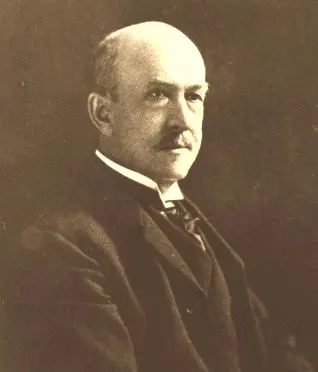
William Graham Sumner (1840-1910) was one of the founding father’s of American sociology. Although he trained as an Episcopalian clergyman, Sumner went on to teach at Yale University where he wrote his most influential works. His interests included money and tariff policy, critiques of socialism, social classes, and anti-imperialism.
More in Social Sciences
See all >The Collected Works of James M. Buchanan, Vol. 9 (The Power to Tax)
Geoffrey BrennanThe Collected Works of James M. Buchanan, vol. 7 (The Limits of Liberty)
James M. BuchananZum Abschluss des Marxschen Systems
Earth-Hunger and Other Essays (1913)
William Graham SumnerAn Inquiry Into the Nature and Causes of the Wealth of Nations (Cannan ed.), vol. 2
Adam SmithThe Forgotten Man and Other Essays (corrected edition)
William Graham SumnerThe Collected Works of Lysander Spooner (1834-1886), vol. 1 (1834-1850)
Lysander SpoonerThe Works and Life of Walter Bagehot, vol. 10 (The Life)
Mrs. Russell BarringtonThe Works and Life of Walter Bagehot, vol. 6
Walter Bagehot