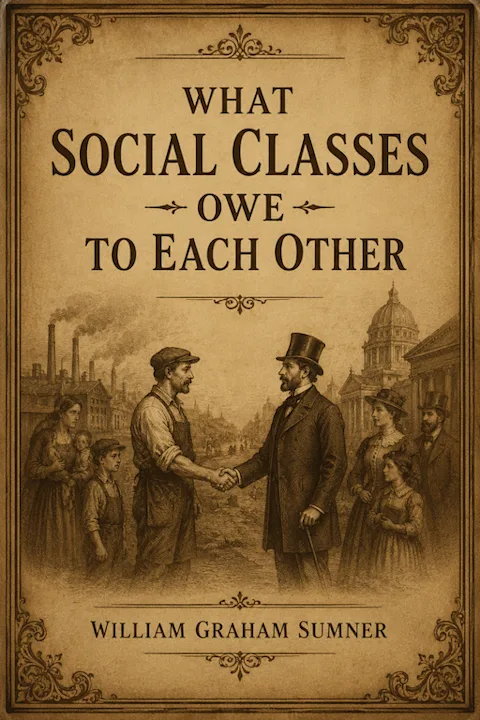
What Social Classes Owe to Each Other
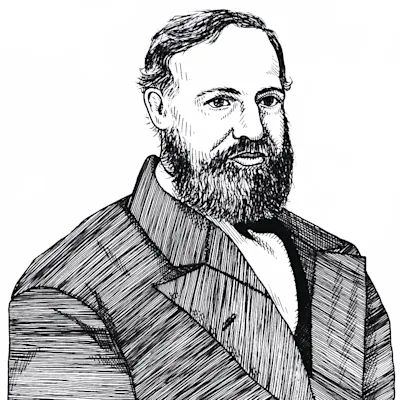
- William Graham Sumner(author)
Sumner was one of the founding fathers of American sociology who explored the relationship between the individual and the state from an individualist and free market perspective. This collection of essays is a good example of his approach to the subject.
Key Quotes
Passages from this text chosen by OLL editors.
- The State“
The history of the human race is one long story of attempts by certain persons and classes to obtain control of the power of the State, so as to win earthly gratifications at the expense of others. People constantly assume that there is something metaphysical and sentimental about government. At bottom there are two chief things with which government has to deal. They are, the property of men and the honor of women. These it has to defend against crime. The capital which, as we have seen, is the condition of all welfare on earth, the fortification of existence, and the means of growth, is an object of cupidity. Some want to get it without paying the price of industry and economy. In ancient times they made use of force. They organized bands of robbers. They plundered laborers and merchants. Chief of all, however, they found that means of robbery which consisted in gaining control of the civil organization—the State—and using its poetry and romance as a glamour under cover of which they made robbery lawful. They developed high-spun theories of nationality, patriotism, and loyalty. They took all the rank, glory, power, and prestige of the great civil organization, and they took all the rights. They threw on others the burdens and the duties.
- Economics“
The modern industrial system is a great (example of) social co-operation. It is automatic and instinctive in its operation. The adjustments of the organs take place naturally. The parties are held together by impersonal force—supply and demand. They may never see each other; they may be separated by half the circumference of the globe. Their co-operation in the social effort is combined and distributed again by financial machinery, and the rights and interests are measured and satisfied without any special treaty or convention at all. All this goes on so smoothly and naturally that we forget to notice it. We think that it costs nothing—does itself, as it were. The truth is, that this great co-operative effort is one of the great products of civilization—one of its costliest products and highest refinements …
About This Edition
Citation
Sumner, William Graham. What Social Classes Owe to Each Other, (New York: Harper and Brothers, 1911).
Sumner, William Graham. What Social Classes Owe to Each Other. Harper and Brothers, 1911. Online Library of Liberty, https://oll.libertyfund.org/titles/sumner-what-social-classes-owe-to-each-other.
Sumner, W. G. (1911). What Social Classes Owe to Each Other. Harper and Brothers. https://oll.libertyfund.org/titles/sumner-what-social-classes-owe-to-each-other
@book{sumner1911other,
  author = {William Graham Sumner},
  title = {What Social Classes Owe to Each Other},
  publisher = {Harper and Brothers},
  address = {New York},
  year = {1911},
  url = {https://oll.libertyfund.org/titles/sumner-what-social-classes-owe-to-each-other},
  note = {Online Library of Liberty}
}TY - BOOK AU - Sumner, William Graham TI - What Social Classes Owe to Each Other PY - 1911 CY - New York PB - Harper and Brothers UR - https://oll.libertyfund.org/titles/sumner-what-social-classes-owe-to-each-other DB - Online Library of Liberty ER -
Copyright
The text is in the public domain.

About the author
William Graham Sumner 1840–1910
William Graham Sumner (1840-1910) was one of the founding father’s of American sociology. Although he trained as an Episcopalian clergyman, Sumner went on to teach at Yale University where he wrote his most influential works. His interests included money and tariff policy, critiques of socialism, social classes, and anti-imperialism.
More in Social history and conditions. Social problems. Social reform
See all >The Collected Works of Arthur Seldon, vol. 7 - The IEA, the LSE, and the Influence of Ideas
Arthur SeldonIn Pursuit: Of Happiness and Good Government
Charles MurrayThe Society of Tomorrow
Gustave de MolinariThe Tribune
John ThelwallOn the Admission of Women to the Rights of Citizenship
Marie-Jean-Antoine-Nicolas Caritat, Marquis de Condorcet