

Albert Eugene Gallatin
1881–1952
Albert Eugene Gallatin was an American art collector, painter, and writer, best remembered as a pioneering champion of modern art in the…


Fine Arts
21 items in this collection
Political, economic, and philosophical ideas are often expressed through works of art. The art collected in the OLL gives us another history of liberty to read--a history written with etchings, paints, pastels, and even carved in stone.
In this collection
7 titles, earliest first.
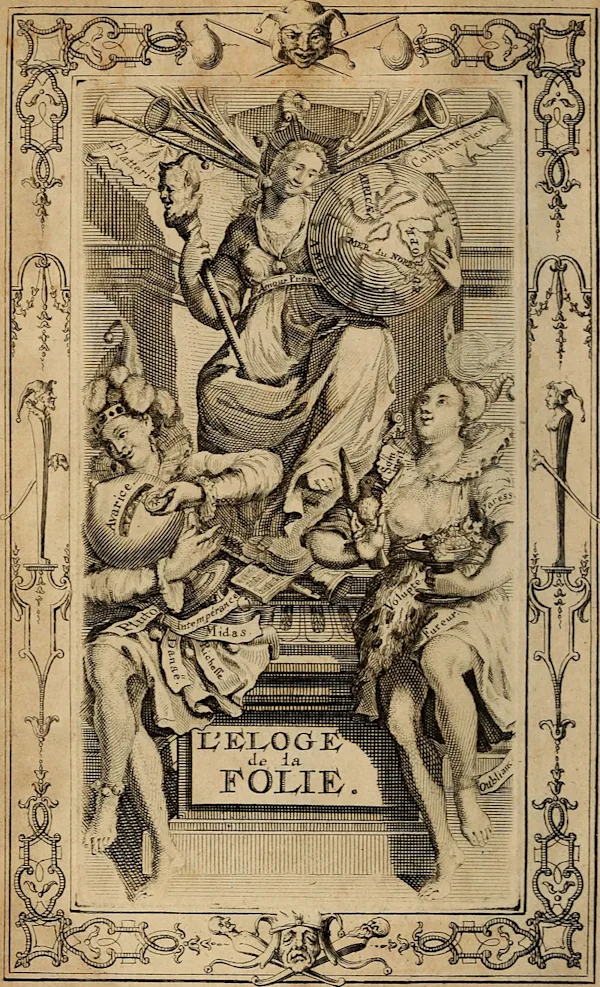
Desiderius Erasmus · 1511
The personification of Folly comes to earth to expose the follies, foibles, and failings of humans. Illustrated with 77 woodcuts by Hans Holbein.
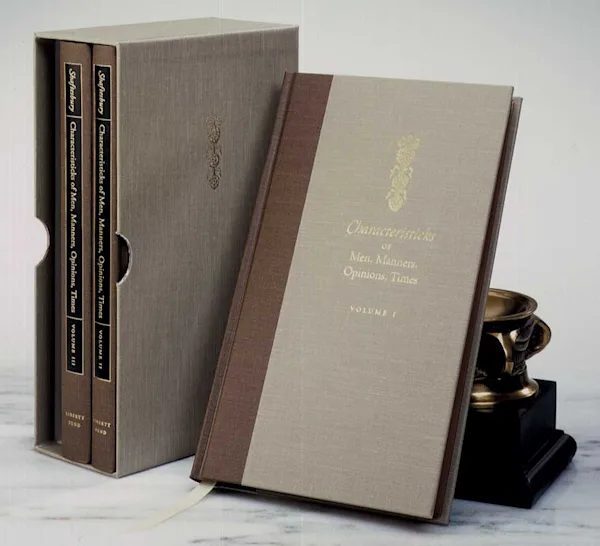
Anthony Ashley Cooper, Earl of Shaftesbury · 1737
The Liberty Fund edition of Characteristicks presents the complete 1732 text of this classic work of philosophy and political theory. Also included are faithful reproductions of the stirring engravings that Shaftesbury…
Anthony Ashley Cooper, Earl of Shaftesbury · 1737
The Liberty Fund edition of Characteristicks presents the complete 1732 text of this classic work of philosophy and political theory. Also included are faithful reproductions of the stirring engravings that Shaftesbury…
Anthony Ashley Cooper, Earl of Shaftesbury · 1737
The Liberty Fund edition of Characteristicks presents the complete 1732 text of this classic work of philosophy and political theory. Also included are faithful reproductions of the stirring engravings that Shaftesbury…
Anthony Ashley Cooper, Earl of Shaftesbury · 1737
The Liberty Fund edition of Characteristicks presents the complete 1732 text of this classic work of philosophy and political theory. Also included are faithful reproductions of the stirring engravings that Shaftesbury…
William Blake · 1823
The book contains a lengthy introduction to the life and work of Blake by Norton as well as full page black and white copies of the etchings which Blake made between 1823 and 1826 for his illustrated edition of the Book…
Thomas Jefferson · 1900
This file contains the following extracts from the Jeffersonian Cyclopedia: the editor’s Preface, the illustrations of Jefferson, a chronology of his life and work, the appendix of key documents, and the Topical Index.
In this collection
2 people central to Art.
1881–1952
Albert Eugene Gallatin was an American art collector, painter, and writer, best remembered as a pioneering champion of modern art in the…

1460–1524
Hans Holbein was a German artist active during the Renaissance and early Reformation. One of his many areas of expertise was in woodcuts…
In this collection
From The Reading Room, Liberty Matters and the library’s other publications.

Lawrence Meyers · Dec 26, 2023

Daniel Ross Goodman · Nov 10, 2023
Alexander Schmid · Aug 25, 2023




Nathaniel Birzer · Mar 10, 2022
Passages from titles in this collection, chosen by OLL editors.
Now if there should arise any starched, formal don, that would point at the several actors, and tell how this, that seems a petty god, is in truth worse than a brute, being made captive to the tyranny of passion; that the other, who bears the character of a king, is indeed the most slavish of serving-men, in being subject to the mastership of lust and sensuality; that a third, who vaunts so much of his pedigree, is no better than a bastard for degenerating from virtue, which ought to be of greatest consideration in heraldry, and so shall go on in exposing all the rest; would not any one think such a person quite frantic, and ripe for bedlam? For as nothing is more silly than preposterous wisdom, so is there nothing more indiscreet than an unreasonable reproof. And therefore he is to be hooted out of all society that will not be pliable, conformable, and willing to suit his humour with other men’s, remembering the law of clubs and meetings, that he who will not do as the rest must get him out of the company.
So have I known a crafty Glazier, in time of Frost, procure a Football, to draw into the Street the emulous Chiefs of the robust Youth. The tumid Bladder bounds at every Kick, bursts the withstanding Casements, the Chassys, Lanterns, and all the brittle vitrious Ware. The Noise of Blows and Out-cries fills the whole Neighbourhood; and Ruins of Glass cover the stony Pavements; till the bloated battering Engine, subdu’d by force of Foot and Fist, and yielding up its Breath at many a fatal Cranny, becomes lank and harmless, sinks in its Flight, and can no longer uphold the Spirit of the contending Partys.
[W]ithout a Publick Voice, knowingly guided and directed, there is nothing which can raise a true Ambition in the Artist; nothing which can exalt the Genius of the Workman, or make him emulous of after-Fame, and of the approbation of his Country, and of Posterity. For with these he naturally, as a Freeman, must take part: in these he has a passionate Concern, and Interest, rais’d in him by the same Genius of Liberty, the same Laws and Government, by which his Property, and the Rewards of his Pains and Industry are secur’d to him, and to his Generation after him.
Every thing co-operates, in such a State, towards the Improvement of Art and Science. And for the designing Arts in particular, such as Architecture, Painting, and Statuary, they are in a manner link’d together. The Taste of one kind brings necessarily that of the others along with it. When the free Spirit of a Nation turns it-self this way, Judgments are form’d; Criticks arise; the publick Eye and Ear improve; a right Taste prevails, and in a manner forces its way. Nothing is so improving, nothing so natural, so con-genial to the liberal Arts, as that reigning Liberty and high Spirit of a People, which from the Habit of judging in the highest Matters for themselves, makes ’em freely judg of other Subjects, and enter thorowly into the Characters as well of Men and Manners, as of the Products or Works of Men, in Art and Science...
What Encouragement our higher Powers may think fit to give these growing Arts, I will not pretend to guess. This I know, that ’tis so much for their advantage and Interest to make themselves the chief Partys in the Cause, that I wish no Court or Ministry, besides a truly virtuous and wise one, may ever concern themselves in the Affair. For shou’d they do so, they wou’d in reality do more harm than good; since ’tis not the Nature of a Court (such as Courts generally are) to improve, but rather corrupt a Taste.
And thus in other respects Wit will mend upon our hands, and Humour will refine it-self; if we take care not to tamper with it, and bring it under Constraint, by severe Usage and rigorous Prescriptions. All Politeness is owing to Liberty. We polish one another, and rub off our Corners and rough Sides by a sort of amicable Collision. To restrain this, is inevitably to bring a Rust upon Mens Understandings. 'Tis a destroying of Civility, Good Breeding, and even Charity it-self, under pretence of maintaining it.

Philosophy (General)
184 titles · 74 publications · 159 people

Language and Literature
282 titles · 6 publications · 321 people

Language and Literature
203 titles · 256 publications · 108 people
8 titles · 6 people

Music
5 titles · 8 people
Language and Literature
112 titles · 156 people