United States1764
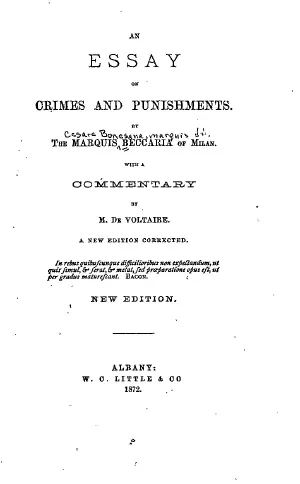
An Essay on Crimes and Punishments
- Cesare Bonesana di Beccaria(author)
- Voltaire(author)
An extremely influential Enlightenment treatise on legal reform in which Beccaria advocates the ending of torture and the death penalty. The book also contains a lengthy commentary by Voltaire which is an indication of high highly French enlightened thinkers regarded the work.
Key Quotes
Passages from this text chosen by OLL editors.
- Law“
No man can be judged a criminal until he be found guilty; nor can society take from him the public protection, until it have been proved that he has violated the conditions on which it was granted. What right, then, but that of power, can authorise the punishment of a citizen, so long as there remains any doubt of his guilt? The dilemma is frequent. Either he is guilty, or not guilty. If guilty, he should only suffer the punishment ordained by the laws, and torture becomes useless, as his confession is unnecessary. If he be not guilty, you torture the innocent; for, in the eye of the law, every man is innocent, whose crime has not been proved.
About This Edition
Citation
An Essay on Crimes and Punishments. By the Marquis Beccaria of Milan. With a Commentary by M. de Voltaire. A New Edition Corrected. (Albany: W.C. Little & Co., 1872).
Beccaria, Cesare Bonesana di and Voltaire. An Essay on Crimes and Punishments. W.C. Little and Company, 1872. Online Library of Liberty, https://oll.libertyfund.org/titles/voltaire-an-essay-on-crimes-and-punishments.
Beccaria, C. B. d. & Voltaire. (1872). An Essay on Crimes and Punishments. W.C. Little and Company. https://oll.libertyfund.org/titles/voltaire-an-essay-on-crimes-and-punishments
@book{beccaria1872punishments,
  author = {Cesare Bonesana di Beccaria and Voltaire},
  title = {An Essay on Crimes and Punishments},
  publisher = {W.C. Little and Company},
  address = {Albany, N.Y.},
  year = {1872},
  url = {https://oll.libertyfund.org/titles/voltaire-an-essay-on-crimes-and-punishments},
  note = {Online Library of Liberty}
}TY - BOOK AU - Beccaria, Cesare Bonesana di AU - Voltaire TI - An Essay on Crimes and Punishments PY - 1872 CY - Albany, N.Y. PB - W.C. Little and Company UR - https://oll.libertyfund.org/titles/voltaire-an-essay-on-crimes-and-punishments DB - Online Library of Liberty ER -
Copyright
The text is in the public domain.

About the author
Cesare Bonesana di Beccaria 1738–1794
Beccaria was an Italian legal philosopher, political economist and politician who was much influenced by the French philosophes. In Milan he introduced a number of legal and monetary reforms but is best known for his 1764 work On Crimes and Punishments in which he advocated an end to torture and the death penalty.
More in United States
See all >The Federalist (Gideon ed.)
Alexander HamiltonCollected Works of James Wilson, vol. 2
James WilsonCollected Works of James Wilson, vol. 1
James WilsonThe Records of the Federal Convention of 1787, vol. 3
Max FarrandThe Records of the Federal Convention of 1787, vol. 2
Max FarrandThe Records of the Federal Convention of 1787, vol. 1
Max FarrandFriends of the Constitution: Writings of the “Other” Federalists, 1787-1788
Colleen A. SheehanIn Defense of the Constitution
George W. CareyColonial Origins of the American Constitution: A Documentary History
Donald S. Lutz