United States1850
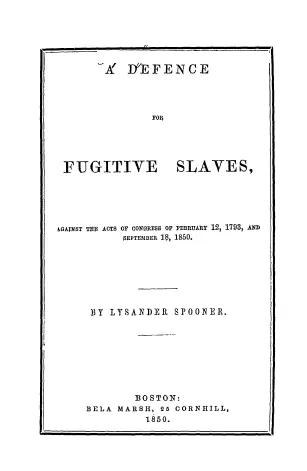
A Defence for Fugitive Slaves, against the Acts of Congress of February 12, 1793, and September 18, 1850
- Lysander Spooner(author)
Since, in Spooner’s view, slavery was both unjust and unconstitutional, men and women held in slavery had the right to flee, and other people had the right and the duty to help the runaway slaves escape to freedom. This meant violating the Fugitive Slave Acts and breaking the law, but such disobedience would be in the freedom-loving spirit of the Constitution.
About This Edition
Citation
Spooner, Lysander. A Defence for Fugitive Slaves, against the Acts of Congress of February 12, 1793, and September 18, 1850 (Boston: Bela Marsh, 1850).
Spooner, Lysander. A Defence for Fugitive Slaves (1850). Bela Marsh, 1850. Online Library of Liberty, https://oll.libertyfund.org/titles/spooner-a-defence-for-fugitive-slaves-1850.
Spooner, L. (1850). A Defence for Fugitive Slaves (1850). Bela Marsh. https://oll.libertyfund.org/titles/spooner-a-defence-for-fugitive-slaves-1850
@book{spooner18501850,
  author = {Lysander Spooner},
  title = {A Defence for Fugitive Slaves (1850)},
  publisher = {Bela Marsh},
  address = {Boston},
  year = {1850},
  url = {https://oll.libertyfund.org/titles/spooner-a-defence-for-fugitive-slaves-1850},
  note = {Online Library of Liberty}
}TY - BOOK AU - Spooner, Lysander TI - A Defence for Fugitive Slaves (1850) PY - 1850 CY - Boston PB - Bela Marsh UR - https://oll.libertyfund.org/titles/spooner-a-defence-for-fugitive-slaves-1850 DB - Online Library of Liberty ER -
Copyright
The text is in the public domain.

About the author
Lysander Spooner 1808–1887
Lysander Spooner (1808-1887) was a legal theorist, abolitionist, and radical individualist who started his own mail company in order to challenge the monopoly held by the US government. He wrote on the constitutionality of slavery, natural law, trial by jury, intellectual property, paper currency, and banking.
Related People
Frederick Douglass
Author
Spooner and Douglass corresponded and collaborated on various anti-slavery initiatives, with Spooner providing legal and intellectual support to Douglass's activism.
William Lloyd Garrison
Author
While both Spooner and Garrison advocated for the end of slavery, they disagreed on strategies and tactics. Spooner criticized Garrison's gradualism and believed in more immediate and radical approaches to ending slavery.
Henry David Thoreau
Author
While not direct collaborators, Thoreau and Spooner shared a belief in resisting unjust laws and promoting individual conscience over blind obedience.
Wendell Phillips
Author
Phillips and Spooner often found themselves aligned in their anti-slavery efforts and their belief in the power of individual activism to effect social change.
John Brown
Author
Spooner's writings and legal arguments influenced Brown's fervent abolitionist stance, and both men believed in taking more forceful actions against the institution of slavery.


Critical Responses
Works that answer or challenge this text.
- Journal Article
The Antislavery Judge Reconsidered
Jeffery M. SchmittVisit site ↗This article discusses the apparent bind for antislavery judges to rule on the Fugitive Slave Act between liberty and fidelity for the law. It discusses Spooner’s conclusion that slavery was unconstitutional, and how that was applied in practice for antebellum judges.
Connected Readings
What to read next.
 Book
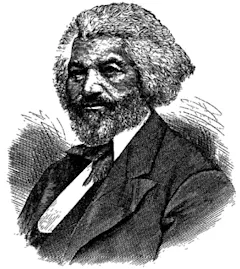
The Life and Times of Frederick Douglass: From 1817-1882
Frederick DouglassView title >This autobiographical work provides a firsthand account of Douglass’s journey from slavery to freedom, highlighting the struggles and triumphs of his life as a prominent abolitionist.
 Podcast
Michael Munger on Slavery and Racism
Michael Munger and Russ RobertsEconTalk
Visit site ↗In this EconTalk podcast Munger and host Russ Roberts discuss how attitudes in the American South toward slavery evolved over time and what we can learn from that evolution about the role culture plays in our lives.
 Book
Anti-Slavery Tracts. First Series, Nos. 1-20 (1855-56)
David M. HartView title >This is a collection of anti-slavery tracts published during Lysander Spooner’s lifetime by the American Anti-Slavery Society. These tracts demonstrate the heterogeneity of abolitionist tactical arguments at the time, as they range from religious arguments to attacks on the constitution.
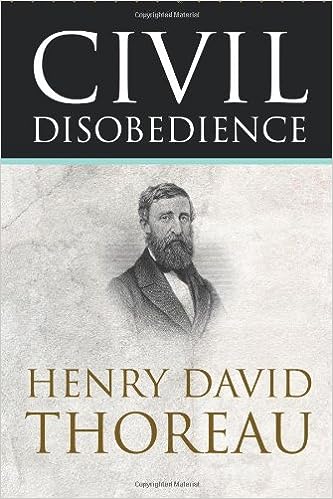 Book
Civil Disobedience
Henry David ThoreauVisit site ↗In this essay, Thoreau discusses the importance of resisting unjust laws and government actions through nonviolent means. His ideas on individual conscience and resistance influenced many future activists.
- Website
Fugitive Slave Acts
History.comVisit site ↗This History.com primer on the Fugitive Slave Acts includes a video where historian Matthew Pinsker presents a rundown of the 1850 Fugitive Slave Act. It also breaks down the history of the acts from their enactment by Congress in 1793 to their repeal in 1864.
- Liberty Matters
The Significance of Lysander Spooner
Randy E. Barnett, Roderick T. Long, Aeon J. Skoble, and Matt ZwolinskiView title >This Liberty Matters online discussion explores the constitutional theories of Lysander Spooner, concluding. It concludes by asserting that Spooner’s approach to the constitutional is “as fresh as it was in 1845”.
More in United States
See all >Collected Works of James Wilson, vol. 2
James WilsonCollected Works of James Wilson, vol. 1
James WilsonThe Records of the Federal Convention of 1787, vol. 3
Max FarrandThe Records of the Federal Convention of 1787, vol. 2
Max FarrandThe Records of the Federal Convention of 1787, vol. 1
Max FarrandFriends of the Constitution: Writings of the “Other” Federalists, 1787-1788
Colleen A. SheehanIn Defense of the Constitution
George W. CareyColonial Origins of the American Constitution: A Documentary History
Donald S. LutzThe Federal and State Constitutions, 7 vols.
Francis Newton Thorpe