

Randy E. Barnett
Lead essay · Jan 03, 2016
The highwayman takes solely upon himself the responsibility, danger, and crime of his own act. He does not pretend that he has any rightful claim to your money, or that he intends to use it for your own benefit. He does not pretend to be anything but a robber. He has not acquired impudence enough to profess to be merely a “protector,” and that he takes men’s money against their will, merely to enable him to “protect” those infatuated travellers, who feel perfectly able to protect themselves, or do not appreciate his peculiar system of protection. He is too sensible a man to make such professions as these. Furthermore, having taken your money, he leaves you, as you wish him to do. He does not persist in following you on the road, against your will; assuming to be your rightful “sovereign,” on account of the “protection” he affords you. He does not keep “protecting” you, by commanding you to bow down and serve him; by requiring you to do this, and forbidding you to do that; by robbing you of more money as often as he finds it for his interest or pleasure to do so; and by branding you as a rebel, a traitor, and an enemy to your country, and shooting you down without mercy, if you dispute his authority, or resist his demands. He is too much of a gentleman to be guilty of such impostures, and insults, and villanies as these. In short, he does not, in addition to robbing you, attempt to make you either his dupe or his slave.[4]
The Constitution has no inherent authority or obligation. It has no authority or obligation at all, unless as a contract between man and man. And it does not so much as even purport to be a contract between persons now existing. It purports, at most, to be only a contract between persons living eighty years ago. And it can be supposed to have been a contract then only between persons who had already come to years of discretion, so as to be competent to make reasonable and obligatory contracts. Furthermore, we know, historically, that only a small portion even of the people then existing were consulted on the subject, or asked, or permitted to express either their consent or dissent in any formal manner. Those persons, if any, who did give their consent formally, are all dead now. Most of them have been dead forty, fifty, sixty, or seventy years. And the constitution, so far as it was their contract, died with them. They had no natural power or right to make it obligatory upon their children. It is not only plainly impossible, in the nature of things, that they could bind their posterity, but they did not even attempt to bind them. That is to say, the instrument does not purport to be an agreement between any body but “the people” THEN existing; nor does it, either expressly or impliedly, assert any right, power, or disposition, on their part, to bind anybody but themselves.[34]
Our constitutions purport to be established by “the people,” and, in theory, “all the people” consent to such government as the constitutions authorize. But this consent of “the people” exists only in theory. It has no existence in fact. Government is in reality established by the few; and these few assume the consent of all the rest, without any such consent being actually given.[37]
All governments ... that profess to be founded on the consent of the governed, and yet have authority to violate natural laws, are necessarily frauds. It is not a supposable case, that all or even a very large part of the governed, can have agreed to them. Justice is evidently the only principle that everybody can be presumed to agree to, in the formation of government.[38]
- Constitutions do not bind the people themselves, but provide instead the law that governs those who govern the people, to which government officials bind themselves by oath;
- Only laws that are consistent with the natural and inalienable rights of the people can justly claim a duty of obedience; therefore,
- A legitimate constitution is one that adopts procedures to ensure that the laws that are imposed on the nonconsenting public are likely to be just.
- “The Deist’s Immortality, and an Essay on Man’s Accountability for His Belief” (1834) </titles/2290#lf1531-01_head_001>
- “The Deist’s Reply to the Alleged Supernatural Evidences of Christianity” (1836) </titles/2290#lf1531-01_head_006>
Roderick T. Long
Response · Jan 06, 2016 · Own page
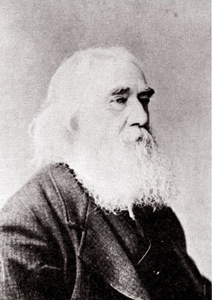
1. Preliminaries
Imagine that you and I disagree about the substantive requirements of social justice. We then differ as to how the concept of justice applies; we differ, that is, about the principles of justice. This is possible if the concept of justice admits of different interpretations, or competing conceptions.... Now consider a constitutional example.... [A] court applying the just compensation clause would not necessarily decide a case as the original authors would have done.... Instead, a court would understand the Constitution to mean precisely what it says and thus to require just compensation. A court would need to defend a particular conception of just compensation ... against the most plausible alternatives.... Contested concepts do not seem confined to morality and law. Their properties are at any rate similar to those of concepts referring to natural substances or phenomena, such as water and heat. On a plausible understanding of the development of science, for example, the caloric and kinetic theories of heat are (or at one time were) competing conceptions of the concept heat.... If, as most people would agree, ‘heat’ refers to a determinate physical phenomenon, there can be, in principle, a best theory of heat. This implies that there can be a best conception of a contested concept. This suggests, in turn, that contested concepts in the Constitution might have best interpretations.... Now if the idea that the Constitution includes contested concepts is correct, then to apply the Constitution in terms of their best interpretation is, in effect, to apply doctrines whose application is called for by the original Constitution. But, just as interpretation of the concept heat requires more than mere reflection, any interpretation of this type inevitably draws upon resources that are neither implicit in the text nor purely linguistic. It ... requires that courts applying ‘vague clauses’ of the Constitution interpret ‘contested concepts,’ which requires reasoning about moral or political principles.[47]
Aeon J. Skoble
Response · Jan 07, 2016 · Own page
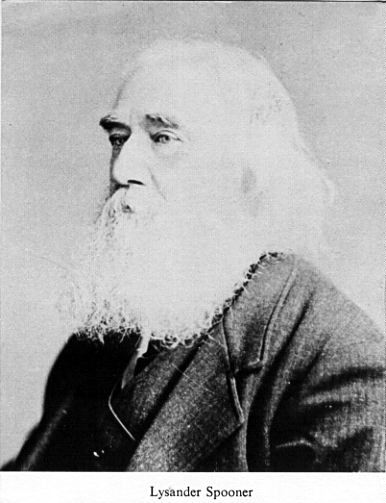
Randy Barnett argues that Lysander Spooner is an important and influential legal theorist. Barnett also explains how Spooner’s work influenced Barnett’s own thinking about how to interpret the Constitution. Since Barnett is himself an important and influential theorist, the first claim is therefore true. QED. But there are more interesting questions, such as why Barnett finds Spooner compelling and whether we should as well.
Matt Zwolinski
Response · Jan 08, 2016 · Own page
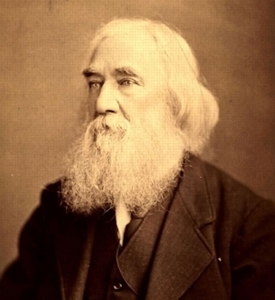
Lysander Spooner, like many libertarians, believed that individual consent was a necessary condition for political authority. In other words, for a government to have legitimate authority, every single individual living under it must give his or her actual (as opposed to merely hypothetical) consent to it. Since that condition is manifestly not met in the case of the government of the United States – or, I might add, any other government that currently exists or ever has existed – Spooner believed that the government lacks legitimate authority. And this is, no doubt, the correct conclusion to draw from his premises. Once one accepts any version of consent theory strong enough to be worthy of the name, the road to philosophical anarchism is but a short one.
The key move is to recognize that a constitution does not bind the people themselves; instead, a constitution is supposed to bind those who govern the people. To the extent that consent is relevant, each and every office holder takes an oath to obey the Constitution and thereby consents to its terms. So what matters is not whether a constitution was assented to by the people, but whether the laws that are imposed under its auspices bind the people in conscience to obedience.
If their laws command anything but justice, or forbid anything but injustice, they are themselves unjust and criminal. If they simply command justice, and forbid injustice, they add nothing to the natural authority of justice, or to men’s obligation to obey it. It is, therefore, a simple impertinence, and sheer impudence, on their part, to assume that their commands, as such, are of any authority whatsoever.[55]
Randy E. Barnett
The Gap · Jan 11, 2016
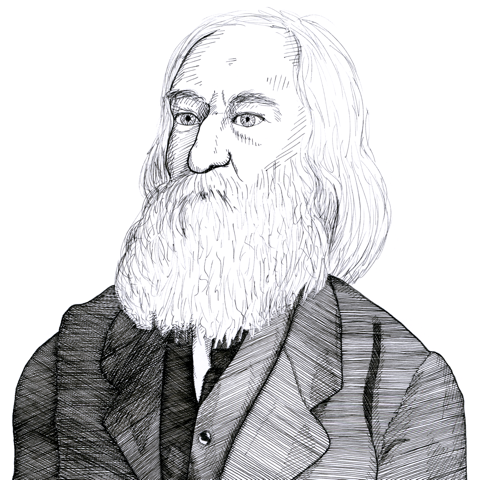
I thank my friends and colleagues Rod Long, Aeon Skoble, and Matt Zwolinski for their very insightful comments on my essay on Lysander Spooner. In some respects, their pieces expand upon mine, which was necessarily limited in what it could cover by a requirement that it be 3000 words and no more. In other respects, however, they register some disagreement.For example, Rod Long contends that Spooner did not actually change his mind about the Constitution’s authority between 1845, when the first edition of The Unconstitutionality of Slavery was published, and 1870 when No Treason appeared. Although I might contest this claim, I have no interest in prevailing in such an exegetical contest. I would be very content if Spooner had indeed remained consistent in his publicly expressed views. And his correspondence provides reason to believe that Spooner kept some of his views private lest he undermine the appeal of his views on slavery and the Constitution.Space prevented me from elaborating on two distinctions that might narrow the range of disagreement between Rod and myself, as well as correct a possible misunderstanding of my position expressed by Matt Zwolinski. The first is the distinction between interpretation and construction. The second is the distinction between justice and legitimacy. Both are extensively explained in my book Restoring the Lost Constitution.Interpretation and ConstructionConstitutional interpretation is the activity of identifying the communicative content of the Constitution’s text. Constitutional construction is the activity of giving that communicated content legal effect. Knowing what the words of a constitution means is not the same thing as applying those words to particular cases. And constitutions with no legal effect, like that of the Confederate States of America, still have an ascertainable meaning.What defines originalism as a method of constitutional interpretation is the belief that (a) the communicative content of the written Constitution was fixed at the time of its enactment, and that (b) this meaning should be followed by constitutional actors until it is properly changed by a written amendment. The first of these propositions is descriptive; the second is normative. In my view, the original meaning of the text provides the law that governs those who govern us; and those who are bound by the Constitution, whether judges or legislators, may not properly change its meaning without going through the amendment process.But why the meaning the text of the Constitution had at the time of its enactment ought to be followed is distinct from ascertaining what that meaning is.The activity of determining the communicative content at the time of enactment required by the first proposition is empirical, not normative. Although we can choose to use words however we wish, as Alice discovered in Wonderland, the social or interpersonal linguistic meaning of words is an empirical fact beyond the will or control of any given speaker (which was the point being made by Alice in Wonderland’s author). As Spooner explained in The Unconstitutionality of Slavery, “[I]f the intentions could be assumed independently of the words, the words would be of no use, and the laws of course could not be written.”[62]Although the objective meaning of words sometimes evolves, words have an objective social meaning at any given time that is independent of our opinions of that meaning, and this meaning can typically be discovered by empirical investigation. Conducting such an investigation is no more a normative activity to reach conclusions we like than is discovering what is considered good manners in a given society. Say “please” and “thank you”? Shake hands? Bow to someone of higher social status? Wear a veil? We can approve or disapprove of such social practices, and decide whether or not to follow them, but their status as norms is a fact.So too is linguistic usage. Although I am free to say, “trumetric lyperboly,” I cannot expect that anyone but I will have access to what these two words mean. As an empirical matter, this phrase simply has no objective meaning in our community of discourse. By the same token, I can make up my own meaning for “automobile” as a time machine, but if I decide to use the word to communicate my thoughts in an English sentence, others will take me to be referring to a car.Where the communicative content of the text provides enough information to resolve a particular issue about constitutionality, giving it legal effect will require little, if any, supplementation, and construction will look indistinguishable in practice from interpretation. That each state is entitled to two senators requires little supplementation to apply. But however much information is contained in the text of the Constitution, there is not always enough information to resolve a particular issue without something more.To see why this is so, we must understand how language can be either ambiguous or vague. Ambiguity refers to words that have more than one sense or meaning. Vagueness refers to the penumbra or borderline of a word’s meaning, where it may be unclear whether a certain object is included within it or not. Contracts scholar Allan Farnsworth offered this explanation of these two distinct problems of ascertaining linguistic meaning:Ambiguity, properly defined, is an entirely distinct concept from that of vagueness. A word that may or may not be applicable to marginal objects is vague. But a word may also have two entirely different connotations so that it may be applied to an object and be at the same time both clearly appropriate and inappropriate, as the word “light” may be when applied to dark feathers. Such a word is ambiguous.[63]
In other words, language is ambiguous when it has more than one sense; it is vague when its meaning admits of borderline cases that cannot definitively be ruled in or out of its meaning.When it comes to resolving ambiguity, the context of a statement usually reveals which sense is meant. For example, the term “arms” in the Second Amendment could be referring to weapons or the limbs to which our hands are attached. Context reveals it to refer to weapons. But even when context reveals the intended sense of a potentially ambiguous word, there is still a problem of vagueness. For example, just how much must an object weigh be before we cease calling it light and call it heavy? How tall must a person be before he is no longer short?The problem of ambiguity can usually, though not always, be resolved by originalist interpretive method. Even when we are not entirely certain which of the multiple senses of a word or phrase is the intended meaning, historical evidence almost always establishes one meaning as more probable than the others.Special problems of potentially irresolvable ambiguity can arise either when the evidence of meaning is lost or nonexistent, or when the drafters deliberately injected ambiguity into the text by using euphemisms. This is what the founders did when they referred to slavery by using euphemisms rather than the clear word “slavery,” which they fastidiously avoided including in the text.[64]It was the potential ambiguity created by these euphemisms that Spooner exploited when he attempted to identify an innocent meaning of each and every passage of the Constitution that was alleged to have referred to slavery. Having identified an ambiguity, he could then employ his “clear statement” rule of construction, which he borrowed from John Marshall. In my essay, I explain why this argument fails if, in context, the communicated content of the words was not in fact ambiguous, as I believe to have been the case with the offending passages of the Constitution.In contrast, when it comes to giving legal effect to vague provisions, the terms themselves—even when interpreted contextually—simply do not contain the information necessary to decide matters of application. What is a “reasonable” search? For that matter, what exactly is a “search”? Is the thermal imaging of a house to detect increased heat caused by marijuana growing in the basement a search?[65] Because even vague terms have paradigmatic applications lying clearly within the core of their semantic meaning and clearly outside their penumbra, they are not wholly indeterminate. Instead, they are underdeterminate.[66] Clear cases of items that are light or heavy, of actions that are a search or not a search, exist.This is not to say that, when the information provided by interpretation has run out, all decision rules have run out. We could adopt a decision rule that, where a term is vague, it is given its narrowest meaning. Or, in constitutional cases, we could say that, whenever the text is vague, legislatures have a free choice in borderline cases and cannot be second-guessed by judges. But such decision rules are rules of construction, not rules of interpretation. They are rules that apply when the information conveyed by the text itself is insufficient to decide an issue, but the issue still must somehow be decided. They are not found in the communicative content of the written Constitution.This is exactly how Spooner’s proposed rule of construction operated: “the court will never, through inference, nor implication, attribute an unjust intention to a law; nor seek for such an intention in any evidence exterior to the words of the law. They will attribute such an intention to the law, only when such intention is written out in actual terms; and in terms, too, of ‘irresistible clearness.’”[67]Spooner is acknowledging here that clearly communicating an “unjust intention” in “actual terms” would be the communicative content of the text. If so, we would still need to decide whether we ought to adhere to that meaning or give it “legal effect.” But when the intention was clearly conveyed, we could not then deny that such was the meaning of the Constitution, which is why Spooner spent so much energy showing that the communicative content of the text was ambiguous. For each of the references to slavery, he found an “innocent” meaning.Before the traditional distinction between interpretation and construction was reintroduced into constitutional discourse, constitutional scholars and philosophers often indiscriminately called both activities “interpretation.” But because these are two distinct activities, this failure to distinguish them has long caused enormous confusion.The phrase “just compensation” in the Takings Clause of the Fifth Amendment, the example offered by David Lyons and cited by Rod, is more accurately conceived as a vague provision rather than an ambiguous one. The communicative content of the phrase clearly refers to monetary payments to the property owner. The issue is exactly how much compensation is enough to “justly” compensate the owner for the deprivation of his or her property? Just as there are clear cases of “light” and “heavy” objects, there will be clear cases of compensation that is unjustly low or extremely generous. The communicative content of “just compensation,” however, does not itself resolve the matter of borderline cases. Therefore, rules of constitutional construction will be needed to give the Takings Clause legal effect.Rod focuses on Spooner’s treatment of the term “due” in Article IV’s requirement that persons held to service be “delivered up on claim of the party to whom such service or labor may be due.” Of course, like Lyons, Spooner might be improperly conflating interpretation with construction here, but he need not be read as doing so. Although he might be making a moral realist argument here, Spooner’s own rule of construction eschews such an argument when it concedes that the meaning of the “actual terms” of the text might well be unjust provided that meaning was communicated clearly. For this reason, Spooner then focuses on the innocent meaning of the word “due” to show that it renders innocent the entire sentence in which it appears:No person held to service or labor in one state, under the laws thereof, escaping into another, shall, in consequence of any law or regulation therein, be discharged from such service or labor, but shall be delivered up on claim of the party to whom such service or labor may be due.
But if, at the time it was enacted, the communicative content of this sentence as a whole was taken by all reasonable readers as referring to slavery—then Spooner’s argument about the meaning of “due” fails because the sentence, in context, was neither innocent nor ambiguous.Legitimacy and JusticeMatt Zwolinski notices my claim that a “legitimate constitution is one that adopts procedures to ensure that the laws that are imposed on the nonconsenting public are likely to be just.” This was an oblique reference to a more extended discussion of constitutional legitimacy in Restoring the Lost Constitution. There, I contended that, if a constitution contains adequate procedures to assure that laws imposed on nonconsenting persons are just (or not unjust), it can be legitimate even if not consented to unanimously, whereas a constitution that lacks adequate procedures to ensure the justice of valid laws is illegitimate even if consented to by a majority.In my account, there is a “gap” between the justice of a law’s substance and the legitimacy of the law-making procedures that produced it, as well as a gap between a law’s legitimacy and its validity. The concept of legitimacy I have advanced looks to whether the process by which a law is determined to be valid is such as to warrant that the substance of the law is just.According to my usage, therefore, a valid law could be illegitimate and a legitimate law could be unjust. A law may be valid because produced in accordance with all procedures required by a particular lawmaking system, but be illegitimate because these procedures are inadequate to provide assurances that the law is just. Such a law would not be binding in conscience. A law might be legitimate because it is produced according to procedures that assure that it is just, and yet be unjust because in this case the procedures (which can never be perfect) have failed. Such a law would be binding in conscience unless its injustice was somehow established.In other words, there is a “gap” between the legitimacy of a law-making system, such as the one established by the Constitution, and the justice of the laws that are produced by this system. This gap is the difference between the actual justice of any particular law and the likelihood that laws resulting from particular procedures are just. Why a law might bind in conscience because it is likely to be just is too involved to fully elaborate here. But consider an analogy.Consumers presume that the sausages they buy in a grocery store are wholesome and fit for consumption, though they have no personal knowledge that this is the case. They give the sausages the benefit of the doubt. Moreover, their presumption is (or ought to be) based not on the inspection of each and every sausage for wholesomeness, but on the process of sausage manufacturing that, if properly designed, assures that sausages produced this way are highly likely to be fit for consumption and are entitled to the benefit of the doubt. In essence, the perception that the sausages are wholesome is based on faith in the system that made them. But the truth of whether the sausage-making process is indeed “legitimate” is based on whether this faith in the process is rationally warranted.So too with laws that are produced by a process that ensures their wholesomeness or justice. Like sausages, when laws are made by procedures that assure they are “wholesome,” such laws deserve the benefit of the doubt. There is a duty to obey, not merely because a law was validly made, but because the procedures by which it was made give us reason to believe that such laws do not violate the rights of the nonconsenting persons on which they are imposed. Because this assessment is probabilistic, rather than absolute, the duty of obedience created by such a legitimate law-making process is defeasible or prima facie. Like the sausages purchased in the store, the existence of such a duty may be rebutted by close individual inspection.As I have explained at greater length elsewhere,[68] this gap between the concepts of “legitimacy” and “justice” necessitates a refinement of contemporary libertarian theory. A radical libertarian could hold that a legal system is unjust because it confiscates its income by force and puts its competitors out of business by force, but still believe it to be legitimate because the laws it imposes on nonconsenting persons are formulated, applied, and enforced by procedures that assure they are just. In short, an unjust legal system could still be legitimate if it has a good design or “constitution.” But, to return to the distinction between interpretation and construction, to decide whether a legal system that is governed by a written constitution is “good,” one must begin by ascertaining what the written constitution means.Rod contends that by 1870, Spooner came to question the utility of the U.S. Constitution, as well he might have. As I relate in Restoring the Lost Constitution, after taking constitutional law in law school, I too concluded that the Constitution had failed, because most of its liberty-protective provisions had been ignored. For this reason, when I went into teaching I became a contracts professor.In my writings I claim only that if it was followed, the text of the Constitution—as it has been amended—would be legitimate in the sense I use that term. I do not claim that the law-making and application system in operation today can impart the benefit of the doubt on the laws it promulgates and enforces. Of course, even if it does not, one may still obey its laws out of a well-justified desire to avoid the costs of punishment for disobedience.But our republican Constitution[69] has not been repealed and still means what it says. Most Americans believe that it is the governing document of the United States, which makes it worthwhile to ascertain its meaning and insist that it ought to be followed. This was Spooner’s project in 1845. And such insistence would be consistent with justice even if the regime established by text of the Constitution is in some important ways unjust, and even if, as Spooner claimed in 1870, it did not enjoy the actual consent of We the People, each and every one.Endnotes[62.] Lysander Spooner, The Unconstitutionality of Slavery (Boston: Bella Marsh, 1860), 220.[63.] E. Allan Farnsworth, “’Meaning’ in the Law of Contracts,” Yale Law Journal, vol. 76 (1967): 939, 953.[64.] See U.S. Const. art. I § 2, cl. 3, amended by U.S. Const. amend. XIV (referring to slaves as “other Persons”); ibid. at § 9, cl. 1 (referring to slaves as “such Persons” and “each Person”); ibid. at art. IV § 2, cl. 3 (referring to slave as a “Person[s] held to Service of Labour”). See James McClellan, Liberty, Order, and Justice: An Introduction to the Constitutional Principles of American Government (3rd ed.) (Indianapolis: Liberty Fund, 2000). </titles/679#McClellan_0088_1034>. The specific articles and clauses in "APPENDIX C: Constitution of the United States of America (1787)" </titles/679#lf0088_label_092>:- art. I § 2, cl. 3, amended by U.S. Const. amend. XIV (referring to slaves as “other Persons”) </titles/679#McClellan_0088_961>
- ibid. at § 9, cl. 1 (referring to slaves as “such Persons” and “each Person”) </titles/679#McClellan_0088_1000>
- ibid. at art. IV § 2, cl. 3 (referring to slave as a “Person[s] held to Service of Labour”) </titles/679#McClellan_0088_1034>
[65.] See, e.g. Kyllo v. United States, 533 U.S. 27 (2001) (holding that thermal imaging a house from a public vantage point is a search under the Fourth Amendment).[66.] See Lawrence B. Solum, “On the Indeterminacy Crisis: Critiquing Critical Dogma,” 54 Univ. of Chicago Law Review, vol. 54 (1987): 462, 473 (distinguishing between indeterminacy and underdeterminacy).[67.] Spooner, The Unconstitutionality of Slavery, 220[68.] See Randy E. Barnett, “Libertarianism and Legitimacy: A Reply To Huebert,” Journal Of Libertarian Studies, vol. 19, No. 4 (Fall 2005): 71-78. <https://mises.org/library/libertarianism-and-legitimacy-reply-huebert>.[69.] Randy E. Barnett, Our Republican Constitution: Securing the Liberty and Sovereignty of We the People (Broadside Books, 2016). Amazon.com: <http://www.amazon.com/dp/0062412280/ref=cm_sw_su_dp>.Matt Zwolinski
On Clear Cases of Injustice · Jan 13, 2016
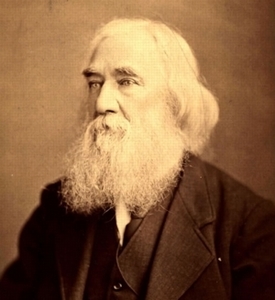
Randy’s helpful distinction between constitutional interpretation and constitutional construction helps to make clear that there are two questions we must ask when thinking about how to understand the U.S. Constitution (or any constitution). First, what does the Constitution say; and second, what -- in practical legal terms -- should we do about what it says?Let’s focus on that second question for now. There are three obvious ways of answering that question which reflect different ways of understanding the relationship between the Constitution and natural justice.- We ought to implement whatever the Constitution says regardless of the justice or injustice of its principles.
- We ought to implement whatever the Constitution says only insofar asits principles are consistent or can be construed as consistent with justice.
- We ought to implement whatever the Constitution says only insofar as its principles are consistent or can be construed as consistent with justice, or if the unjust intention of the author(s) of the Constitution was expressed with irresistible clearness.
Thankfully, nobody around here seems to be at all interested in option 1. Option 2 seems to be roughly the view expressed by Roderick in his essay. And option 3 is the view that Randy attributes to Lysander Spooner.My question is: why would anyone ever go for option 3? Option 1 is crazy, of course, but at least, along with option 2, it seems to take a consistent position on the relationship between constitutions and justice. Option 1 says that justice doesn’t matter at all in construing the Constitution. Option 2 says justice reigns supreme -- that the injustice of a construction is always sufficient reason for rejecting it.Option 3, on the other hand, appears to occupy a kind of wishy-washy middle ground. Basically, it says that we should reject any construction of the Constitution that is inconsistent with natural justice unless the authors were really, really clear that injustice is precisely what they wanted.Why would anyone ever think this? If natural justice is a good reason to read a vague constitutional phrase in one way rather than another, then why isn’t it also a good reason to ignore, dismiss, or erase phrases that are clearly unjust?This is especially puzzling when we recall, as Randy reminds us, that construction is a normative enterprise. What we ought to do about the question is a separate question from what the Constitution says. But if constitutional construction is normative, and justice is something close to the supreme normative principle -- a “trump” -- then why should we ever choose to give practical effect to a clearly unjust aspect of the Constitution?And why would Spooner, of all people, think this? If he really believed, as he said, that "If [the government’s] laws command anything but justice, or forbid anything but injustice, they are themselves unjust and criminal,”[70] then why would he make an exception when the unjust command is expressed without a trace of vagueness or ambiguity?Endnotes[70.] Lysander Spooner, A Letter to Grover Cleveland, on his false Inaugural Address, the Usurpations and Crimes of Lawmakers and Judges, and the consequent Poverty, Ignorance, and Servitude of the People (Boston: Benjamin R. Tucker Publisher, 1886). </titles/2224#Spooner_1481_14>.Aeon J. Skoble
Thesis and Nomos · Jan 13, 2016
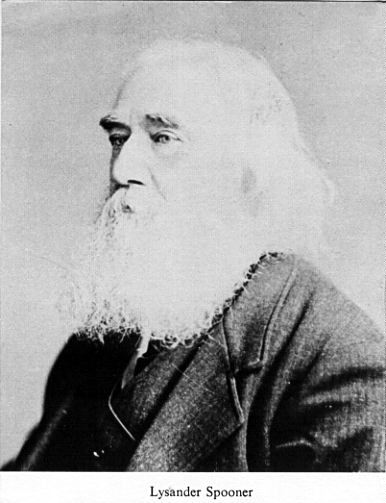
Roderick Long concludes his essay by saying, “I’d also be interested in discussing the relation between Spooner’s and Hayek’s theories of law.” Let’s do that. Here’s Barnett on Spooner again:“If legislation be consistent with natural justice, and the natural or intrinsic obligation of the contract of government, it is obligatory: if not, not.” [Spooner, The Unconstitutionality of Slavery, 8] For Spooner, then, the choice was a conception of law that was consistent with natural justice, which would then carry with it a duty of obedience, or a conception of law based solely on the successful imposition of power, which there would be no moral duty to obey.
Spooner also notes that “only laws that are consistent with the natural and inalienable rights of the people can justly claim a duty of obedience.” Spooner, then, is aware that there are things we call laws, but which really have no basis other than someone’s use of coercion to compel obedience, and other things, sometimes called laws, which are consistent with natural justice.This distinction calls to mind Hayek’s distinction between thesis and nomos.[71] In Law, Legislation, and Liberty, Hayek uses thesis for rules imposed by the sovereign, a top-down process involving coercion; and nomos for rules that emerge in a bottom-up, evolutionary process. While Hayek didn’t claim to be working in the natural-law tradition, the parallels are interesting: nomos doesn’t involve coercion and is most consistent with respect for liberty. It reflects the evolving results of people’s attempts to coordinate their actions and live together in peace and prosperity. It is not imposed from above by threat of violence but instead reflects common practice and sensibility.This seems to be very friendly to Spooner’s conception of natural justice: while Hayek and Spooner seem to oppose coercion for different reasons, they both end up with the idea that coercion is detrimental to human well-being and therefore not a proper basis for the social order. Hayek eschews the language of “natural and inalienable rights” but nevertheless praises liberty and offers us good reasons to disapprove of coercive rules imposed by force. It’s not obvious that the spontaneous order evolves teleologically “towards” natural law, but it’s certainly possible, and in any case a society based on Hayekian nomos seems like it would satisfy Spooner’s conditions for legitimate authority.Roderick suggested that the two theories would benefit from each other; perhaps this is one dimension of that. Perhaps the Hayekian nomos needs some idea of a teleology of human good, of which Spoonerian natural law is an example; and perhaps Spooner’s constitutionalism would be sharper with an understanding of the thesis/nomos distinction mixed in.Endnotes[71.] F.A. Hayek, Law, Legislation and Liberty: A New Statement of the Liberal Principles of Justice and Political Economy. Volume I: Rules and Order (The University of Chicago Press, 1973). Chapter 5: “Nomos: The Law of liberty” and Chapter 6: “Thesis: The Law of Legislation”.Roderick T. Long
Realism and Reference · Jan 13, 2016
Randy says: “The activity of determining the communicative content at the time of enactment ... is empirical, not normative.” This is the nub of our disagreement. If we adopt (as I think we should, and as I think Spooner implicitly does) both a realist theory of reference and a realist theory of normativity, then determining communicative content will in many cases be a normative enterprise.And here I am indeed talking (in Randy’s terms) about interpretation, not just construction – that is, I’m talking about what the text of the law means, irrespective of whether it should be applied. (Incidentally, I take Matt’s option 3 to describe Spooner’s approach to interpretation, not his approach to construction, which I would take to be closer to Matt’s option 2.)I agree with Randy that “words have an objective social meaning at any given time that is independent of our opinions of that meaning.” In the dictum of Hilary Putnam, one of the founders of the realist theory of reference, “‘meanings’ just ain’t in the head.”[72] But Putnam wasn’t just saying that the meaning of words isn’t determined solely by the psychological states of any individual speaker; rather, his point was that such meaning isn’t determined solely by the psychological states of society at large either.Recall from Greek mythology the story of Oedipus. As king of Thebes, Oedipus issues a decree that whoever killed the previous king, Laius, must be punished. Oedipus initially has no idea – nor does anyone else – that he himself is the killer (and incidentally the son) of Laius; he remembers Laius only as a quarrelsome stranger he came to blows with on the road years ago.Does Oedipus’s decree mean that Oedipus himself should be punished? (I’m asking about what the decree means, i.e., what implementing it would involve, not about whether it should be implemented.) Surely it does. Yet not only did Oedipus not intend his own punishment, but no one to whom the decree was promulgated took it as calling for Oedipus’s punishment.The moral of this example is that what Oedipus’s decree means is determined not solely by anyone’s psychological states (either the enactor’s or the general populace’s), but rather by those psychological states together with the fact that Oedipus really did kill Laius.What determines which person the phrase “the killer of Laius” refers to? Of course the psychological states of the people using the phrase, as well as of the general society in which the phrase is used, are part of the story; sounds or marks by themselves don’t mean anything. But those psychological states generate a reference only with the help of external reality, because those using the phrase “the killer of Laius” intend to refer to whatever person, known or unknown, is actually the killer of Laius. Thus if all the Thebans were mistakenly convinced that Laius had been killed by his wife Jocasta, “the killer of Laius” would still refer to Oedipus, not to Jocasta. Mind-independent facts of reality, including facts not generally recognized, play a part in determining what people’s words mean.[73]Now in this case, determining that the decree requires Oedipus’s killer’s punishment will indeed be a matter of empirical inquiry – not just inquiry into the psychological states of the Theban populace, however, but inquiry into what actually happened to Laius on the road years ago.But sometimes the terms whose interpretation is at issue are normative. For example, the text of the Fifth Amendment calls for “just compensation” – which means not “compensation we think is just” or “compensation generally thought to be just,” but “compensation that is actually just.” And just as “the killer of Laius” refers to Oedipus even if everyone thinks it refers to Jocasta, so “just compensation” refers to whatever compensation is actually just, even if everyone thinks some other compensation is what’s just.The communicative content of normative phrases like “just” – or “due” – makes itself hostage to the real, possibly unrecognized nature of justice, just as the communicative content of “the killer of Laius” makes itself hostage to the real, possibly unrecognized facts about what happened to Laius on the road. The difference is that figuring out what happened to Laius on the road is an empirical enterprise, whereas figuring out the nature of justice requires normative reasoning.Of course this analysis assumes that there are objective facts about justice, in the same way that there are objective facts about who killed Laius. But this is just what Spooner does assume, since he describes justice as a “natural principle” that “can no more be changed” than “the law of gravitation” or “the principles of mathematics.”[74]If we agree (as I think we should) with the reference realists that unrecognized facts can play a part in determining what our words refer to, and if we agree (as, again, I think we should) with the moral realists that those unrecognized facts can include facts about justice, then Spooner’s interpretation of the fugitive-slave clause becomes much more defensible.Endnotes[72.] Hilary Putnam, “Meaning and Reference,” p. 704; in Journal of Philosophy 70 (1973), pp. 699-711.[73.] For elaboration, see my working paper “Inside and Outside Spooner’s Natural Law Jurisprudence,” available online at: <https://praxeology.net/Spooner-OB.doc>.[74.] Lysander Spooner, Natural Law: Or a Treatise on Natural Law, Natural Justice, Natural Rights, Natural Liberty, and Natural Society; Showing That All Legislation Whatsoever Is an Absurdity, a Usurpation, and a Crime, Part First (Boston: A. Williams, 1882), p. 11. Online: </titles/2182>.Roderick T. Long
Legitimacy and Monopoly · Jan 14, 2016
According to Randy, “If a constitution contains adequate procedures to assure that laws imposed on nonconsenting persons are just ... it can be legitimate even if not consented to unanimously.”I’m inclined to disbelieve that. Unless “adequate procedures” means “infallible procedures” (and these we wot not of), even the presence of adequate procedures will realistically allow some unjust laws to slip through; and an unjust law lacks moral force – both in the sense of being wrong to impose and in the sense of not being wrong to disobey – even if the institution that generated that law is such as to generate just laws most of the time.Nevertheless, suppose we do grant that the presence of adequate procedures is enough to render a constitution worthy of obedience. I still don’t think that will give much support to the actual U.S. Constitution.Here’s why. Either the Constitution claims territorial monopoly status for the political system it describes, or it doesn’t.Suppose it does – and Article VI’s stipulation that “This Constitution, and the Laws of the United States which shall be made in Pursuance thereof ... shall be the supreme Law of the Land” – certainly gives that impression. Then the problem is that territorial monopolies are by their nature subject to incentival and informational perversities that make them extremely unlikely to produce reliably just laws. For an excellent presentation of the case for this claim, I refer the reader to Randy’s own book The Structure of Liberty.[75]But that means that no territorial monopoly can have adequate procedures for avoiding unjust laws; and so, on the assumption that the U.S. Constitution authorizes a territorial monopoly, it follows that the U.S. Constitution cannot meet Randy’s test for legitimacy.On the other hand, suppose it turns out (perhaps through a creative Spoonerite interpretation of Article VI) that the U.S. Constitution does not claim a territorial monopoly. Then the Constitution implicitly acknowledges the potential permissibility of rival legal systems within its territory.Imagine that such a rival system arises and develops procedures for avoiding unjust laws that are just as good as the Constitution’s. Then it cannot be the case that the mere existence of such procedures generates a duty to obey the institution that uses them, because then one would have a duty to obey both the U.S. law and the rival system’s law even where they diverged, which violates the principle of ought-implies-can.If the Constitution claims a territorial monopoly, it is too unjust to deserve general obedience. If the Constitution does not claim a territorial monopoly, then it is too just to demand general obedience.Endnotes[75.] Randy E. Barnett, The Structure of Liberty: Justice and the Rule of Law, 2d ed. (New York: Oxford, 2014).Matt Zwolinski
Consent, Legitimacy, and Risk · Jan 15, 2016
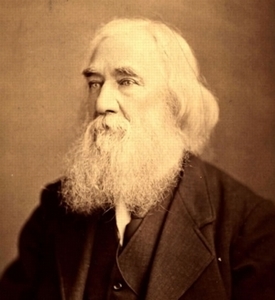
Randy says that “if a constitution contains adequate procedures to assure that laws imposed on nonconsenting persons are just (or not unjust), it can be legitimate even if not consented to unanimously.” Legitimacy, in turn, is important because “[a] law can be legitimate because it is produced according to procedures to assure that it is just, and yet be unjust because in this case the procedures (which can never be perfect) have failed. Such a law would be binding in conscience unless its injustice was somehow established."In other words, you might be duty-bound to obey an unjust law if that law was produced by a procedure that is generally pretty good at producing only just laws.I have a couple of worries about this view. First, who gets to decide what count as “adequate procedures”? One of the advantages of requiring universal consent is that each and every individual can decide on his or her own. If I’m selling a legal system, and you don’t think my procedures are very reliable, you can always say “no.” If we deny individuals this veto power, then we need to have some other way of ensuring that procedures are reliable. But what is it?Second, by what means must the injustice of a law be “established” in order for it not to be binding in conscience? Must the injustice of a law be recognized by some state-sanctioned authoritative body, like the Supreme Court? Or would it be enough for an individual subject to “establish” the injustice of the law on her own, based on her own understanding of morality and the proper scope of state action? The latter view comes close to establishing a kind of de facto requirement of universal consent, which Randy wants to avoid. But is it really plausible to say that an individual is duty-bound to obey a law that she sincerely believes to be unjust, and that really is unjust, simply because it was produced by a procedure that has (somehow) been established to be fairly reliable?Randy is no doubt correct that lawmaking is like sausage-making, at least in the most famous respect in which those two enterprises are often compared. But I get to choose who sells me sausage, and which sausage-makers’ procedures are reliable enough to be worth the risk of a stomachache. And that makes an important difference – not just in terms of the incentival and informational effects noted by Rod, but in the moral permissibility of imposing risk on innocent persons. People who knowingly and voluntarily subject themselves to others’ risky procedures might be morally bound to accept the results when those risks turn out badly. But I’m much less confident that the same is true for individuals who, without ever having had the opportunity to say “no,” are subjected to risky procedures by their governments.Roderick T. Long
No Laws But Just Laws? · Jan 25, 2016
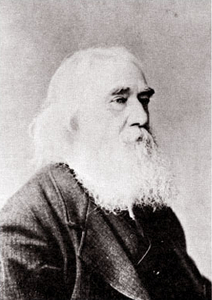
I’ve defended Spooner’s claim that normative terms in the Constitution (or any statutory law) should be interpreted as invoking whatever is the objectively correct moral truth, rather than invoking the opinions on morality held by the authors or socially prevalent at the time of its enactment. Let’s call this View A.But Spooner’s views are still more radical than this. To begin with, he holds that genuine constitutional law “consists only of those principles of the written constitution, that are consistent with natural law, and man’s natural rights.”[76] This implies that, e.g., slavery wouldn’t have been constitutionally legal regardless of what the text of the Constitution said. Let’s call this view – that any genuine law must be consistent with natural law – View B.Moreover, not content merely with View B, Spooner further holds, more radically yet, that there is no law other than natural law: “being the paramount law, [natural law] is necessarily the only law: for, being applicable to every possible case that can arise touching the rights of men, any other principle or rule, that should arbitrarily be applied to those rights, would necessarily conflict with it.”[77] Consequently, Spooner denies the existence of any “power, on the part of the legislators, so-called, to make any laws of their own device, distinct from the law of nature.”[78] Let’s call this View C.Views B and C, today, are even less popular than View A. Nevertheless, I want to say a few words in defense of both of them. I’ll focus on View B in the present post, reserving View C for my next post.View B seems to run counter to ordinary usage; after all, we standardly speak all the time of “laws” we consider to be unjust. In the words of John Austin, one of the foremost proponents of legal positivism, “The existence of law is one thing; its merit or demerit is another.”[79]Yet it’s worth noting that far from being an eccentric position, View B was the standard orthodoxy in Western jurisprudence for over two millennia, being endorsed by thinkers from Plato and Cicero to Thomas Aquinas and William Blackstone; and in the past century, though it had long since ceased to be orthodoxy, it continued to attract such defenders as libertarian writer Rose Wilder Lane and civil-rights leader Martin Luther King Jr.[80] Even today the view has a hold in popular culture; for example, in the 2010 film Machete, Jessica Alba’s character says: “There are lots of laws. But if they don’t offer us justice, then they aren’t laws; they are just lines drawn in the sand by men who would stand on your back for power and glory.” These endorsements don’t show that View B is true, but they do give us reason to take it seriously.Why might one think View B is true? Well, to begin with, laws claim authority; and one might accordingly think that a successful law – that is, something that succeeds in being a law – would have to be one that actually has the authority it claims. If only just laws can have authority, we get the upshot that lex injusta non est lex – an unjust law is not a law. This style of argument seems to be the dominant one in the natural-law tradition.A slightly different argument for View B takes laws as having a function; by that reasoning, only statutes that are suited to achieve that function will count as genuine laws, at least in the full-fledged sense. If the function in question is one to which justice is requisite, then lex injusta non est lex follows once again.This latter style of argument seems to be the one that Spooner finds most compelling. For Spooner, knowledge of natural law is “the science which alone can tell us on what conditions mankind can live in peace,” and accordingly “wherever mankind have attempted to live in peace with each other,” they have found obedience to natural law to be an “indispensable condition.”So long as these conditions [of natural law] are fulfilled, men are at peace, and ought to remain at peace, with each other. But when ... these conditions [are] violated, men are at war. And they must necessarily remain at war until justice is re-established.[81]
Given the radically libertarian character of natural law as Spooner understands it, he presumably cannot mean that every workable legal system must be libertarian. Rather, his point is that every workable legal system is so in virtue of its libertarian aspects and to the extent that it is libertarian. Restraining people from aggression against the persons and property of others is the core, the essence, of any legal system, whereas any additions and exceptions to this core are accidental, and indeed are impediments to proper legal functioning. And if a statute’s legal character derives from its libertarian character, then unlibertarian statutes will not be strictly legal. (Spooner’s position here bears some resemblance to that of the 20th-century jurist Lon Fuller, who likewise saw certain moral principles as implicit in the enterprise of law itself, though for Fuller, unlike Spooner, these principles were primarily procedural rather than substantive.)[82]But even if we grant that protecting libertarian rights is the true essence and function of law, so that unlibertarian statutes are unsuccessful examples of lawmaking and thus will be bad as laws (rather than simply being laws, perfectly in order as laws, that happen to be, in addition but separately, morally bad), why not indeed say that they are bad laws rather than nonlaws?Here I think the terminological question is secondary. In ordinary language the sentences “Three of the Rembrandts in your collection are fakes” and “Three of the paintings in your collection that you think are Rembrandts actually aren’t Rembrandts, but instead are fakes” both sound like acceptable standard usage, even though the first seems to treat fake Rembrandts as a kind of Rembrandt while the second declines to do so. What is crucial to View B is less whether we call unjust statutes “laws” than whether we regard them as successful or unsuccessful examples of lawmaking.[83]On this view, an unjust law is a failed law; whether one regards its failure as so great as to disqualify it from being a law, or merely as marking it as an inferior-grade law (how dull does a knife have to be before it’s no longer a knife?), the point is that it fails to have the full status that a properly formulated law would have. It claims authority, but actually lacks it; it seeks to coordinate human behavior in a peaceful way, but actually promotes unnecessary conflict. Unjust laws are botched laws.Endnotes[76.] Spooner, The Unconstitutionality of Slavery, Part I (Boston: Bela Marsh, 1845), p. 14.[77.] Ibid., pp. 6-7.[78.] A Letter to Thomas F. Bayard: Challenging His Right – and That of All the Other So-Called Senators and Representatives in Congress – to Exercise Any Legislative Power Whatever Over the People of the United States (Boston, 1882), p. 5.[79.] John Austin, The Province of Jurisprudence Determined (London: John Murray, 1832), p. 278.[80.] For citations, see my working paper “Legal Naturalism Is a Disjunctivism,” online at: <https://praxeology.net/legal-naturalism-disjunc.pdf>.[81.] Spooner, Natural Law; or the Science of Justice: A Treatise on Natural Law, Natural Justice, Natural Rights, Natural Liberty, and Natural Society; Showing That All Legislation Whatsoever Is an Absurdity, a Usurpation, and a Crime. Part First, in The Collected Works of Lysander Spooner (Indianapolis, IN: Liberty Fund, 1882).[82.] Lon Fuller, The Morality of Law (New Haven: Yale University Press, 1969).Roderick T. Long
No Law But the Natural Law? · Jan 25, 2016
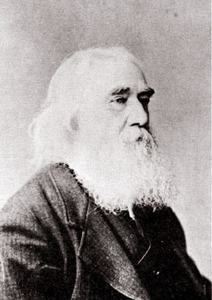
In my last post I distinguished three positions, in increasing order of radicalism, all of which Spooner defends:View A: normative terms in statutes should be interpreted in accordance with whatever natural law actually says, not in accordance with the opinions of the authors or the wider society as to what natural law says.View B: no statute counts as a genuine law unless it is consistent with natural law.View C: natural law is the only genuine law.
I’ve likewise defended Views A and B. What about C?At first blush, View C seems to run afoul of one of the most basic functions of law. As Charles Johnson writes:[I]t may be that justice requires that cars going opposite directions on a highway should drive on opposite sides – so that drivers will not needlessly endanger each other’s lives. But natural justice surely has nothing in particular to say about whether motorists should drive on the left or drive on the right. It requires that some rule of the road should be adopted, and that once adopted, the rule should be obeyed by each individual motorist. But the question of which to adopt is a matter that needs to be settled by some means other than appeals to natural justice. Medieval legal writers described these sorts of cases as reducing the natural law (in the sense of making it more specific): the idea is to spell out the details for cases where the principles of natural justice underdetermine the correct application of individual rights.[84]
But View C appears to rule out the possibility of “reducing” the natural law in this way. For if natural law doesn’t say which side of the road one should drive on, then according to View C it seems there can be no law settling this. View B by itself doesn’t pose this problem, since it allows laws in addition to natural law so long as those laws don’t conflict with natural law; but View C apparently rejects any role for convention in law. (This, incidentally, is one place where Spooner seems to part company with Hayek. The two thinkers agree in contrasting law with legislation; but the spontaneously evolving norms that Hayek champions certainly do allow a role for convention.)Moreover, not only does View C seem implausible in itself, but it also seems to conflict with View B. What’s the point of telling us that no unjust statutes can count as laws if it turns out that no statutes, just or unjust, count as laws? After all Spooner tells us that even just statutes – those that “command men to do justice” – nevertheless “add nothing to men’s obligation to do it, or to any man’s right to enforce it,” and so are “mere idle wind.”[85]To be sure, Spooner does in the very same paragraph suggest a different way that a statute could be a law, for he says of statutes generally that it is “a falsehood to call them laws; for there is nothing in them that either creates men’s duties or rights, or enlightens them as to their duties or rights.” This opens the door to the possibility that a statute might count as a law, despite not creating any duties or rights, if it did “enlighten” people as to their duties and rights. But it’s still hard to see how to reconcile this with the claim that natural law is the only law.But let’s think about it this way. Suppose I’m in the country where the established statute says to drive on the right. Should I drive on the right? Yes, but not because of the statute, or at least not directly. The reason I should drive on the right is that most other people are driving on the right, and so I need to drive on the right in order to satisfy natural law’s requirement not to endanger other drivers needlessly.Now perhaps the other drivers are driving on the right out of respect for the statute, in which case the statute will be indirectly the reason I should drive on the right. But the statute’s role is not essential. After all, suppose that the statute said to drive on the left, but in practice most people were still driving on the right; in that case I should still drive on the right. The general practice of driving on the right gives me reason to drive on the right – be that practice the result of top-down legislation, or a spontaneously evolved Hayekian norm, or what have you. But the authority I’m following is not the practice itself, any more than it is the statute (if any) behind it; I’m ultimately following the authority of the natural-law principle not to endanger other drivers needlessly. It’s just that conventions – statutory or otherwise – can play a role in determining what counts as following the natural-law in particular situations.By analogy, suppose that natural law says “shoot anyone wearing a red hat.”[86] Then Bartholomew, by wearing a red hat, makes it the case that I should shoot Bartholomew. But Bartholomew didn’t create any new norm for me to follow; in shooting him I’m just following the original norm of shooting anyone wearing a red hat.Thus it is possible to hold, simultaneously and consistently, both that statutory and other conventions can change what genuine law requires, and that unchanging natural law is the only genuine law. Whether one wants to call the conventions that “reduce” the natural law’s requirements “laws” or not is an optional terminological question; the crucial point is that these conventions have no independent authority.Endnotes[84.] See Charles Johnson’s working paper “A Place for Positive Law A Contribution to Anarchist Legal Theory,” online at: charleswjohnson.name/essays/a-place-for-positive-law. The position Johnson goes on to defend in his paper is broadly similar to the one I defend here.[85.] Spooner, A Letter to Grover Cleveland on His False Inaugural Address, the Usurpations and Crimes of Lawmakers and Judges, and the Consequent Poverty, Ignorance, and Servitude of the People (Boston: Benjamin R. Tucker, 1886), p. 4.Aeon J. Skoble
Fake Law or Bad Law? · Jan 25, 2016
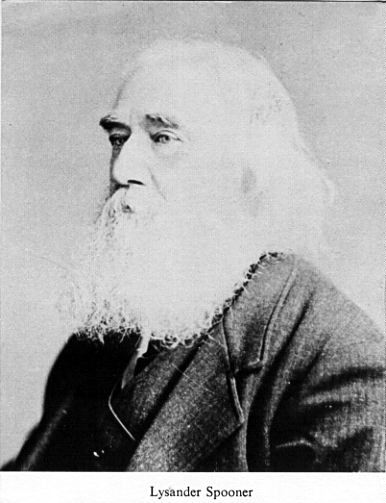
Roderick says, “Even if we grant that protecting libertarian rights is the true essence and function of law, so that unlibertarian statutes are unsuccessful examples of lawmaking and thus will be bad as laws (rather than simply being laws, perfectly in order as laws, that happen to be, in addition but separately, morally bad), why not indeed say that they are bad laws rather than nonlaws?” I agree that this is a problem for those of us sympathetic to natural-law arguments, for it impacts our ability to explain what we’re saying. Are unjust laws bad laws or nonlaws?Roderick suggests the example of art forgeries – it’s not that you own a fake Rembrandt, but that you own something you think is by Rembrandt but isn’t. I agree that that’s the right way to think about forgeries, but what about prints? If I have a print of a Rembrandt, that’s like the fake in one way (neither was physically produced by Rembrandt), but unlike it in another way – it’s a copy not designed to deceive but merely to show. This means it resembles the thing it’s a copy of, but isn’t actually that thing. It’s a lesser version. If you said, “Show me an example of Rembrandt’s work,” the print is an example. But it’s also right to say, “Of course, this isn’t really a Rembrandt. It’s a copy.”So are the makers of unjust laws like forgers or like printmakers? Neither seems accurate. Rather, they’re like bad art students who try to imitate the master’s style but have no sense of perspective, color, or composition, and who produce greatly unappealing pictures – but then are allowed to display them in the Rembrandt collection. If the person in charge of the collection gives it a number, it will in fact be “Rembrandt collection item #175” despite not really being a Rembrandt at all. I wonder if unjust laws that have nevertheless passed in accordance with proper rules are like that. They’re called “laws” by the people in charge of the collection and receive corresponding numbers. But they’re not really laws at all. With one exception: we’re at liberty to proclaim loudly that Rembrandt collection item #175 is not, in fact, a Rembrandt and that, furthermore, it’s horrible -- and we won’t get killed. But the unjust things-that-aren’t-laws-but-the-state-calls-laws have the force of the state behind them, and we can be killed for disobeying them.I like Roderick’s conclusion that thinking of them as “botched laws” is most accurate, but when he says such a law “claims authority, but actually lacks it” – we must be careful to differentiate senses of authority. They do have authority in the sense that others will enforce them, although I agree that they lack authority in the moral sense. But here’s the payoff: To rally people to see that lack of authority, is it better to say, “That’s not even a law!” or “That’s a bad law”? While I think the former is true, it’s the latter that has the more effective strategy for mobilizing dissent. People who go around insisting that the income tax is illegal are generally regarded the same way as moon-landing-hoax people or flat-earthers. Might be better to simply argue that it’s a bad idea.Randy E. Barnett
Procedural Justice and Constitutional Legitimacy · Jan 26, 2016
On the question of the validity of unjust laws, there is an epistemic problem: by what procedure does one conclude that a law is unjust? In this regard, I admit to having been influenced by George H. Smith’s Journal of Libertarian Studies article “Justice Entrepreneurship in a Free Market” (1979).[87] In that article, George’s aim was to refute my previous essay in which I adopted much the same stance as is being expressed here by others. I found -- and have publicly acknowledged -- George’s response to my arguments to be persuasive. And it planted the seed for a conception of procedural constitutional legitimacy that I identified in my earlier essays on Spooner in this forum and that I have defended elsewhere.In his article, George stated the problem this way:I agree with Barnett that a Victim of invasion has the right to seek restitution from the Invader, and that the actual guiltof the Invader is the only germane issue (as far as the Victim is concerned). But Nozick raises an important issue of knowledge of guilt and its relation to the enforcement of justice. In adopting procedural rights, however, Nozick takes a wrong turn and fails to see the solution to his own problem. The important social relation that generates the whole question of reliable procedures is not that between the Victim and the Invader, but the relationship between the Victim and impartial Third Parties. It is for his own safety, to prevent violent Third Party intervention in his quest for restitution, that the Victim must concern himself with matters of legal procedure.
As he explains:Before restitution can be accomplished, ... several preliminary issues must be settled. Did a violation of rights occur? If so, who was responsible? And what was the extent of the responsibility? These matters of fact must be decided before the subject of restitution is germane, and they are the first priority of a court of justice.The first task of a court, therefore, is to settle an issue of knowledge: Did or did not the accused commit the crime charged against him? A court, as an arbiter of guilt and innocence, is the personification of epistemological standards. It represents the social application of epistemological procedures, whose purpose is to assess the rational basis for a given knowledge claim -- the charge of the plaintiff (the alleged Victim) against the defendant (the alleged Invader). The onus of proof is on the plaintiff to prove his case with certainty -- i.e. “beyond reasonable doubt” -- and the defendant is presumed innocent until proven otherwise.
George then poses the following thought experiment:Now consider the same situation with the addition of a Third Party who is absent during Crusoe's theft. Suppose that Friday makes no attempt to inform the Third Party of Crusoe's deed, or that Friday charges Crusoe with the theft but provides no evidence to substantiate the allegation. (Crusoe, of course, denies the charge.) Friday proceeds to invade Crusoe's hut in an attempt to reclaim his coconuts (or the equivalent in value). Crusoe, in the meantime, screams that he is being aggressed against and solicits the aid of the Third Party to restrain Friday. The Third Party intervenes, using force to stop Friday.Friday, acting on his knowledge, is morally justified in seeking restitution. But the Third Party, acting on hisknowledge, is (as I shall argue) justified in coming to the "defense" of Crusoe, the apparent Victim. With the existence of a Third Party, Friday's act of restitution -- when no effort is made to enlighten the Third Party as to the circumstances -- becomes a high-risk activity. It exposes Friday to potential harm for which he has no legitimate redress. That is to say, if a Third Party, believing Friday to be the true Invader, injures him in the process of resisting his "invasive" act, Friday cannot then seek restitution from the Third Party. Friday's failure to provide public notice and proof of his claim against Crusoe, generates an inevitable clash between Friday and the Third Party --a clash, it must be noted, that Friday could have avoided but did not. The responsibility for this Third Party conflict, therefore, rests with Friday; and he undertakes private restitution against Crusoe at his own risk.From the potential conflict of Friday and the Third Party, there arises a need for a "public trial" to ascertain Crusoe's guilt or innocence. This trial is required not because of special "procedural rights" supposedly possessed by Crusoe (such as the "right to a fair trial"), but because this public demonstration of Crusoe's guilt is the only way to eradicate or minimize the potential conflict between Friday and a Third Party. By allowing the Third Party to examine the basis of Friday's allegation against Crusoe, with the opportunity for Crusoe to respond, it is possible to harmonize the knowledge of Friday (that Crusoe is guilty) with the knowledge of the Third Party, so that the Third Party can cooperate (or at least not interfere) with Friday's quest for restitution.The same principles apply to any society of three or more persons. Impartial Third Parties are not privy to the special experience of a Victim seeking restitution. Man's knowledge is limited -- he is not omniscient -- and individuals must act on the context of knowledge available to them. Friday may be a true Victim seeking restitution, but this fact may be inaccessible to others. Friday knows it, and Crusoe (presumably) knows it; but Third Parties do not. If Crusoe denies the charge of theft, and if Friday fails to substantiate it, then Third Parties are epistemologically obliged to view Friday as an Invader. Given their context of knowledge, there is no other rational option.
He then stresses how procedures are needed to address the knowledge problem facing Third parties to any claim of injustice:We must remember the purpose of public verification: it is not to justify the Victim's restitutive act morally, but to identify the kind of action he is taking. The potential misunderstanding between a Victim and Third Parties is factual, not evaluative. Violent acts do not bear external characteristics which enable one visually to distinguish between invasion and restitution. Invasion, for instance, may involve fraud without overt violence, in which case the Victim may be the first (and only) one to employ actual violence in his quest for restitution. The distinction between invasion and restitution can be drawn only with reference to property rights and property titles, and such particularized information is rarely accessible to Third Parties without deliberate effort.
The problem George identifies with respect to third-party judgments of individuals who are alleged Invaders applies to legislation writ large. Laws that violate the rights of those upon whom they are imposed are unjust wholesale invasions of rights. As such they are not obligatory. But there is still the issue of how to ascertain and establish their injustice. Just as a trial provides procedures by which to assess guilt and innocence to the satisfaction of third parties, a legitimate constitution provides procedures to assure the public that a legislature is not acting as an Invader, but is instead protecting the rights of the individuals who are the ultimate sovereign. The citizens are not omniscient, and have limited time to devote to the assessment of the justice or injustice of the laws imposed upon them. As with the inspection of their food supply for wholesomeness, they must delegate this assessment to a legal system. A legal system with procedures that are able to make this assessment reliably is what I am calling a “legitimate” one.But just as trials are imperfect – innocent people are convicted, and guilty ones acquitted, -- so too are even legitimate lawmaking procedures. The question is whether the particular lawmaking procedures of a particular constitutional order are reliable enough to impart a defeasible duty to obey to the laws that are somehow adjudicated as just? The difference between the results of that adjudication, which create a prima facie duty of obedience, and the actual or underlying justice of each and every law is what I am calling “the gap.”So I ask the others: how do they address the epistemological issue of ascertaining the justice of laws so individuals know which to obey and which to disobey? How do you respond to George Smith's defense of procedural justice?Endnotes[87.] George H. Smith, “Justice Entrepreneurship in a Free Market”, Journal of Libertarian Studies (vol. 3, no. 4, 1979). <https://mises.org/library/justice-entrepreneurship-free-market-0>.Roderick T. Long
Bad Laws and Good Rhetoric · Jan 27, 2016
Aeon asks: “To rally people to see [an unjust statute’s] lack of authority, is it better to say, ‘That’s not even a law!’ or ‘That’s a bad law’?” And Aeon suggests by way of answer that even if the first approach should turn out to be technically correct, the second approach is a “more effective strategy for mobilizing dissent”; and his reason for this is that those who “go around insisting that the income tax is illegal” are “generally regarded the same way as moon-landing-hoax people or flat-earthers.”I think the income-tax denial approach is actually a different strategy from the lex injusta non est lex approach. The income-tax denier says, “That’s not a law because of the details of positive legislation (e.g., the text of some statute, the history of its enactment, or both).” The lex injusta approach, by contrast, says, “That’s not a law because it’s unjust.” So any rhetorical drawbacks of the income-tax denial approach do not necessarily reflect negatively on the lex injusta approach.Of course Spooner uses both approaches. In 1845 he took the income-tax denial approach in appealing to the text of the Constitution, properly interpreted, to show that slavery lacked legal authority; and in 1870 he in a way took the income-tax denial approach again in appealing to the circumstances of the Constitution’s ratification to show that the Constitution itself lacked legal authority. (Though of course his way of conducting the income-tax denial approach involves normative premises.) And in both periods he also defended the broader view that any legislative enactment inconsistent with natural law lacks legal authority.In any case, Spooner’s income-tax denial approach with regard to slavery’s legality seems to have had a fair bit of rhetorical effectiveness. The Unconstitutionality of Slavery went through several printings, won the endorsement of such prominent abolitionists as Frederick Douglass and Gerrit Smith, and was even “officially adopted by the Liberty Party in 1849”[88] as the decisive statement on the legal status of the institution. This is hardly akin to the reception accorded flat-earthers.But the lex injusta non est lex approach seems to have its share of rhetorical effectiveness too. After all, it’s the basis of Martin Luther King’s arguments in his “Letter From Birmingham Jail,”[89] one of the most popular and frequently cited documents of the civil-rights movements; and as I’ve mentioned before, the doctrine’s use in a mainstream action movie like Machete is likewise indicative of its possessing some popular resonance.Plus it was the rallying cry of Spooner’s great rival William Lloyd Garrison; while the two disagreed on what I’ve been calling, following Aeon, the income-tax denial approach (far from defending the Constitution à la Spooner as a crypto-abolitionist document, Garrison denounced it as “a covenant with death and an agreement with hell”),[90] the two men were quite close on the lex injusta doctrine. Garrison wrote that “properly speaking, there is but one government, – and that is not human, but divine; there is but one law, – and that is ‘the higher law’”; and all human governments, democratic or otherwise, are “based upon the doctrine that ‘might makes right’” and so “must ultimately perish.”[91] Given Garrison’s status as arguably the most influential of the American abolitionists, the lex injusta approach must not be such a rhetorical dealbreaker.As I’ve written elsewhere, “for those of us who are involved in radical political projects such as agorism that involve promoting mass disobedience to and bypassing of governmental edicts,” the lex injusta approach has the attraction of “depriving unjust statutes and decrees of the ... aura of authority that attaches to the word ‘law’” – while “those whose political projects are more moderate and reformist may reasonably prefer the weaker ... terminology.”[92]I think some remarks of Spooner’s fellow abolitionist Wendell Phillips lend additional (and inadvertent) support for my preference for the lex injusta approach. In his 1847 critique of the first volume of Spooner’s Unconstitutionality of Slavery, Phillips complains that by upholding the principle that “Only what is just and right is law,” Spooner is taking “the first step toward anarchy.”[93] Phillips writes:There can be no more self-evident proposition, than that, in every Government, the majority must rule, and their will be uniformly obeyed. Now, if the majority enact a wicked law, and the Judge refuses to enforce it, which is to yield, the Judge, or the majority? Of course, the first. On any other supposition, Government is impossible. Indeed, Mr. Spooner’s idea is practical no-governmentism. It leaves every one to do “what is right in his own eyes.”[94]
Phillips, by contrast, insists that “for the purpose of the civil government of any nation,” it is properly up to “the majority of that nation” to “decide what is just and right”; and “their decision is final, and constitutes, for that nation, Law.”[95]I think Phillips is right about the natural connection between the lex injusta doctrine and anarchism (even though most historical proponents of lex injusta – Plato, Cicero, Aquinas, etc. – have been very far from being anarchists). The difference is that I reverse the evaluation; if Spooner’s legal naturalism is “practical no-governmentism,” I say not so much the worse for Spooner’s approach, but rather so much the better.Of course Phillips’s concern about the dangers of unrestrained private judgment are akin to those that Randy raises in his most recent contribution. I’ll address that concern in my next post.Endnotes[88.] Kunal M. Parker, Common Law, History, and Democracy in America, 1790-1900: Legal Thought Before Modernism (Cambridge: Cambridge University Press, 2011), p. 180.[89.] Martin Luther King, Jr., “Letter From Birmingham Jail,” Liberation: An Independent Monthly (June 1963), pp. 10-16, 23.[90.] Quoted in Wendell Phillips Garrison and Francis Jackson Garrison, William Lloyd Garrison, 1805-1879: The Story of His Life Told by His Children, vol. 3 (Boston: Houghton Mifflin, 1894), p. 412.[91.] William Lloyd Garrison, “Voting – Government – Slavery and War,” The Liberator (1 August 1856), p. 2; online at: < https://praxeology.net/WLG-VGS.htm>.[92.] “Legal Naturalism Is a Disjunctivism,” online at: <https://praxeology.net/legal-naturalism-disjunc.pdf>.[93.] Wendell Phillips, Review of Lysander Spooner’s Essay on the Unconstitutionality of Slavery, Reprinted From the “Anti-Slavery Standard,” With Additions (Boston: Andrews & Prentiss, 1847), p. 15.[94.] Phillips, op. cit., p. 10.Roderick T. Long
Private Judgment and Public Justification · Jan 27, 2016
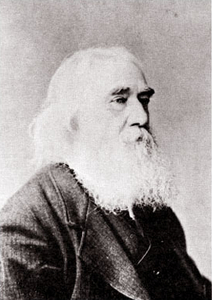
Unjust statutes have no authority that anyone is bound to respect; so says Spooner, and I agree. But Randy raises an objection. Citing an argument by libertarian theorist George Smith,[96] Randy maintains that even if I am in my moral rights in any given dispute, it is in my interest to establish my correctness through some public procedure in order to reduce the likelihood of conflicts with third parties. Hence I cannot realistically go around using my sole private judgment as to which laws to obey or disobey, without some concern to vindicate the justice of my actions in a public forum.With some reservations (which I’ll get to), I’m generally in agreement with this defense of concern for public procedures of justice. But I’m a bit puzzled at Randy’s glossing this point as equivalent to “the epistemological issue of ascertaining the justice of laws so individuals know which to obey and which to disobey.” The question how do I know I’m justified in disobeying this requirement? and the question how do I convince others that I’m justified in disobeying this requirement? seem like different questions.For one thing, convincing others of one’s justification often involves establishing matters of fact that one doesn’t need to establish for oneself. Consider the following two cases:Case #1: Officer Freundlich seeks to arrest Emma for stabbing her roommate Voltairine. Emma has not in fact stabbed anyone, so she takes herself to be in her rights to resist arrest. But by resisting arrest, she risks conflict with third parties who are not convinced that she’s innocent of stabbing her roommate.Case #2: Officer Freundlich seeks to arrest Voltairine for selling marijuana to her roommate Emma. Voltairine has indeed sold Emma marijuana, but she regards selling marijuana as legitimate, so she takes herself to be in her rights to resist arrest. But by resisting arrest, she risks conflict with third parties who are not convinced that selling marijuana is legitimate.
In case #1 it may be in Emma’s interest to convince third parties, via some public procedure, that she hasn’t stabbed her roommate; but (absent unusual circumstances – amnesia, hypnotism, or the like) she doesn’t need to do any special epistemological work to establish to her own satisfaction that she hasn’t stabbed her roommate.But perhaps case #2, involving normative rather than positive inquiry, is more the kind of case that Randy has in mind. Here too, though, establishing for oneself that a requirement is unjust is not quite the same as (though it will ordinarily display considerable overlap with) demonstrating to the wider society that that requirement is unjust; the former requires seeking reflective equilibration within one’s own belief-set, while the latter requires seeking reflective equilibration within a set of beliefs widely accepted by the relevant community.[97] So I’m not sure why Randy seems to be running the two questions together.I’m even more puzzled by the question of how Randy gets from the suggestion, which I accept, that there’s a need for public procedures of justification to reduce the risk of conflict with third parties, to what strikes me as the entirely different suggestion, and one that I don’t at all accept, that such procedures, if of the right sort, might “impart a defeasible duty to obey ... the laws that are somehow adjudicated as just” even when those laws lack “actual or underlying justice.” It’s one thing to say that we have prudential reasons (and more than prudential – it’s arguably a requirement of civility, at least in many contexts) to try to prove our case in a public forum; it’s another thing to say that when the public procedure generates the wrong answer, we somehow magically acquire a duty, even a prima facie one, to submit to injustice.[98]In any case, while it will often be advisable to submit one’s disputes to a public system of third-party arbitration, in many cases there will be no good reason to do so. One such case involves emergency situations of self-defense when there is no time to call in third parties. Another such case is one in which the prevailing legal institutions, or the political culture, or both, are such as to make a fair adjudication highly unlikely. For example, when Frederick Douglass decided, in 1838, to try to escape from slavery in Baltimore to freedom in Philadelphia, he followed his own private judgment that his enslavement was wrong; he did not first convene a hearing in the local community and try to make a public justification of the rightness of his escaping. Given that the legal institutions and political culture of Baltimore were firmly biased in favor of slavery, it would have been grossly unjust to demand of Douglass that he first make his case to a Baltimore court before attempting to free himself.Now consider the following four propositions about present-day society, in the United States and, really, most places on the planet:- Prevailing legal institutions pervasively forbid what they should permit.
- Prevailing legal institutions, even when what they forbid is what genuinely should be forbidden, pervasively assign punitive penalties when they should instead be focusing on restitution.
- The failures of prevailing legal institutions are not accidental, but are the predictable result of the incentival and informational perversities inherent in the monopolistic power structure that defines the state itself.
- Most people support prevailing legal institutions.
For a defense of the first three propositions, I refer the reader to Randy’s own previous work.[99] I take the fourth to be fairly obvious. The first three propositions show that prevailing political institutions are unlikely to generate a fair result. (Randy may protest that these institutions would be likely to generate a fair result if their administrators followed the Constitution as he interprets it. But I take the third proposition to show why no legal system is likely to follow the Constitution as he interprets it.) Consequently, even assuming a duty to justify one’s disobedience in a public forum, such a duty cannot equate to a duty to justify one’s disobedience in a government court. And the fourth proposition shows that prevailing political culture is not likely to generate a fair result either.John Locke famously cites the problem of people being “judges in their own case” as one of the “inconveniences of the state of Nature” that are to be remedied by civil government. I think Locke was correct (within the limitations I’ve just sketched) to see third-party arbitration as generally preferable to unchecked private judgment.[100] But his mistake lay in seeing the establishment of a territorial-monopoly state as the means of implementing this desideratum. First, a monopoly is not necessary to solve the problem, since successful nonmonopolistic systems of public legal arbitration are fairly common throughout history.[101] Second, a monopoly cannot solve the problem, because a monopoly by definition does not submit its own disputes with its subjects to third-party arbitration.[102] Randy understands nonstate legal systems too well to make Locke’s mistake; but the argument he is making looks to me surprisingly like Locke’s mistake.Endnotes[96.] Incidentally, I think it unlikely that George would agree with all the conclusions that Randy wants to draw from George’s argument.[97.] For my defense of the reflective-equilibration approach to moral reasoning, see Roderick T. Long, Review of Leland B. Yeager’s Ethics as Social Science: The Moral Philosophy of Social Cooperation, Quarterly Journal of Austrian Economics 6.1 (Spring 2003), pp. 89-98; online at: < https://mises.org/library/review-ethics-social-science-moral-philosophy-social-cooperation-leland-b-yeager> ; as well as Long, Reason and Value: Aristotle versus Rand (Poughkeepsie: Objectivist Center, 2000); online at: <https://atlassociety.org/sites/default/files/Reason_Value.pdf>.[98.] For related discussion, see my “Eudaimonist Reason versus Public Reason,” Bleeding Heart Libertarians (4 May 2013); online at: <https://bleedingheartlibertarians.com/2013/05/eudaimonist-reason-versus-public-reason>.[99.] Randy E. Barnett, The Structure of Liberty: Justice and the Rule of Law, 2d ed. (New York: Oxford University Press, 2014); see also “Pursuing Justice in a Free Society: Part I – Power vs. Liberty,” Criminal Justice Ethics 4 (1985), pp. 50-72; online at <https://www.bu.edu/rbarnett/4crimjustice50.html>; and “Pursuing Justice in a Free Society: Part II – Crime Prevention and the Legal Order,” Criminal Justice Ethics 5 (1986), pp. 30-53; online at: <https://www.bu.edu/rbarnett/5crimjust30.html>.[100.] Locke, Second Treatise of Government 2.13 (1689): </titles/222#Locke_0057_229>.[101.] For bibliographic references through 1992, see Tom W. Bell, “Polycentric Law,” Humane Studies Review 7.1 (Winter 1991/92); online at: <http://osf1.gmu.edu/~ihs/w91issues.html> . More recent sources include Peter Leeson, Anarchy Unbound: Why Self-Governance Works Better Than You Think (Cambridge: Cambridge University Press, 2014), and Edward Peter Stringham, Private Governance: Creating Order in Economic and Social Life (New York: Oxford University Press, 2015).[102.] For elaboration of this critique of Locke, see my “Market Anarchism As Constitutionalism,” in Roderick T. Long and Tibor R. Machan, eds., Anarchism/Minarchism: Is a Government Part of a Free Country? (Aldershot: Ashgate, 2008), pp. 133-54.Roderick T. Long
More on Private Judgment and Public Justification · Jan 27, 2016
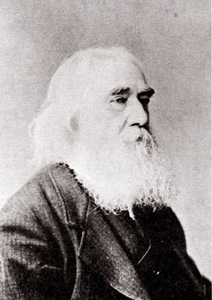
A couple of addenda to my last post:1. I also want to distinguish between the question What procedures does a provider of legal services (a private court, say) need to follow in order to assure third parties that it’s behaving in a reliable manner? and the question What procedures does a provider of legal services need to follow in order to generate in others a prima facie duty to obey its edicts even when those edicts are wrong? In answering the first question, I think Randy’s Structure of Liberty is a pretty good guide.[103] (One requirement for reliability, though not the only one, is that the provider not forbid competitors.) By contrast, I think the answer to the second question is: no possible procedures could be sufficient to produce this result.2. In answer to my argument that disputants are not bound to obey the unjust decisions of courts, someone might object: what if they’ve contractually agreed to binding arbitration? My answer is: it depends on the details of the contract. Either the contract surrenders alienable rights or it seeks to surrender inalienable rights. If the rights the contract seeks to surrender are inalienable, the contract is not binding. (On this point see Randy’s excellent article “Contract Remedies and Inalienable Rights.”)[104] On the other hand, if the rights surrendered in the contract are alienable, the contract is binding; but in that case, even if the result of arbitration is mistaken, it will not be unjust. (For example, if I’ve agreed to pay a fine if Court X finds me guilty, then even if I’m innocent there’s no injustice in requiring me to pay the fine, since the condition licensing the fine is not my guilt but rather Court X’s finding.) In neither case, then, do we find a duty to obey unjust requirements.Endnotes[103.] Randy E. Barnett, The Structure of Liberty: Justice and the Rule of Law, 2d ed. (New York: Oxford University Press, 2014).[104.] Randy E. Barnett, “Contract Remedies and Inalienable Rights,” Social Philosophy and Policy 4.1 (Autumn 1986), pp. 179-202.Matt Zwolinski
Spooner on Historical Injustice · Jan 28, 2016
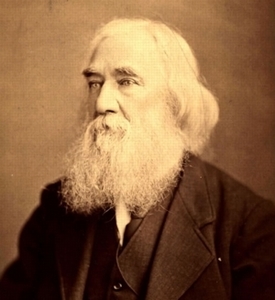
One of Spooner’s less-appreciated contributions to political philosophy is his discussion of the problem of historical injustice. That problem concerns what we ought to do now about injustices that occurred in the relatively distant past, but that nevertheless affect people living today. For instance, the enslavement of African-Americans in the United States ended more than 150 years ago. Nevertheless, the effects of that injustice are still felt: both by those who have inherited the wealth unjustly acquired by slave-owners and others who profited from slavery, and by those who have inherited the hardships and poverty of slaves. Similarly, much of the land currently owned by Americans was, at some point in the past, violently or fraudulently seized from Native Americans. As a result, the descendants of those original Native Americans are almost certainly poorer than they otherwise would be, while others who benefitted from that theft are materially better off.Spooner addressed the problem of historical injustice in one of his last published writings, an 1880 pamphlet entitled, “Revolution: The Only Remedy for the Oppressed Classes of Ireland, England, and Other Parts of the British Empire” (1880).[105] Here, Spooner takes up the so-called “Irish Question” of how to deal with the increasing resistance of the Irish to British occupation and rule. Ireland had been conquered by the Tudors in the 16th century, and in the process of this conquest most of the land in Ireland was seized by the British. Much of this confiscated land was given to British nobles, who rented it to Irish peasants from afar. By the late 19th century many Irish had become increasingly dissatisfied with this arrangement, viewing it as a sort of feudalism and calling for the British to return their stolen lands and leave the country.In “Revolution,” Spooner comes down squarely on the side of the Irish peasantry against the British nobility. British landlords, Spooner argued, had no just title to the lands they held.These lands, largely or mostly, were originally taken by the sword, and have ever since been held by the sword. Neither the original robbers, nor any subsequent holders, have ever had any other than a robber’s title to them. And robbery gives no better title to lands than it does to any other property.[106]
Of course, the robberies – like slavery and land-theft in America – occurred long ago, in the distant past. And all of the original parties to the injustice – both the perpetrators and the victims – are dead. But, Spooner argued,No lapse of time can cure this defect in the original title. Every successive holder not only indorses all the robberies of all his predecessors, but he commits a new one himself by withholding the lands, either from the original and true owners, or from those who, but for his robberies, would have been their legitimate heirs and assigns.[107]
Others, such as Herbert Spencer and Auberon Herbert had considered this sort of problem before. In his 1851 Social Statics, Spencer took essentially the same position as Spooner, arguing that the mere passage of time is insufficient to convert a wrong into a right.[108] But a little over 40 years later, Spencer claimed that his earlier argument had been based on a mistake. In a letter to the Daily Chronicle, Spencer clarified his position, which he felt had been misinterpreted by the general public and deliberately misused by the English Land Restoration League -- a group which sought the establishment of a universal tax on the unimproved value of land in accordance with the writings of Henry George.My argument in Social Statics was based upon the untenable assumption that the existing English community had a moral right to the land. They never had anything of the kind. They were robbers all round: Normans robbed Danes and Saxons, Saxons robbed Celts, Celts robbed the aborigines, traces of whose earth-houses we find here and there. Let the English Land Restoration League find the descendants of these last, and restore the land to them. There never was any equity in the matter, and re-establishment of a supposed equity is a dream. The stronger peoples have been land-thieves down to the present hour.[109]
Auberon Herbert took a similarly conservative position, for similar reasons, but the topic remained an intense subject debate among British individualists – see, for instance, this fascinating Symposium on the Land Question edited by J.H. Levy (1890) and featuring contributions from Spencer, Herbert, Wordsworth Donisthorpe, and others.[110]Spooner, for his part, did not believe that the complexities of historical injustice undermined the Irish case for restitution. The mere fact that we cannot trace the individual descendants of the perpetrators and victims of injustice, he argued, does not shield the present holders of unjustly seized property from liability. Even if we cannot establish precisely who has legitimate title to the lands, we can at least establish that the current titles are illegitimate.Spooner concludes his pamphlet on a strident note:The ruling classes in England, from the time the Anglo-Saxons first came there, have been hostes humani generis: enemies of the human race.[111]
Like pirates, these ruling classes are motivated solely by plunder, and wholly indifferent to whom or where they plundered. And so it followed, Spooner claimed, “that they may justly and rightfully be killed, whenever and wherever they are found, and by whoever could kill them.”If Spooner is right, then his argument has uncomfortable implications for those of us who live in comfort and prosperity today. How much of our own wealth might be traced, if we cared to look, to unjust origins of the sort that Spooner decries? And if it can be, then what should we do about it?Libertarians are champions of property rights. But not just any property rights will do. Libertarianism’s theory of justice, as Robert Nozick has noted,[112] is an historical one. And that means that the justice of any distribution of property rights depends entirely on how that distribution came about. So, given the bloody and unjust nature of our own history – what does that mean for us?Endnotes[105.] No. 1. Revolution: The only Remedy for the Oppressed Classes of Ireland, England, and Other Parts of the British Empire. A Reply to “Dunraven” (Second Edition, n.p., 1880). In, Shorter Works, vol. 2: .[106.] Spooner, Revolution, </titles/2292#Spooner_1531-02_1366>.[107.] Spooner, Revolution, </titles/2292#Spooner_1531-02_1367>.[108.] Herbert Spencer, Social Statics (New York: Robert Schalkenbach Foundation, 1995), p. 105. Online: </titles/273>.[109.] Herbert Spencer, “Letter to the Daily Chronicle,” 29 August 1894, in Herbert Spencer and Frederick Verinder, Mr. Herbert Spencer and the Land Restoration League (London: Page and Pratt, 1895), p. 8. See also his discussion of this issue in “The Land Question,” Appendix B to Herbert Spencer, The Principles of Ethics Vol. 2, (Indianapolis IN: Liberty Fund, 1978.) Online: </titles/334#lf0155-02_label_126>.[110.] A Symposium on the Land Question, ed. Joseph Hiam Levy (London: T. F. Unwin, 1890). Google Books: <https://books.google.com/books?id=V4QO53km3_kC&printsec=frontcover&source=gbs_ge_summary_r&cad=0#v=onepage&q&f=false>.[111.] Spooner, Revolution, </titles/2292#Spooner_1531-02_1384>.Roderick T. Long
Lysander Spooner’s Theory of Class · Jan 28, 2016
Modern theories of class struggle come in three principal forms. The best known is the theory, famously associated with Karl Marx, according to which the ruling class is distinguished from the ruled class by its differential access to the means of production. In other words, the power of the rulers derives from their having monopolized the land, factories, capital equipment, etc., forcing the class lacking such possessions to work for the rulers on the rulers’ terms, or die.Although the official Marxist account of how this state of affairs arose appeals to systematic violence, including state violence, Marxists nonetheless tend to view this as inessential, treating class rule as an inevitable consequence of even peaceful private commodity production, and regarding the ruling class’s control of the state as more an effect than a cause of its power. In effect, when Marxists are replying to those who defend economic inequality on the grounds that it arose from private property and free exchange, Marxists stress, by contrast, the historical role of state violence in originating and subsequently maintaining such inequality; but when it comes time to evaluate private property and free exchange themselves, Marxists tend to switch hats and condemn private property and free exchange as the basis of existing economic inequalities.[113]A different approach was pioneered by the classical liberals of early 19th-century France.[114] For these thinkers, the key to explaining the division between ruling and ruled classes was not differential access to the means of production, but rather differential access to political power and privilege. For Adolphe-Jérôme Blanqui, for example, the two great parties are “those who wish to live by their own labour, and those who wish to live off the labour of others.”Thus, in one country it is by means of taxes that one strips the worker, under the pretext of the good of the State, of the fruit of his sweat; in another, it is by means of privileges, declaring labour the object of royal concession, and charging a heavy price for the right to engage in it. The same abuse is repeated under more indirect but no less oppressive forms when, by means of customs duties, the State shares with privileged industries the proceeds from taxes imposed on all those that are not thus privileged.[115]
Similarly in England, James Mill divided society into “the ruling Few,” or “Ceux qui pillent” (those who pillage), and “the subject Many,” or “Ceux qui sont pillés” (those who are pillaged).[116]But these liberal class theorists, for the most part, saw differential access to the means of production as a harmless byproduct of free exchange, not something to be condemned. Charles Comte, for example – one of the pioneers of liberal class theory – writes that while the division of society into “a large number of men who live off the products of their lands” and “a still larger number who have nothing to live on but the products of their daily labour” initially seems unjust, we ought to be reconciled to the situation once we recognize that it is primarily the product of private property and free exchange, rather than force or fraud.[117] James Mill likewise defended the rights of existing capital owners,[118] and described those who criticized differential access to the means of production as purveyors of “mad nonsense” who sought “the subversion of civilised society.”[119]A third approach was offered by the British political economist Thomas Hodgskin. Hodgskin, like Marx after him, criticized the division of society into owners of land and capital on the one hand, and proletarian wage-earners on the other;[120] but he, much more consistently than would Marx, saw this division as one arising primarily from state privilege, and so his proffered solution was not to suppress private property and free exchange, but rather to embrace and extend them.[121]In short, Hodgskin’s theory of class could be described (albeit anachronistically, since it preceded Marx) as a fusion of the Marxist approach and the classical-liberal approach: his criterion of class division was neither differential access to political power per se nor differential access to the means of production per se, but rather differential access to the means of production rooted in differential access to political power. Thus if “capitalism” refers to a system based on private property and free exchange, then Hodgskin was an ardent capitalist; but if it refers to the division of society into a class of capital owners on the one hand and a class of wage workers on the other, then Hodgskin was an ardent anti-capitalist.It was this Hodgskinian approach that would become dominant among the 19th-century individualist anarchists, including Ezra Heywood and Benjamin Tucker, and in particular it was the approach of Lysander Spooner, who holds that “substantially all the legislation of the world has had its origin in the desires of one class of persons to plunder and enslave others.” Spooner elaborates:In process of time, the robber, or slaveholding, class – who had seized all the lands, and held all the means of creating wealth – began to discover that the easiest mode of managing their slaves, and making them profitable, was not for each slaveholder to hold his specified number of slaves, as he had done before, and as he would hold so many cattle, but to give them so much liberty as would throw upon themselves (the slaves) the responsibility of their own subsistence, and yet compel them to sell their labor to the land-holding class – their former owners – for just what the latter might choose to give them.Of course, these liberated slaves, as some have erroneously called them, having no lands, or other property, and no means of obtaining an independent subsistence, had no alternative – to save themselves from starvation – but to sell their labor to the landholders, in exchange only for the coarsest necessaries of life....The result of all this is, that the little wealth there is in the world is all in the hands of a few – that is, in the hands of the law-making, slave-holding class; who are now as much slaveholders in spirit as they ever were, but who accomplish their purposes by means of the laws they make for keeping the laborers in subjection and dependence....[122]
According to Spooner, the “very unequal proportions” in which “property ... is now distributed” are, contrary to the claims of apologists for the present system, “not the result – except in a partial degree – of the superior mental capacities, which enable some men, consistently with honesty and fair competition, to compass more of the means of acquiring wealth than others,” but are rather “the result, in a very important measure, of arbitrary and unjust legislative enactments, and false judicial decisions, which actually deprive a large portion of mankind of their right to the fair and honest exercise of their natural powers, in competition with their fellow men.”[123] Where Marxists on the one hand, and classical liberals like Charles Comte and James Mill on the other, are often in agreement in regarding differential access to the means of production as a natural byproduct of differential access to political power, and differ only in the evaluation, Spooner anticipates today’s “free-market anti-capitalists”[124] in resembling socialists in their goals (according to one source, Spooner was even a member of the socialist First International)[125] but free-market libertarians in their means. As an adherent of the same viewpoint, I take this aspect of Spooner’s thought to be a point in his favor.Endnotes[113.] For Marxist inconsistency on this question, see Kevin A. Carson, Studies in Mutualist Political Economy (Charleston SC: BookSurge, 2007), pp. 89-164; online at: <http://www.mutualist.org/sitebuildercontent/sitebuilderfiles/MPE.pdf>.[114.] See, e.g., David Hart, Class Analysis, Slavery and the Industrialist Theory of History in French Liberal Thought, 1814-1830: The Radical Liberalism of Charles Comte and Charles Dunoyer (1994); online at: <http://davidmhart.com/liberty/Papers/CCCD-PhD/CCCD_Book_2013.html>.[115.] Adolphe-Jérôme Blanqui, Histoire de l'économie politique en Europe [1837] (Paris: Gauillaumin, 1860), pp. 4-5; translation mine.[116.] James Mill, “State of the Nation,” London Review I.1 (April 1835), pp. 1-24; online at: </titles/2520#Mill_1624_2954>.[117.] Charles Comte, Traité de la Propriété, vol. I (Paris: Chamerot, Ducollet, 1834), pp. 159-60; translation mine. Online: <davidmhart.com/liberty/FrenchClassicalLiberals/Comte/Books/Comte_1834TdP1.pdf>.[118.] James Mill, Elements of Political Economy, 3rd ed. (London: Henry G. Bohn, 1844); online at: </titles/302>.[119.] Quoted in Alexander Bain, James Mill: A Biography (London: Longmans Green, 1882), p. 365.[120.] Thomas Hodgskin, Labour Defended Against the Claims of Capital, or, The Unproductiveness of Capital Proved With Reference to the Present Combinations of Journeymen (London: Knight and Lacey, 1825); online at: <http://davidmhart.com/liberty/EnglishClassicalLiberals/Hodgskin/Hodgskin_1825LabourDefended.pdf>.[121.] Thomas Hodgskin, The Natural and Artificial Right of Property Contrasted (London: B. Steil, 1832).; online at: </titles/323>.[122.] Lysander Spooner, Natural Law; or the Science of Justice: A Treatise on Natural Law, Natural Justice, Natural Rights, Natural Liberty, and Natural Society; Showing that All Legislation Whatsoever Is an Absurdity, a Usurpation, and a Crime, Part First (Boston: A. Williams & Co., 1882), pp. 19-20.[123.] Lysander Spooner, Poverty: Its Illegal Causes and Legal Cure, Part First (Boston: Bela Marsh, 1846), p. 7.[124.] See, e.g., Kevin A. Carson, Studies in Mutualist Political Economy, op. cit.; Carson, Organization Theory: A Libertarian Perspective (Charleston SC: BookSurge, 2008), online at: <http://www.mutualist.org/sitebuildercontent/sitebuilderfiles/otkc11.pdf> ; Gary Chartier and Charles W. Johnson, eds., Markets Not Capitalism: Individualist Anarchism Against Bosses, Inequality, Corporate Power, and Structural Poverty (London: Minor Compositions, 2011), online at: <http://radgeek.com/gt/2011/10/Markets-Not-Capitalism-2011-Chartier-and-Johnson.pdf> ; and Roderick T. Long, “Left-Libertarianism, Market Anarchism, Class Conflict and Historical Theories of Distributive Justice,” Griffith Law Review 21.2 (2012), pp. 413-431.[125.] George Woodcock, Anarchism: A History of Libertarian Ideas and Movements (Melbourne: Penguin, 1962), p. 434. Certainly several of the American individualist anarchists – including Josiah Warren, Stephen Pearl Andrews, and William Batchelder Greene – are indeed documented as having been members of the First International. However, the only source I’ve thus far come across for Spooner’s membership is this Woodcock citation; so until I find an earlier corroborating source I’m inclined to reserve judgment.Roderick T. Long
Lysander Spooner’s Theory of Property · Jan 29, 2016
As our conversation on Spooner draws to a close, I’m glad we’ve debated the issues of legal legitimacy in some detail, but sorry we haven’t really explored the breadth of Spooner’s views on other topics. As my final contribution to the discussion, picking up on Matt’s comments on restitution, I want to say just a bit about Spooner’s theory of property rights.Spooner’s approach to property rights is broadly Lockean; one acquires title “first, by simply taking possession of natural wealth, or the productions of nature; and, secondly, by the artificial production of other wealth.”[126] And we’ve seen from Matt’s post that Spooner accepts what Nozick calls a “historical” approach to distributive justice.[127]Unlike both Locke and Nozick, however, Spooner’s rejects the proviso that first appropriators must leave enough and as good for others. Against the provision that “the first comer is bound to leave something to supply the wants of the second,” Spooner argues, by reductio ad absurdum, that such a provision “would be just as good against the right of the second comer, the third, the fourth, and so on indefinitely,” thus rendering all appropriation impossible. He likewise notes that under a rule favouring first appropriators, “the last man’s wants are better supplied than were those of the first.”[128]Many of Spooner’s fellow individualist anarchists were critical of profit, interest, and rent. Some, like Josiah Warren[129] and Stephen Pearl Andrews,[130] offered moral arguments against these phenomena; others, like Benjamin Tucker[131] and Francis Tandy,[132] offered economic arguments predicting that these phenomena would wither away without state support. Both groups tended to envision a future society in which one must continually use and occupy land in order to retain title to it.[133]Because Spooner moved in the same circles, and published in the same journals, as many of these thinkers and shared their general “free-market anti-capitalist” perspective, it is often assumed that he must have shared their views on profit, interest, and rent as well. Murray Rothbard, for example, labels the position I’ve been describing the “Spooner-Tucker Doctrine.”[134] But in fact Spooner had no problem with profit, rent, or interest. On the contrary, he writes that “there is no more extortion in loaning capital to the best bidder, than in selling a horse, or renting a house to the best bidder”;[135] and far from condemning absentee land ownership, Spooner insists that “the owner of a thing has absolute dominion over it, whether he have it in actual possession or not, and whether he himself wish to use it or not;” and that “no one has a right to take possession of it, or use it, without his consent.”[136] Spooner did support the rent-strike movement in Ireland, but only on the grounds that the lands in question “were originally taken by the sword and have ever since been held by the sword,”[137] and not because of any inherent illegitimacy of rent.While I’m generally sympathetic to most of Spooner’s views on property, I regard his position on intellectual property (specifically, copyrights and patents) as a serious mistake.Spooner argues that if we own the products of our labor, that must include the abstract products of our intellectual labor. Moreover, this ownership must be perpetual; if ordinary property rights don’t expire after a certain period of time, intellectual property rights shouldn’t either, for we have the “same reasons” for “allowing men a perpetual property in their ideas” as we do for “allowing them a perpetual property in the material products of their labor.”[138] Thus if we could trace, say, the heirs of the inventor of the wheel, it seems, by Spooner’s lights, that we could not licitly use wheels without the current heirs’ permission. We might take this as a reductio ad absurdum of Spooner’s position, but he evidently would not.I do think Spooner performs a useful service of showing what the consistent implications would be of treating abstract ideas as property. But I also think that any defense of intellectual property (perpetual or otherwise) conflicts with one’s ability to defend other forms of property. As Spooner notes: “if the laborer own the stone, wood, iron, wool, and cotton, on which he bestows his labor, he is the rightful owner of the additional value which his labor gives to those articles.”[139] But how can one defend one’s right to labor on the material objects one owns if one seeks to defend intellectual property as well.Suppose Spooner writes a poem and recites it aloud; I hear it, and memorize (perhaps inadvertently, perhaps not). I now have a copy of the poem transcribed onto my brain. If I then pick up a pen (that I own) with my hand (that I own), and transcribe the poem from my brain (that I own) onto some paper (that I own), whereupon I either give it to you, or else trade it to you for something that you own, how can Spooner forbid me to do this, without violating my right to use my own property – my brain, my hand, my pen, my paper?[140]I’ll also note, in closing, that Spooner’s ideas would probably be much less influential today if they were still under copyright – because they probably wouldn’t be available for free on the Internet. Hence, precisely because I’m a fan of Spooner’s ideas in general, I’m very glad that his ideas on perpetual intellectual property have not prevailed.Endnotes[126.] Spooner, The Law of Intellectual Property; or An Essay on the Right of Authors and Inventors to a Perpetual Property In Their Ideas, Vol. 1 (Boston: Bela Marsh, 1855), p. 21.[127.] Robert Nozick, Anarchy, State, and Utopia, 2d ed. (New York: Basic Books, 2013), ch. 7. For the left-libertarian application of Nozick’s historical approach, see my “Left-Libertarianism, Market Anarchism, Class Conflict and Historical Theories of Distributive Justice,” Griffith Law Review 21.2 (2012), pp. 413-31.[128.] Spooner, Law of Intellectual Property, op. cit., p. 23.[129.] Josiah Warren, Equitable Commerce: A New Development of Principles, as Substitutes for Laws and Governments, for the Harmonious Adjustment and Regulation of the Pecuniary, Intellectual, and Moral Intercourse of Mankind, Proposed As Elements of New Society (New York: Fowlers and Wells, 1852).[130.] Stephen Pearl Andrews, The Science of Society, No. 1: The True Constitution of Government in the Sovereignty of the Individual As the Final Development of Protestantism, Democracy and Socialism (New York: William J. Baner, 1851); Andrews, The Science of Society, No. 2: Cost the Limit of Price: A Scientific Measure of Honesty in Trade As One of the Fundamental Principles in the Solution of the Social Problem (New York: Fowlers and Wells, 1852).[131.] Benjamin R. Tucker, Instead Of A Book, By A Man Too Busy To Write One: A Fragmentary Exposition of Philosophical Anarchism (New York: Tucker, 1893).[132.] Francis Dashwood Tandy, Voluntary Socialism: A Sketch (Denver: Tandy, 1896).[133.] For a contemporary defense of this view, see Kevin A. Carson, Studies in Mutualist Political Economy (Charleston SC: BookSurge, 2007), ch. 5; online at: <http://www.mutualist.org/sitebuildercontent/sitebuilderfiles/MPE.pdf> . For a critique, see my “Land-Locked: A Critique of Carson on Property Rights,” Journal of Libertarian Studies 20.1 (2006), pp. 87-95.[134.] Murray N. Rothbard, “The Spooner-Tucker Doctrine: An Economist’s View,” Journal of Libertarian Studies, 20.1 (2006), pp. 5-15; online at: <https://mises.org/library/spooner-tucker-doctrine-economists-view-0>.[135.] Spooner, Poverty: Its Illegal Causes and Legal Cure, Part First (Boston: Bela Marsh, 1846), p. 12.[136.] Spooner, Law of Intellectual Property, op. cit., p. 80. See also my “Spooner on Rent,” Austro-Athenian Empire (21 February 2006): < https://praxeology.net/unblog02-06.htm#12>.[137.] Spooner, Revolution: The Only Remedy for the Oppressed Classes of Ireland, England, and Other Parts of the British Empire: A Reply to “Dunraven” (1880), p. 4.[138.] Spooner, Law of Intellectual Property, op. cit., p. 136.[139.] Ibid., p. 25.[140.] For elaboration of this argument, see my “Thoughtcrime,” Austro-Athenian Empire (14 September 2003); online at: <https://praxeology.net/unblog09-03.htm#02>.Aeon J. Skoble
Rectification and Knowledge · Jan 29, 2016
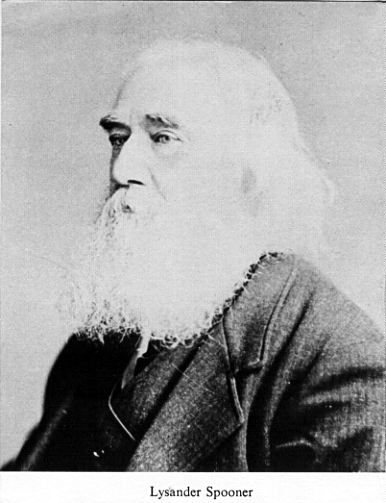
Matt comments on Spooner’s argument that the Irish were right to want the British to leave and Ireland returned to the Irish: “If Spooner is right, then his argument has uncomfortable implications for those of us who live in comfort and prosperity today. How much of our own wealth might be traced, if we cared to look, to unjust origins of the sort that Spooner decries? And if it can be, then what should we do about it?” But unlike the agrarian past, it’s no longer the case that land is the only source of wealth. Bob may live in a 500-square-foot rental unit but still be incredibly wealthy. To assume that Bob’s wealth is unjustly held is partly fixed-pie fallacy – Bob’s wealth used to belong to someone else the same way British land used to belong to the Irish. But unlike land, new wealth can be created. So while it’s easy to look at British-held land and say, “Actually, that belongs to someone else,” it’s far from obvious that we can say this of Bob’s wealth. The argument that “the justice of any distribution of property rights depends entirely on how that distribution came about” overstates the case.It overstates the case in another way: Spooner assumes the Irish from whom the British seized the land were themselves properly entitled to it. Part of the unclarity arises from falling into the trap of talking about “the Irish” as if that term refers to an entity which can own something and be stolen from. But in reality, some particular Irish person had his land stolen by the British government. This isn’t nitpicking: the particular Irish person, let’s call him Bill, who was dispossessed – was he a legitimate owner in the very sense Spooner is concerned with? Or was his title itself illegitimate? The claim is “No lapse of time can cure this defect in the original title,” so on this view if Bill’s great-great-great-great-grandfather acquired that land by dispossessing some prior indigenous person, Bill wasn’t the legitimate owner. Does this mean the British are doing no wrong to seize Bill’s land? That seems like the wrong conclusion. Of course we don’t know the backstory of every single Irish landowner, but we surely don’t want to say either that the British were wrong to seize this one but not that one. The “unjust origins” objection means that no one can clearly be said to own anything. It gets its traction by making us think of common-sense legal principles. If I knowingly buy stolen property, I can hardly complain when the owner wants it back or even uses force to get it back.There are two possible ways to object to Spooner on this point. One is to deny his claim that time is completely irrelevant. Even after a hundred thousand years? Are we all squatters on Neanderthal land? The other, and they’re related, is accept the irrelevance of time provided that victims and perpetrators are identifiable. Bill’s great-grandson may be able to produce a deed showing that the land in question had been taken unjustly from Bill. But even there, the “victims” would have to have had just title in the first place. If Bill’s great-grandfather unjustly acquired his land, then it’s not obvious that Bill’s great-grandson can claim timeless justice in claiming reparations from the British. What if the person Bill’s great-grandfather stole the land from emigrated to another part of the world. None of that person’s descendants have worked towards reclaiming their land, and indeed have started a new chain of possession of their new lands (which they acquired justly or unjustly?). So do other Irish people then have a claim on this land just because “the Irish” were dispossessed by “the British”?It’s unsurprising that a proponent of natural law would also have an idea that time doesn’t negate injustice. And I think it’s true that time doesn’t negate injustice. But the question isn’t whether an injustice was committed – it’s what to do about it. The rectification of injustice cannot entail new injustice. We can’t rectify injustice without knowing victims and perpetrators, and we must not start thinking that “the British” or “the Irish” are names of intentional entities. On this particular point, I’m afraid Spooner’s theory proves too much: no one can know who justly owns what, so rectification goes to whoever claims it? That’s not justice. The best way to insure justice is to respect people’s natural rights, and apply rectification when knowledge permits.